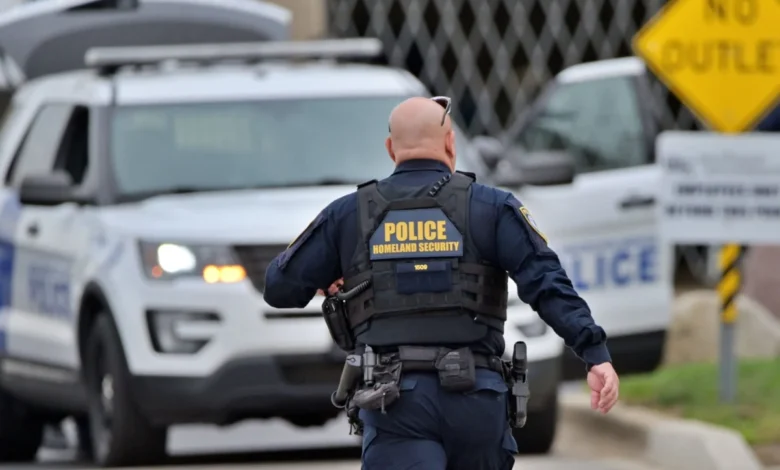
The revelation, contained within newly released Homeland Security Investigations (HSI) documents, details a coordinated effort by a joint task force comprising 14 law enforcement personnel—six local officers and eight HSI Chicago agents—who conducted in-person and electronic surveillance during an April 2 speaking event in the Bridgeport neighborhood of Chicago. The event, hosted at the Co-Prosperity gallery, featured activists from the Twin Cities sharing experiences regarding resistance to Operation Metro Surge, a federal immigration initiative that has faced intense scrutiny following the deaths of two U.S. citizens during related enforcement actions.
The Anatomy of the Surveillance Operation
The operation, codenamed "Antifa Roadshow" in an internal HSI report, underscores the increasing integration of local police departments into federal intelligence-gathering networks. Documents produced by the Kane County Sheriff’s Office reveal that the task force leveraged a broad array of investigative tools to monitor the gathering. These included the deployment of undercover agents, the utilization of Chicago’s expansive CCTV network, and the collection of license-plate-reader (LPR) data from 219 vehicles identified in the vicinity of the gallery.
The logistical precision of the operation was significant. According to the report, a plainclothes officer from the Aurora Police Department was transported to the venue by an officer from the village of Downers Grove. Once the Aurora officer confirmed that no security screening protocols were in place at the entrance, an undercover HSI agent entered the facility. For approximately one hour, the agent transmitted live audio of the proceedings to a surveillance team, until technical difficulties severed the connection.
The gathered intelligence, which included remarks by defendant Callum Robinet regarding the formation of rapid-response networks, was subsequently shared with HSI supervisors in Minneapolis. This information has now been integrated into the federal felony conspiracy case against the 15 activists, a development that has drawn sharp condemnation from defense attorneys and civil liberties advocates who argue that the investigation represents a form of political repression.
Contextualizing the Minnesota 15 Investigation
The legal proceedings against the Minnesota 15 stem from their resistance to federal immigration enforcement surges. The activists, associated with various mutual aid networks, have been accused of conspiring to obstruct federal operations. However, the scope of the federal investigation has expanded far beyond Minnesota. The speaking tour, organized by the anarchist collective Crimethinc, was intended to disseminate information on grassroots community defense.
The federal interest in Crimethinc is not new. The collective has been a frequent subject of infiltration and monitoring by federal agencies for decades, often resulting in high-profile prosecutions. The current investigation, however, appears to be operating under a broader mandate. Recent reports indicate that HSI, rather than the FBI, has emerged as a lead agency in addressing internal dissent, recently serving a search warrant on the office of U.S. Representative Ilhan Omar, a move that has intensified the national debate over the agency’s evolving mandate and its proximity to political investigations.
The Role of Local Law Enforcement
The participation of Chicago-area departments in this federal probe raises complex questions regarding the autonomy of local agencies and their compliance with state-level mandates. While Illinois law strictly prohibits local law enforcement from participating in immigration enforcement operations, these restrictions are often bypassed through "task force" agreements. Because the HSI investigation was categorized as a criminal racketeering probe rather than an immigration-related action, participating departments maintain that their involvement remains within the bounds of state law.
The Chicago Police Department (CPD) has noted that no First Amendment notifications were filed for the April 2 operation, citing the nature of the investigation as a federal criminal matter. This lack of transparency regarding the intersection of federal surveillance and local police power has prompted calls for a formal inquiry. Ed Yohnka, a spokesman for the American Civil Liberties Union of Illinois, described the surveillance as "very troubling," emphasizing that local law enforcement should be held accountable for their role in monitoring constitutionally protected activities.
Chronology of Surveillance and Escalation
- Autumn 2025: Operation Midway Blitz takes place in Illinois, sparking local protests and public inquiries into the extent of cooperation between Chicago law enforcement and ICE.
- March 2026: Protests occur outside the ICE detention center in Broadview, Illinois, drawing the attention of federal investigators who document the presence of specific vehicles and individuals.
- April 2, 2026: The Co-Prosperity event in Bridgeport is targeted by the "Antifa Roadshow" surveillance team. Agents monitor the venue for roughly two hours, logging attendees and vehicle information.
- April 2026: A formal report is compiled by HSI, documenting the infiltration of the event and the sharing of data with federal prosecutors in Minnesota.
- May 2026 (Ongoing): The defense team for the Minnesota 15 begins the discovery process, revealing the depth of the multi-state coordination and the reliance on local police to track political activists across state lines.
Broader Implications for Civil Liberties
The data collected during the Chicago operation reveals a sophisticated, multi-jurisdictional intelligence machine. By identifying attendees and linking them to protests in Illinois, Michigan, and Washington, federal agents have sought to construct a narrative of a coordinated, national conspiracy. The use of license plate readers to cross-reference attendees with participants in earlier, unrelated protests suggests a high level of persistence in tracking individuals engaged in ideological expression.
Critics argue that the chilling effect of such operations is the intended outcome. When local police act as an extension of federal intelligence agencies, the distinction between criminal law enforcement and political surveillance blurs. This creates an environment where citizens are hesitant to engage in public dissent for fear that their attendance at a community meeting will be logged in a federal database and shared with prosecutors across the country.
Official Responses and Institutional Silence
Requests for comment sent to the Aurora Police Department, the Downers Grove Police Department, and the Kane County Sheriff’s Office regarding their specific contributions to the HSI task force went unanswered. Similarly, the Chicago Mayor’s Office declined to provide a statement.
ICE, for its part, maintains a policy of neither confirming nor denying the details of ongoing investigations. An agency spokesperson noted that individual agents are not authorized to speak to the media, effectively insulating the specific actors within the task force from public scrutiny.
Future Outlook
As the trial for the Minnesota 15 approaches, the documentation of these surveillance efforts will likely become a central point of contention in the courtroom. Defense attorneys are expected to challenge the legality of the information-sharing agreements and the constitutional validity of the surveillance itself.
The incident has also galvanized local activists in Chicago, who are increasingly pressing their elected representatives to withdraw from joint federal-local task forces that lack sufficient civilian oversight. The ongoing friction between federal national security priorities and local commitment to civil liberties suggests that this case will serve as a bellwether for the future of domestic intelligence gathering in the United States. Whether the courts will view these actions as a necessary component of federal law enforcement or an overreach into protected speech remains a pivotal question that will shape the legal landscape for years to come.