Building a Multilingual Text Classification Pipeline Using Multilingual Large Language Model Embeddings and Scikit-learn

The landscape of natural language processing (NLP) is undergoing a significant transformation as developers move away from the traditional, labor-intensive practice of training isolated machine learning models for every individual language. By leveraging multilingual large language model (LLM) embeddings, organizations can now construct unified text classification pipelines that operate seamlessly across diverse linguistic boundaries. This shift not only reduces technical debt but also democratizes access to advanced AI capabilities for global applications.
The Shift Toward Unified Multilingual Architecture
Historically, building a globalized text classification system required a "siloed" approach. If a company operated in five languages, it typically maintained five separate classification models, each requiring its own training data, hyperparameter tuning, and maintenance schedule. This fragmentation was not only inefficient but also hindered the ability to transfer knowledge from a high-resource language, such as English, to lower-resource languages.
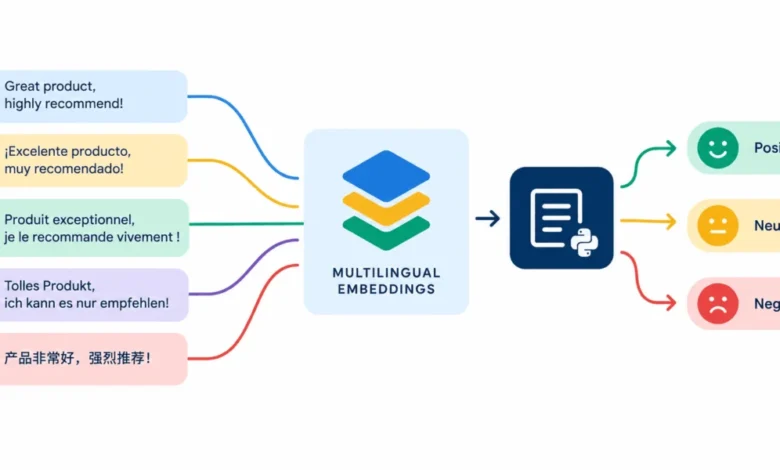
The emergence of multilingual embedding models—numerical representation engines that map different languages into a shared, high-dimensional vector space—has rendered this multi-model approach largely obsolete. By converting text into these "barrier-free" embeddings, the underlying semantic meaning is preserved regardless of the language of origin. Consequently, a downstream classifier, such as a logistic regression model or a random forest, can interpret these vectors without needing to understand the specific vocabulary or syntax of the input language.
Technical Foundations and Implementation Strategy
To implement a scalable multilingual pipeline without incurring the costs associated with proprietary, cloud-based APIs like OpenAI, developers are increasingly turning to local, open-source alternatives. A common stack involves using Scikit-LLM in conjunction with Ollama, a framework designed to run large language models locally on consumer-grade or enterprise-grade hardware.
The implementation process begins with the deployment of a robust embedding model, such as BGE-M3. This model is notable for its state-of-the-art performance in dense retrieval and its ability to handle over 100 languages. By hosting this model locally, organizations eliminate latency issues related to API calls and ensure that sensitive data remains within their own infrastructure.
Once the environment is configured, the pipeline architecture consists of two primary stages. First, the input text—whether in English, Spanish, Mandarin, or French—is fed into the BGE-M3 embedding generator. This stage produces a dense vector representation. Second, this vector is passed to a lightweight, classical machine learning classifier. Because the embedding model acts as a semantic translator, the classifier operates on universal "concepts" rather than language-specific tokens.
Data Acquisition and Preprocessing
A critical component of any machine learning pipeline is the quality and balance of the training data. Using the Amazon Multi-language Reviews dataset as a benchmark, researchers typically aggregate thousands of entries across multiple languages to ensure the model achieves global coverage.
In a practical workflow, data is randomized and shuffled to ensure class diversity—essential for preventing the model from developing a bias toward any single language. Once the training-test split is performed, the pipeline is trained on the embeddings. For instance, when the system receives the English phrase "This product is fantastic!" and the Spanish equivalent "¡Este producto es fantástico!", the BGE-M3 model maps both to nearly identical coordinates in the vector space. The classifier, therefore, learns to associate these coordinates with a "5-star" rating label regardless of the linguistic path taken to arrive at that vector.
Evaluating Model Performance
In initial trials, this unified approach to multilingual classification yields promising, albeit nuanced, results. In a sample of 2,000 reviews, test accuracy often hovers around 50–60%. A deeper dive into the classification report reveals that the model performs significantly better at identifying extreme sentiments—such as 1-star or 5-star reviews—compared to intermediate ratings.
There are two primary reasons for this performance gap:
- Semantic Clarity: Extreme reviews tend to use highly polarized, universally recognized sentiment words (e.g., "amazing," "terrible," "horrible," "perfect"), which translate clearly into consistent vector representations across languages.
- Data Sparsity: Intermediate ratings (2, 3, and 4 stars) are often more subjective and context-dependent. Phrases such as "it was okay" or "not exactly what I expected" are harder to map into a clear, universal sentiment vector, leading to greater confusion for the classifier during the training phase.
Broader Implications for Industry
The transition to this architecture has profound implications for global enterprises. First, the cost of maintenance is drastically reduced. Instead of managing dozens of models, engineering teams manage one, with the embedding model handling the cross-lingual heavy lifting. Second, the time-to-market for deploying services in new languages is shortened. Adding a new language no longer requires gathering thousands of new training samples to build a dedicated model from scratch; it simply requires ensuring the new language is supported by the underlying embedding model.
Furthermore, this method facilitates "zero-shot" or "few-shot" learning scenarios. If an organization has a high-quality classifier trained on English data, it can immediately begin processing Spanish or German text without further training, provided the embedding space is sufficiently robust.
Future Outlook
While current results are solid, the trajectory of this technology points toward even higher precision. As models like BGE-M3 continue to evolve and as hardware capabilities for local LLM inference expand, the performance gap between monolithic, language-specific models and unified, multilingual pipelines will likely vanish.
The current limitation remains the reliance on the quality of the embedding model itself. If the embedding model fails to capture the nuance of a specific regional dialect or slang, the classifier will inevitably struggle. However, the flexibility of the Scikit-LLM and Scikit-learn framework allows for rapid iterative improvements. Developers can swap out embedding models as new versions are released or tune the hyperparameters of the downstream classifier to better handle the specificities of their dataset.
In conclusion, the era of training language-specific models is drawing to a close. By leveraging the semantic power of multilingual embeddings, developers can now build sophisticated, scalable, and language-agnostic pipelines that handle the complexities of a globalized digital world. This approach not only streamlines development but also provides a more robust foundation for the future of international natural language processing. As we look toward the next generation of AI-driven applications, the ability to abstract away language in favor of semantic meaning will become the gold standard for global data analysis.