Blind Testing Gemini 4 Neon: An Empirical Evaluation of AI Model Performance in Specialized SEO Research

The rapid evolution of Large Language Models (LLMs) has left many professional users and software developers questioning whether the latest iterations, such as Google’s Gemini 4 series, offer tangible performance improvements over their predecessors. For Marie Haynes, a prominent search consultant, this uncertainty led to the development of "Marie’s Brain," a private AI co-pilot grounded in a hand-curated Open Knowledge Format (OKF) library. This library, which aggregates years of search and AI research, serves as the primary dataset for a series of blind taste tests designed to compare the efficacy of Gemini 3.8 Flash, Gemini 4 Hydrogen, and the newly released Gemini 4 Neon.
The findings from this comparative study suggest that while newer models offer superior reasoning, their performance is heavily dependent on prompt engineering and the mitigation of "over-eager" AI behaviors that can inflate costs and obscure relevant information.
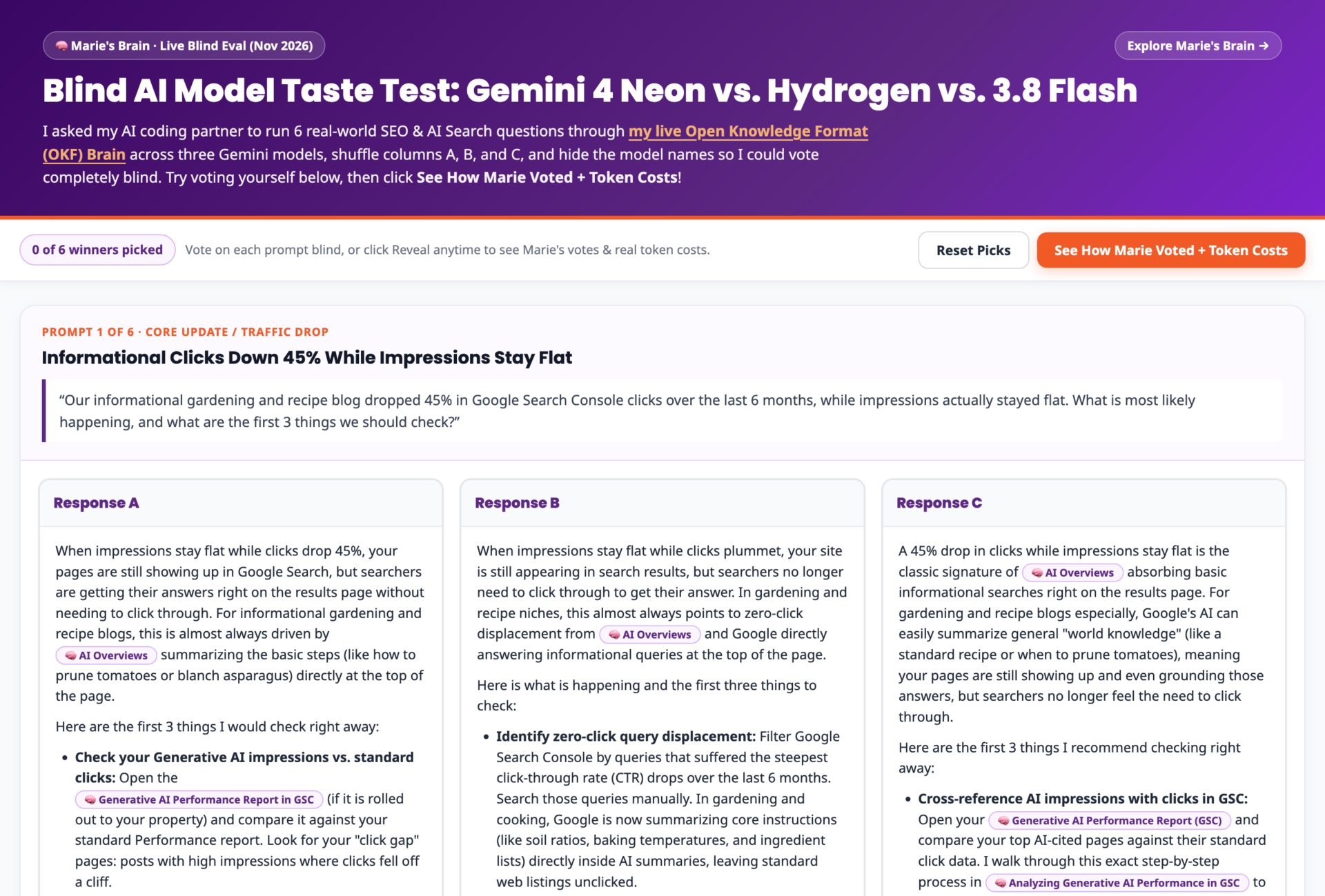
The Methodology of the Blind Taste Test
The core of the evaluation involved a six-question battery focusing on complex search engine optimization (SEO) scenarios. These included inquiries regarding traffic drops in the wake of AI Overview updates, the strategic decision-making process for pruning or rewriting informational content, the implementation of "Main Content" standards for commercial buyer’s guides, the removal of thin location-based pages, and the integration of technical standards like /llms.txt for agentic readiness.
To ensure objectivity, the testing interface randomized columns A, B, and C for every query. This blind methodology prevented the bias of knowing which model generated which response. The models were tasked with retrieving information from the same static OKF library, which comprises a master index of approximately 55,000 tokens of verified research data.
Identifying the "Prompt Problem"
Before the comparative analysis could be finalized, the researchers encountered an unexpected hurdle: output length and complexity. The default "Detailed" mode utilized in the initial setup encouraged the models to perform exhaustive research loops.
Gemini 4 Hydrogen, for example, exhibited a tendency to ingest an average of 21 OKF files per prompt. This resulted in long-form, 1,600-word responses that were not only costly but often cluttered with unnecessary internal Google engineering jargon, such as "MAGIT" and "FastSearch." For a business owner seeking actionable SEO advice, this technical noise served as a deterrent rather than a benefit.
The discovery prompted a refinement of the system’s operational parameters. Adjustments were made to impose stricter word ceilings and to re-orient the AI toward a "Concise" mode. By curbing the model’s tendency to over-analyze, the testing team was able to isolate the core reasoning capabilities of the models, moving away from verbose, loop-heavy outputs that lacked practical utility.
Comparative Performance: Gemini 4 Neon Emerges
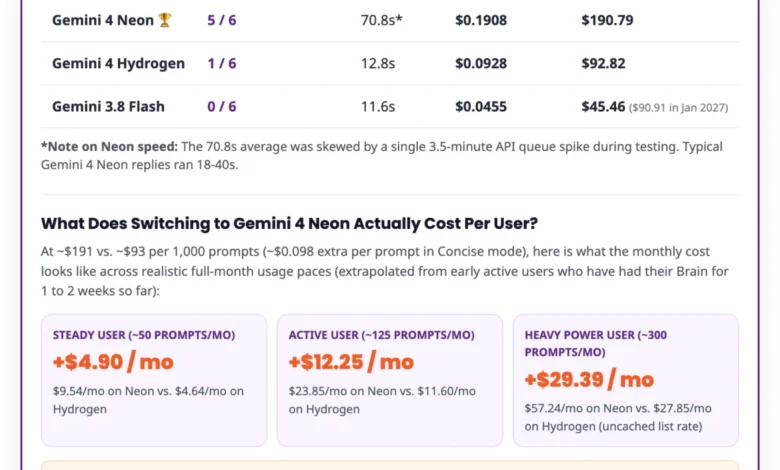
Once the prompt constraints were standardized, the results of the blind test indicated a clear preference for the Gemini 4 Neon model. Out of the six questions posed, Gemini 4 Neon was selected as the superior response in five instances.
The distinction between the models was primarily attributed to communication style rather than factual accuracy, as all three models accessed the same underlying dataset. Testers noted that Gemini 4 Neon demonstrated a more human-like reasoning process. While Gemini 3.8 Flash and Gemini 4 Hydrogen provided reliable data, their responses were described as more predictable and mechanical. Neon’s output, by contrast, synthesized the research into coherent, strategic advice that mirrored the cadence of an experienced consultant.
Economic Implications and Cost-Benefit Analysis
A critical component of this study was the evaluation of the fiscal impact of deploying these models at scale. While Gemini 4 Neon demonstrated superior reasoning, it also introduced a higher price point per prompt.
The cost analysis, based on live Gemini API usage metadata, revealed the following breakdown for "Concise" mode operations:
- Gemini 3.8 Flash: An average cost of $0.0455 per turn.
- Gemini 4 Hydrogen: An average cost of $0.0928 per turn.
- Gemini 4 Neon: An average cost of $0.1908 per turn.
At first glance, the $0.19 price point for Neon represents a significant increase compared to the Flash model. However, the study posits that these costs are mitigated by context caching. Because the AI consistently references the same 55,000-token OKF Master Index, the system benefits from implicit caching discounts, which reduce the cost of repeated input tokens across multi-turn interactions.
Furthermore, the "speed" of the model—often a point of contention—proved variable. While Gemini 4 Neon showed a slower average response time (70.8 seconds) compared to Flash (11.6 seconds), this was heavily influenced by occasional API queue spikes. In standard operations, Neon consistently returned responses in 18 to 40 seconds, a latency window considered acceptable for complex, high-value advisory tasks.
The Broader Impact on AI-Driven Research
The implications of these findings extend beyond the SEO industry. As organizations look to build specialized AI agents, the transition from general-purpose models to specialized ones requires a nuanced understanding of cost, latency, and tone.
The test results suggest that for specialized knowledge management, the "newer is better" heuristic is not always sufficient. Instead, performance is dictated by how the model interacts with a curated dataset. The success of Gemini 4 Neon in this test underscores a shift in the industry: as raw model capability reaches a plateau, the value of an AI agent is increasingly defined by its ability to synthesize information in a way that is human-readable and strategically sound.
For developers and business owners, the study highlights a critical path forward:
- Iterative Prompting: Default settings are rarely optimized for specific tasks; manual intervention in output length and jargon management is essential.
- Blind Evaluation: Subjective preference remains a vital metric. Measuring output quality through blind tests is a necessary safeguard against the assumption that the most expensive or latest model is inherently the most effective for a specific use case.
- Context Caching: Utilizing models that support efficient token caching is the most effective way to manage costs when working with large, proprietary knowledge bases.
Conclusion
The blind test conducted by Marie Haynes serves as a case study in the maturation of AI-assisted consulting. By moving away from anecdotal evidence and toward a structured, empirical framework, the team was able to identify that Gemini 4 Neon offers a distinct advantage in reasoning and clarity.
While the economic overhead of utilizing more advanced models is non-negligible, the potential for higher-quality outcomes in complex decision-making processes provides a compelling argument for their adoption. As AI continues to integrate into professional workflows, the ability to balance cost-efficiency with the "human-like" quality of responses will likely become the standard for determining the efficacy of enterprise-grade AI tools. The ongoing shift toward agentic readiness—as evidenced by the industry’s focus on llms.txt and similar discovery protocols—suggests that this is only the beginning of a larger trend toward more autonomous, highly specialized AI research assistants.