Managing a robust WooCommerce catalog traditionally requires a significant investment in manual labor. Store administrators frequently spend hours navigating the WordPress dashboard to execute routine tasks such as individual product edits, category-wide price adjustments, and the remediation of fragmented data. As e-commerce environments grow in complexity, the shift toward AI-assisted management has become a focal point for developers and store owners alike. A recent technical workflow demonstrates how the integration of Novamira Pro with Claude AI can fundamentally alter these standard operations, moving from manual, click-heavy processes to high-level prompt-based management.

The workflow leverages Novamira Pro’s ability to interface directly with the WooCommerce database. Unlike generic AI integrations that treat a website as an external entity, Novamira provides Claude with structured access to core WooCommerce schema elements, including regular and sale prices, inventory levels, shipping classes, and product attributes. By utilizing PHP and direct database communication, the system allows for the execution of complex administrative tasks without the need for manual CSV imports or custom coding for basic updates.
A Chronology of the AI-Integrated Workflow
The implementation of this workflow follows a systematic, five-step progression designed to mimic the lifecycle of a modern online retail store. Testing was conducted on a localized WordPress environment to ensure that all modifications could be audited before potential deployment to a live, production-ready server.

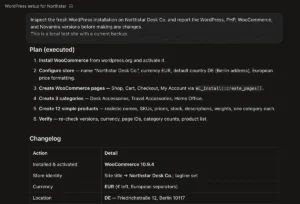
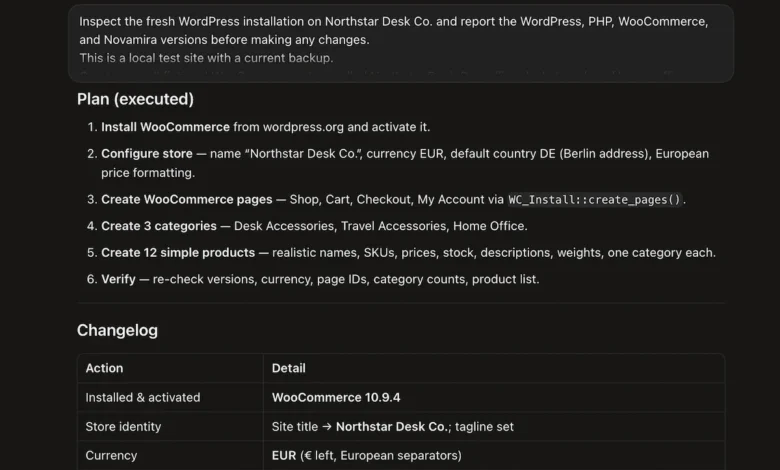
The initial phase focused on store instantiation. Rather than utilizing the standard WooCommerce onboarding wizard, the user tasked the AI agent with generating a complete catalog for a fictional retailer, "Northstar Desk Co." This included the creation of three distinct product categories and a set of 15 simple products with comprehensive metadata, including SKUs, pricing in Euros, and stock quantities. This phase highlighted the efficiency of AI-driven data population, which reduced the setup time to approximately 15 minutes.
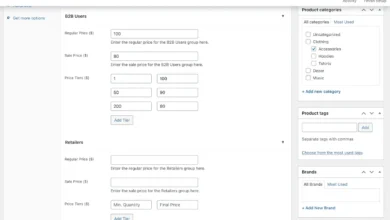
Following the setup, the workflow transitioned into bulk price management. By targeting the "Desk Accessories" category, the system was instructed to perform a 9% price increase across the board, with a specific instruction to round all final figures to a .99 format. The AI agent generated a preview table for verification, ensuring that current prices, proposed adjustments, and existing sale statuses were transparently displayed before the database write-operation occurred.

The third phase involved scheduling a time-bound promotional event. The challenge here was the coordination of category-wide sales, which required the AI to navigate potential conflicts between existing sale prices and the proposed promotional window. While the AI identified that specific duration fields were not natively present in the standard product editing schema, it proposed an effective workaround, ensuring that the promotional campaign was successfully scheduled from August 4th to August 11th.
In the fourth stage, an audit-and-repair cycle was initiated. By intentionally corrupting data—specifically by removing category assignments, short descriptions, and SKU values—the test evaluated the AI’s diagnostic capabilities. The system successfully identified every instance of missing data and generated a remediation plan. Notably, the AI displayed a high degree of technical transparency, flagging reconstructed data, such as inferred SKUs, as recommendations rather than definitive facts.

Finally, the workflow concluded with the creation of a custom feature: a dynamic, on-page notification that informs customers when a scheduled sale is set to expire. The AI analyzed the active theme structure and opted to build a standalone, lightweight plugin rather than modifying the theme’s core files, adhering to best practices for WordPress development.
Technical Data and Implications
The shift toward AI-driven management within WooCommerce carries significant implications for operational scalability. Traditional bulk editing often relies on plugins that may introduce site bloat or require a steep learning curve. In contrast, this AI-assisted approach utilizes direct data interaction.

According to observations during the testing phase, the primary benefit of the Pro version of such tools lies in the retention of "contextual memory." While the Free version of the platform is capable of executing basic PHP-driven tasks, the Pro variant allows the AI to maintain a consistent understanding of store conventions and organizational structures across multiple sessions. This continuity is critical for larger stores where maintaining brand voice and data consistency is paramount.
From a performance perspective, the integration maintains a lightweight footprint. Because the AI acts as a mediator for direct database queries and code execution, it avoids the overhead associated with heavy-duty management plugins. However, this level of access necessitates rigorous security and backup protocols. As noted by the developers of Novamira, the guidance for all users remains consistent: keep AI-based administrative tools disabled on production environments, maintain frequent off-site backups, and treat every AI-generated action as a permanent change to the store’s data.

Official Guidance and Security Standards
Security professionals within the WordPress ecosystem have long warned against the risks of granting AI agents unfettered access to a site’s database. The methodology employed in this workflow addresses these concerns through a "preview-before-action" paradigm. By requiring the agent to present a table of proposed changes before executing a write-command, the user retains a crucial layer of manual oversight.
Furthermore, the practice of developing custom features as isolated, standalone plugins rather than injecting code into a theme’s functions.php file represents a significant improvement over common "quick-fix" solutions. This modular approach ensures that if a feature causes a conflict or is no longer required, it can be disabled or deleted without compromising the integrity of the core site structure.

Broader Impact on E-commerce Management
The rise of AI-integrated workflows signals a transition in the role of the e-commerce manager. The skill set required to operate an online store is shifting from manual data entry and basic technical configuration toward sophisticated prompt engineering and high-level verification.
This transformation could prove particularly beneficial for small-to-medium enterprises (SMEs) that lack the resources for dedicated development teams but possess the need for complex, dynamic catalog management. By lowering the barrier to entry for tasks like custom feature development and large-scale data auditing, AI agents empower store owners to optimize their operations in real-time.

However, the technology is not without its limitations. As evidenced by the initial difficulty in handling specific sale-duration fields, AI agents are limited by the depth of the schema exposed to them. Future iterations of these tools will likely focus on increasing the granularity of data exposure, allowing agents to manipulate more nuanced WooCommerce fields, such as custom taxonomies or advanced product variations.
Future Outlook and Conclusion
The experiment conducted with Novamira Pro and Claude AI serves as a proof-of-concept for the future of headless and semi-headless WordPress management. By treating the CMS as a structured data environment rather than just a visual interface, AI can act as an intelligent layer that bridges the gap between raw data and business objectives.

As the industry moves forward, the success of these workflows will depend on the balance between automated efficiency and human accountability. The ability to verify AI outputs, combined with a disciplined approach to local testing, remains the gold standard for anyone looking to incorporate generative AI into their retail operations. While the current implementation has demonstrated remarkable capabilities in pricing, auditing, and custom development, the evolution of these tools will undoubtedly continue to refine how store owners interact with the underlying mechanics of their businesses. For now, the integration of AI into the WooCommerce workflow is not just a novelty, but a viable, high-efficiency pathway for modern digital commerce.