B2BKing Integrates Model Context Protocol to Enable AI-Driven Configuration for WooCommerce Wholesale Stores


The landscape of e-commerce management is undergoing a significant shift as B2BKing, a prominent plugin for WooCommerce wholesale environments, has introduced native support for the Model Context Protocol (MCP). This development marks a transition from simple, passive AI content generation to active, agentic configuration, allowing AI assistants to directly interact with, modify, and optimize store settings. By leveraging the WordPress Abilities API, B2BKing allows users to manage complex wholesale workflows—such as customer tiering, credit limits, and dynamic pricing rules—through natural language prompts within AI interfaces like Claude, Cursor, and VS Code.
Evolution of AI in the WordPress Ecosystem
For the past two years, the integration of Artificial Intelligence into the WordPress ecosystem has primarily been restricted to "surface-level" applications. Standard implementations have largely focused on AI-assisted copywriting, image generation, or basic chat interfaces embedded within dashboards. While these tools provided marginal utility, they functioned as static add-ons rather than functional controllers.
The industry has recently moved toward a more sophisticated model. With the release of the WordPress Abilities API in version 6.9, the platform established a standardized framework for plugins to expose their internal functions to external agents. This API provides the necessary schemas and permission checks required for an AI to understand what it is allowed to do, effectively creating a "bridge" between the software’s backend and the reasoning capabilities of Large Language Models (LLMs). B2BKing is among the first enterprise-grade plugins to adopt this standard, signaling a move toward fully automated administrative workflows.

The Mechanism: Model Context Protocol and the Abilities API
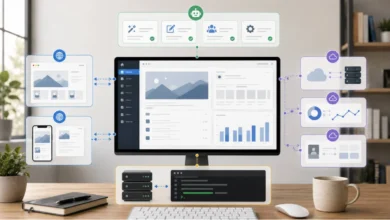
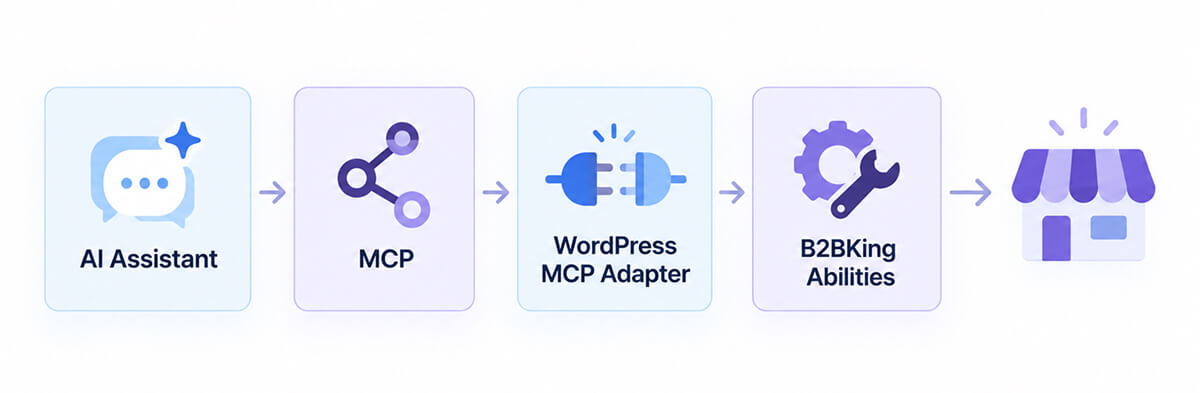
The core of this advancement lies in the intersection of the WordPress Abilities API and the Model Context Protocol (MCP). MCP is an open standard developed to provide a universal way for AI assistants to connect with external systems, databases, and local development environments. By acting as a common language, MCP removes the need for custom, siloed API connectors for every individual plugin.
When B2BKing registers its capabilities via the WordPress Abilities API, it essentially creates a manifest that informs the AI of the available "actions"—such as updating a wholesale price, creating a new customer group, or adjusting visibility rules. Because this follows a standardized schema, an AI agent connected via the official WordPress MCP Adapter can read these abilities, verify its own permissions, and execute changes in real-time. This eliminates the "vibe-coding" approach, where an AI might attempt to write custom code to achieve a result, which often creates technical debt or conflicts with existing store configurations. Instead, the AI operates within the boundaries of the established, tested plugin architecture.
Operational Efficiency in B2B E-commerce
Managing a wholesale store is inherently more complex than a standard B2C retail site. It requires the orchestration of multiple variables: visibility restrictions for guest users, tiered pricing structures, tax exemptions, and credit limits. Traditionally, setting up these parameters involves navigating dozens of settings pages, a process that is prone to human error and time-intensive.
Data suggests that for mid-to-large-sized agencies managing multiple client stores, configuration tasks can consume up to 30% of project time during the development phase. By offloading these repetitive tasks to an AI agent, agencies can reduce the setup time for a complex B2B store from several hours to a few minutes. For instance, a user can input a prompt such as: "Configure the store for a hybrid model; restrict prices for guests; create a ‘Premium Distributor’ tier with a $10,000 credit limit and a 20% discount on the ‘Hardware’ category." The AI agent parses this request, checks for the existence of categories and groups, and executes the necessary database updates through the B2BKing backend.
Security and Risk Management Frameworks
A primary concern for store owners when granting AI access to a live environment is the risk of unauthorized or accidental configuration changes. To address this, the developers of B2BKing have implemented a multi-layered security strategy.
First, the integration respects the existing WordPress user permission hierarchy. The AI agent operates only with the credentials provided via Application Passwords, and every action is subject to the same capability checks as a human administrator. Second, the system includes input validation, preventing the AI from creating invalid rules—such as setting a discount exceeding 100% or assigning a customer to a non-existent group.
Furthermore, the integration provides developers with programmatic control. Through specific filters—b2bking_mcp_enabled and b2bking_mcp_write_enabled—administrators can strictly control the level of access the AI has. They may choose to enable read-only access for auditing and summarization purposes, while disabling write access until they are fully comfortable with the agent’s performance. This "human-in-the-loop" approach ensures that the AI serves as a tool for acceleration rather than an autonomous actor with unchecked authority.
The Competitive Landscape and Future Outlook
B2BKing’s move to embrace MCP is reflective of a broader trend in the software industry: the "Agentic Web." As businesses become increasingly reliant on complex plugins for specialized functions, the ability for those plugins to "communicate" with AI agents will become a competitive necessity.

Unlike newer, experimental systems that attempt to build e-commerce functionality from scratch, B2BKing relies on a codebase that has matured over seven years and is currently deployed on over 15,000 live stores. By connecting an AI interface to a proven, stable backend, the developers are mitigating the risks associated with AI-generated code. This approach ensures that while the configuration process is modernized, the underlying business logic remains consistent with industry standards.
Implications for Agencies and Store Owners
The implications of this integration extend to the broader agency ecosystem. Agencies often struggle with the scalability of onboarding new clients, particularly when those clients require bespoke wholesale settings. The ability to utilize standardized prompts or scripts for store configuration ensures consistency across multiple client sites, reducing the variance that often leads to support tickets and maintenance overhead.
For the store owner, the value proposition is one of accessibility. Many wholesale store managers are not developers and may find the labyrinthine settings of complex plugins intimidating. The shift toward natural language configuration lowers the barrier to entry, allowing owners to modify their store’s business rules without needing to understand the underlying technical implementation.
As the WordPress MCP ecosystem matures, it is expected that more plugins will follow this model. The successful implementation by B2BKing demonstrates that the future of e-commerce management lies not in replacing existing tools with AI, but in providing AI with the standardized "hooks" necessary to navigate and manage the sophisticated tools that already define the digital economy. This evolution represents a maturation of the AI sector, moving away from the novelty of generative text toward the practical utility of agentic, system-level automation.