Build a Fully Local Zero-Cost Agentic AI Workflow Using Hermes Agent and Ollama

The rapid expansion of the artificial intelligence landscape has created a significant divide between cloud-based convenience and data privacy concerns. While platforms like OpenAI’s ChatGPT or Anthropic’s Claude offer immense computational power, they operate on a model that necessitates the transmission of sensitive user data, proprietary code, and private conversations to third-party servers. For developers, researchers, and enterprises handling sensitive information, this reliance on external infrastructure presents both a security risk and an escalating financial burden. Recent industry analysis suggests that heavy agentic workflows—AI tasks that involve autonomous file manipulation, web browsing, and multi-step reasoning—can cost a power user between $5 and $20 per session. In response to these concerns, the open-source community has prioritized the development of "local-first" AI ecosystems that allow users to maintain complete control over their hardware and data.
The emergence of the Hermes Agent, developed by Nous Research, represents a critical shift in this trajectory. Released under the permissive MIT license, Hermes Agent is designed to bridge the gap between simple conversational chatbots and fully autonomous AI agents. When paired with Ollama, a platform designed for running large language models (LLMs) locally, users can now construct a sophisticated, zero-cost, agentic workflow. This article examines the technical architecture required to build such a system, the implications for data sovereignty, and the strategic advantages of maintaining an on-device AI environment.
The Architecture of Local Autonomy
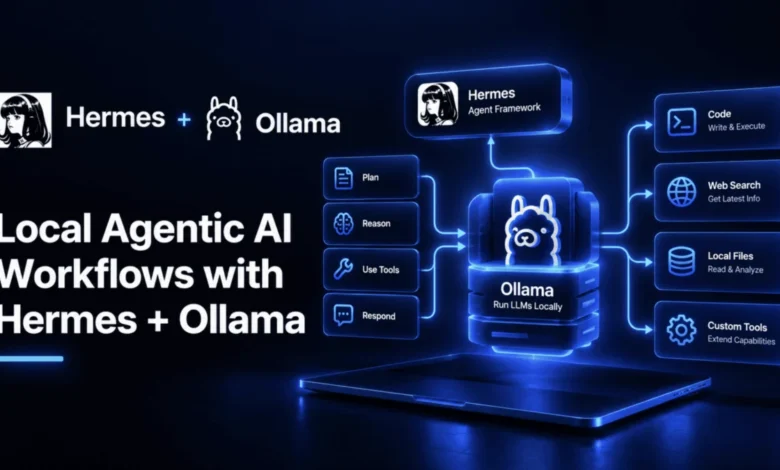
At its core, this workflow relies on a two-tier architecture: the model serving layer and the agentic orchestration layer. Ollama acts as the foundational engine. It is a lightweight, high-performance tool that manages the deployment of open-weights models such as the Llama or Gemma families. By exposing these models through an OpenAI-compatible API at the localhost address, Ollama effectively tricks local applications into treating a machine-bound model as if it were a remote, cloud-hosted endpoint.
The Hermes Agent serves as the "brain" of the operation. Unlike standard interfaces that merely generate text, Hermes is engineered for agency. It possesses the capability to execute terminal commands, edit local files, perform web searches, and even delegate tasks to specialized sub-agents. The agent maintains persistent memory, allowing it to "learn" the structure of a user’s project over time and generate reusable skills. By integrating sandboxing backends—such as Docker or local process isolation—Hermes ensures that the commands it executes on behalf of the user remain constrained within a secure, defined environment, preventing unintended system-wide modifications.
Technical Requirements and Hardware Considerations
Transitioning to a local-first AI workflow requires careful consideration of computational resources. Unlike cloud-based systems where the hardware burden is shifted to server farms, local models demand significant RAM and, ideally, dedicated GPU acceleration.
For those operating on a budget, the entry point is modest. A 3B-parameter model can function on as little as 8GB of RAM with a standard CPU. However, the efficacy of an agentic workflow is tied directly to the model’s "reasoning" capabilities and its ability to perform tool calls. For complex tasks involving file management and code analysis, a 31B-parameter model, such as a high-fidelity version of Gemma, is recommended. This requires approximately 32GB of RAM and, optimally, an NVIDIA GPU with at least 8GB of VRAM. While CPU-only setups are viable, users should anticipate significantly slower token generation speeds, which can impede the fluidity of an interactive agentic session.
Deployment and Configuration Chronology
The setup process follows a disciplined sequence designed to verify the integrity of the local stack before deploying the agent.
- Environment Preparation: The initial step involves installing the Ollama binary. Once installed, verifying the local API—typically via a
curlrequest tolocalhost:11434—ensures the server is active. - Model Selection: The choice of model is the most consequential decision in the process. Because Hermes requires "tool-calling" functionality to execute tasks, not all models are suitable. Users must select models explicitly optimized for tool use to ensure the agent can actually perform actions rather than just providing text responses.
- Endpoint Integration: Hermes is configured by pointing its
base_urlto the local Ollama API. This bypasses the need for API keys or internet-based authentication. - Optimization: Performance can be significantly enhanced by modifying the "Modelfile." By increasing the context window (e.g., to 64,000 tokens), the agent becomes capable of processing larger project directories and longer, more complex instructions without losing track of earlier context.
- Persistence: To prevent latency during model reloads, users can force Ollama to keep the model loaded in active memory for extended periods, such as a 24-hour cycle.
The Impact of Hybrid Fallbacks
A common critique of local-first AI is the performance gap between consumer-grade hardware and massive, trillion-parameter frontier models. To mitigate this, a sophisticated local workflow often incorporates a "fallback" strategy. By configuring the Hermes Agent with an optional cloud-based provider, such as OpenRouter or Anthropic, the system can be instructed to reserve cloud resources exclusively for high-complexity queries that exceed the local model’s reasoning capacity.
This hybrid approach optimizes for both cost and utility. The vast majority of everyday tasks—organizing files, summarizing local documentation, or drafting routine code—are handled locally with zero latency costs and absolute privacy. Only the most challenging queries, which might otherwise result in a "hallucination" or a failure to execute a tool, are routed to the cloud. This ensures that the user only pays for compute when the task genuinely warrants it.
Broader Implications: Data Sovereignty and Security
The shift toward local-first AI agents is not merely a hobbyist trend; it reflects a growing awareness of the risks associated with "data leakage." In a corporate environment, uploading proprietary source code or confidential financial documents to a third-party AI provider can violate NDAs and internal security policies. By keeping the entire workflow on local hardware, organizations can utilize the power of LLMs without ever exposing their data to external scrutiny.
Furthermore, the integration of gateways—such as Telegram, Slack, or Discord bots—allows users to maintain this level of security while working remotely. A user can interact with their local agent via a mobile device, knowing that the "brain" of the operation remains safely inside their own home or office server. The agent acts as a secure proxy, providing the convenience of a remote assistant with the security of an on-premises vault.
Conclusion: The Future of Agentic Workflows
The combination of Hermes Agent and Ollama offers a blueprint for the future of personal computing. As LLMs become increasingly capable, the ability to control one’s own "agentic infrastructure" will likely become as essential as managing one’s own file system. By stripping away the financial costs and privacy risks associated with centralized cloud AI, users can build workflows that are not only more sustainable but also more deeply integrated into their specific project needs.
This, ultimately, is the value proposition of a local-first strategy: it shifts the role of the user from a passive consumer of AI services to an active architect of their own digital environment. Whether for the student, the independent developer, or the security-conscious professional, the tools to build a private, high-functioning, and zero-cost agentic AI are now within reach, marking a significant milestone in the democratization of artificial intelligence.
Related posts: