AI Workflows vs Agents: A Practical Guide to Architectural Decision-Making in Artificial Intelligence

The rapid proliferation of generative AI has introduced a semantic crisis in software engineering, where the term "agent" is frequently applied to everything from rudimentary script-based automations to sophisticated, self-correcting autonomous systems. As enterprises accelerate their integration of Large Language Models (LLMs) into production environments, the distinction between a deterministic workflow and a non-deterministic agent has become the single most critical factor in determining the reliability, cost-efficiency, and maintainability of AI-powered applications. Before a single line of code is committed, developers must navigate this architectural crossroads to ensure they are not over-engineering solutions that could be managed more effectively through structured, predictable pipelines.
Defining the Architectural Divide
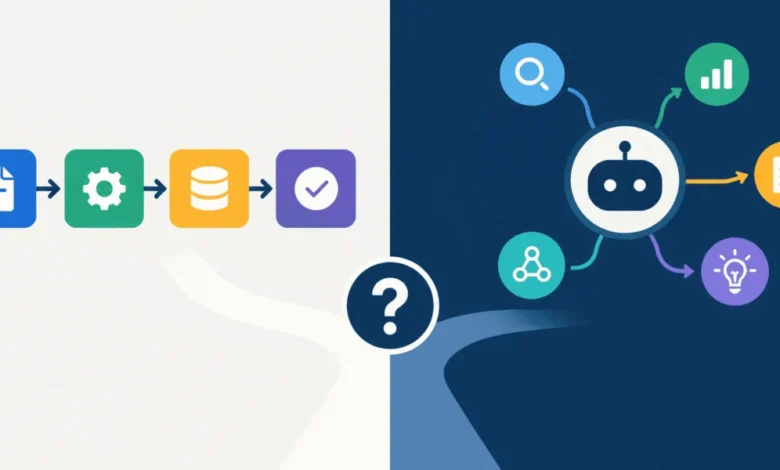
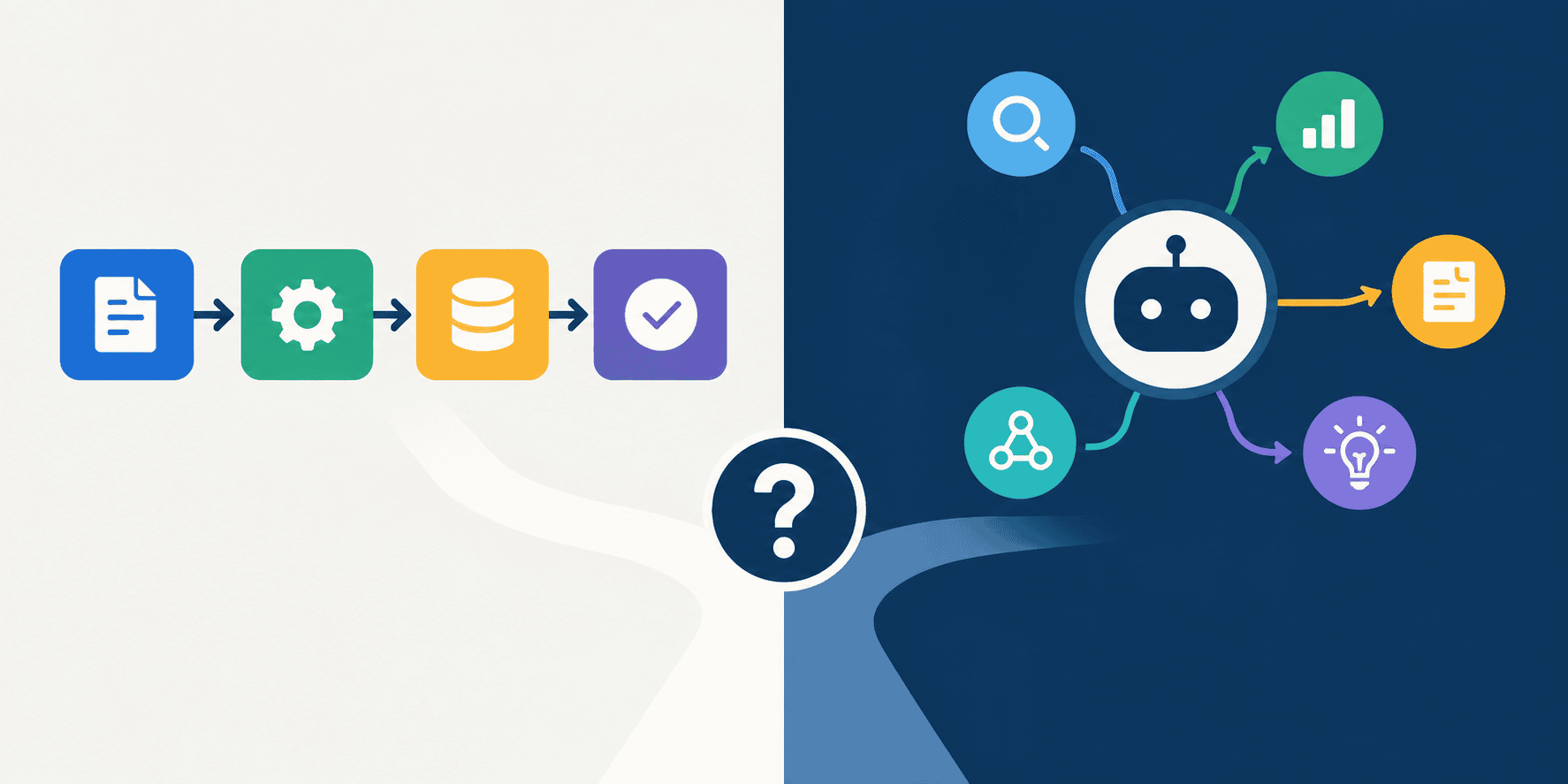
The industry currently grapples with a spectrum of autonomy. At one end, AI workflows—often referred to as pipelines or chains—operate on a control flow established at the design stage. In this paradigm, developers act as the architects of the process, defining the precise sequence of operations, the branches for conditional logic, and the exact stop conditions. While these workflows may utilize LLMs to perform complex reasoning or data extraction at specific nodes, the overarching path remains rigid. The system does not "decide" its next step; it executes a pre-ordained protocol.
Conversely, an AI agent is characterized by dynamic control flow. In an agentic system, the LLM is granted agency to interpret a high-level goal and determine the sequence of actions required to achieve it. The model evaluates its available toolset, selects the most appropriate function, executes the call, observes the output, and iterates. If the initial strategy proves ineffective, the agent can backtrack, loop, or pivot entirely. This distinction represents a fundamental shift in software control: in a workflow, the developer holds the map; in an agent, the developer provides the destination, and the model builds the map in real-time.
Chronology of the "Agentic" Shift
The shift toward autonomous agents gained significant momentum following the public release of foundational models capable of "Chain-of-Thought" (CoT) reasoning. In early 2023, the focus was largely on prompt engineering and static API calls. However, as developers realized that static prompts could not handle the complexity of multi-step, multi-tool tasks, the focus transitioned toward frameworks that allow for iterative loops.
By mid-2024, industry benchmarks—such as those released by the Stanford AI Lab and various open-source repository contributors—began highlighting the performance delta between simple chains and autonomous agents. Data indicated that while agents exhibited higher success rates in ambiguous, complex environments (such as software debugging or multi-step research), they also incurred significantly higher latency and token costs. This realization prompted a retrospective analysis among engineering teams: many organizations discovered that 80% of their "agentic" use cases were, in fact, simple tasks that had been unnecessarily complicated by non-deterministic logic.
Supporting Data: Cost, Latency, and Reliability
A comparative analysis of enterprise deployments reveals stark differences in performance metrics between these two architectures. According to internal performance monitoring data from leading AI infrastructure providers, agentic workflows typically exhibit a 300% to 500% increase in token consumption compared to deterministic workflows. This is primarily due to the "reasoning overhead"—the additional tokens generated as the model writes internal thoughts, logs tool selections, and reviews observational data before reaching a conclusion.
Furthermore, latency profiles diverge significantly. A deterministic workflow follows a predictable O(n) path, where latency is roughly the sum of the time required for each node to execute. An agent, however, may enter a recursive loop, querying tools multiple times until a success condition is met. While this makes the agent "smarter" in handling edge cases, it makes the user experience volatile. For high-volume applications like customer support chatbots, the non-deterministic nature of agents can lead to "hallucinated loops," where the model continues to call tools unnecessarily, driving up cloud infrastructure costs without providing incremental value.
The Diagnostic Test: The Whiteboard Methodology
To mitigate the risk of architectural misalignment, engineers are increasingly adopting the "Whiteboard Test." The premise is straightforward: if a senior engineer can accurately draw the entire flowchart of a process—including all branches, loops, and termination conditions—before the system is ever initialized, a deterministic workflow is almost always the superior choice.
This approach is rooted in the engineering principle of "least privilege and least complexity." By constraining the AI to a workflow, developers maintain granular control over audit trails, compliance, and error handling. For industries like finance, healthcare, and legal services, where auditability is a regulatory requirement, the non-deterministic nature of agents can pose a liability. A workflow provides a clear, documented path that satisfies compliance auditors, whereas an agent’s decision-making process—often referred to as a "black box"—can be difficult to audit post-execution.
Practical Checklist for Architectural Selection
When evaluating whether a project requires agentic capabilities, development teams should address the following criteria:
- Process Predictability: If the major steps and branches can be defined at design time, the system should be built as a workflow. Agents should be reserved for environments where the inputs are fundamentally unpredictable and the path to resolution is undiscoverable until the process begins.
- Input Variability: High-variance tasks—such as troubleshooting unique, open-ended user issues—benefit from the flexibility of an agent. Conversely, standardized tasks like data extraction or document classification should be handled by static pipelines.
- Efficiency Constraints: Organizations operating under strict latency or budget constraints should prioritize workflows. Agents are resource-intensive; for high-volume FAQs or routine data processing, the marginal improvement in accuracy offered by an agent rarely justifies the exponential increase in operational costs.
- Compliance and Auditability: If the application requires a strictly documented execution path to satisfy regulatory requirements, the deterministic nature of a workflow is non-negotiable.
- LLM Judgment Integration: Before attempting an agentic implementation, developers should test a hybrid workflow that utilizes LLM-based classification at specific junctions. Often, inserting a "judgment node" into a workflow provides the nuance of an agent while retaining the structure of a pipeline.
Broader Implications and Future Outlook
The current trend toward "agentic workflows"—a middle ground where workflows are orchestrated by LLMs but constrained by developer-defined guardrails—suggests that the industry is moving away from the binary choice of the past year. In this model, developers define the state machine, but the LLM is given the autonomy to navigate within those predefined constraints.
The implications for the labor market and software development practices are profound. As tools for managing these workflows become more sophisticated, the role of the software engineer is evolving from writing procedural code to designing "reasoning architectures." The focus is shifting from simply "connecting APIs" to designing resilient systems that know exactly when to rely on a hard-coded rule and when to hand the reins to an autonomous model.
Ultimately, the most successful AI applications of the coming years will not be those that use the most complex agents, but those that strike the optimal balance between machine intelligence and human-defined structure. By starting with a constrained, deterministic workflow and introducing agentic capabilities only where the problem demands it, organizations can build systems that are not only performant and cost-effective but also robust enough to survive the rigorous demands of production-grade software. The goal is not to force an agent into every application, but to understand the unique utility of both architectures and deploy them with precision.