Optimizing LLM Performance Through Data Serialization Efficiency: The Case for Markdown Over JSON in AI Agentic Workflows

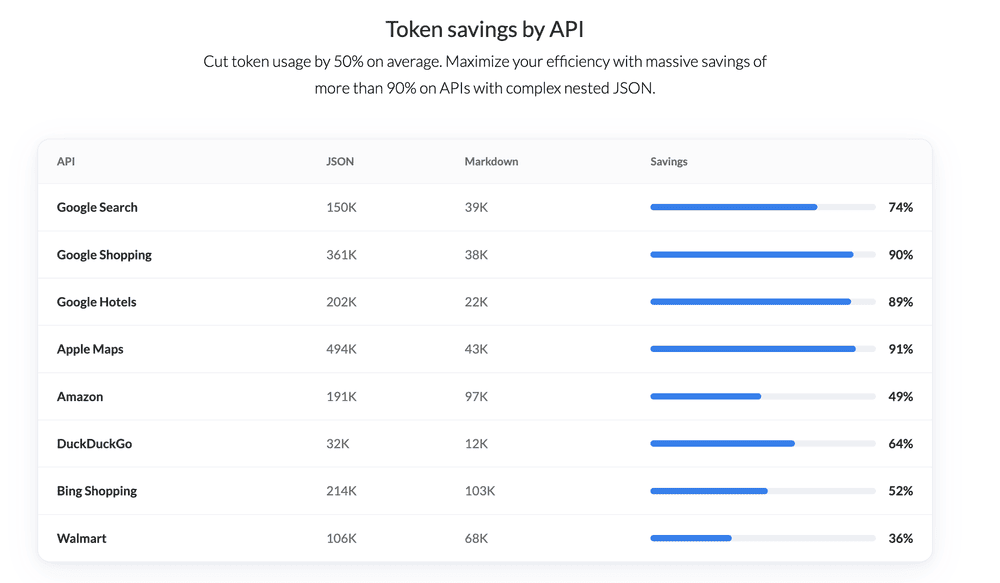
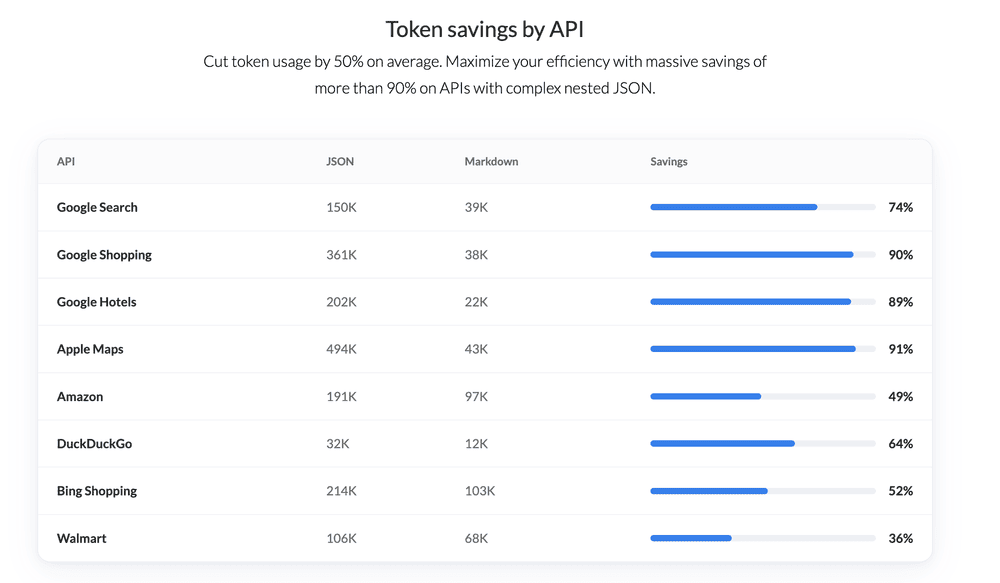
In the rapidly evolving landscape of generative artificial intelligence, the operational cost of deploying autonomous agents has become a primary bottleneck for developers and enterprises alike. As AI agents move from simple chatbots to complex, multi-step problem solvers—often referred to as agentic systems—they rely heavily on real-time data retrieval from the internet. However, a silent tax is being levied on these systems: the massive consumption of context window tokens by redundant data structures. Recent data indicates that by shifting from traditional JavaScript Object Notation (JSON) to streamlined Markdown formatting, developers can reduce token consumption by as much as 74%, significantly lowering latency and overhead costs while maximizing the utility of the available context window.
The Token Economy and the Agentic Tax
To understand the significance of this shift, one must first look at the mechanics of tokenization. Large Language Models (LLMs) do not process text in words or sentences; they process tokens, which are the fundamental units of text and code. When an AI agent is tasked with a search query, it must ingest the retrieved data into its context window. Standard web APIs have historically returned data in JSON, a format optimized for programmatic parsing by machines. JSON includes extensive structural metadata, such as repetitive field keys, tracking links, and nested objects that are necessary for software integration but often provide zero semantic value to an LLM.
When an agent retrieves search results, it frequently pulls in logs, raw metadata, and nested hierarchies that the model must read and parse. If an agent performs a recursive loop—re-running a query multiple times to refine its answer—these bloated payloads compound rapidly. A single, seemingly benign search for "local coffee shops" can generate a response containing thousands of tokens of metadata. The model is billed for every token it reads, regardless of whether that information is relevant to the final answer. This "agentic tax" leads to higher API costs and, more critically, the premature exhaustion of the LLM’s context window, which can cause the model to "forget" earlier instructions or truncate vital information.
Chronology of Data Retrieval Optimization
The industry’s reliance on JSON has persisted for over two decades, largely because it has been the gold standard for web development and API communication. However, the rise of Large Language Models has necessitated a paradigm shift.
- 2020-2022: As LLMs like GPT-3 gained prominence, developers began using raw API dumps. The focus was on "getting the data," with little regard for the formatting efficiency of the payload.
- 2023: The emergence of agentic frameworks such as LangChain and AutoGPT highlighted the limitations of the context window. Developers began experimenting with prompt engineering to "ignore" or "strip" irrelevant JSON fields, though this often required additional, expensive processing steps.
- 2024: Industry providers began recognizing that the structural needs of LLMs are fundamentally different from the structural needs of traditional software. Companies like SerpApi initiated research into specialized serialization formats, leading to the public release of Markdown-native API outputs.
Comparative Analysis: The Token Reduction Benchmark
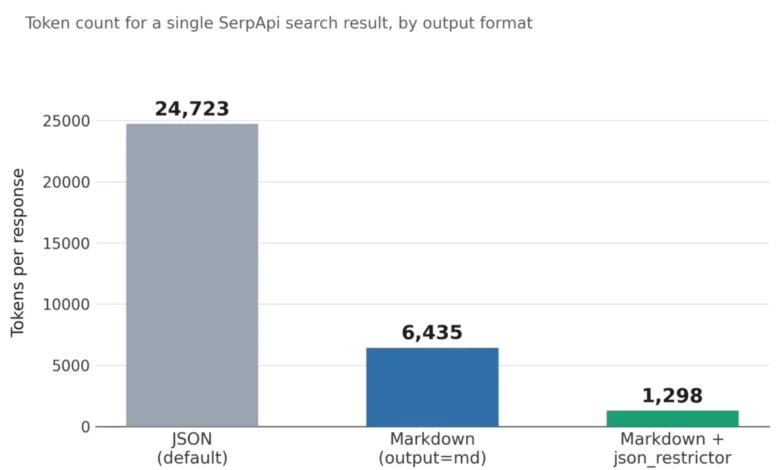
The shift to Markdown is not merely a cosmetic change; it is a fundamental optimization of information density. In a controlled test comparing a standard JSON response to a Markdown-formatted response for an identical query ("coffee"), the results were stark. The JSON payload required 24,723 tokens to convey the requested information. When the same query was processed using a Markdown-optimized output, the requirement dropped to 6,435 tokens. A further refined, restricted view reduced the count to just 1,298 tokens.
This represents a total reduction of approximately 95% from the original baseline in optimized scenarios. By stripping away structural noise—such as repetitive object wrappers, internal tracking identifiers, and deeply nested arrays that an LLM does not need to reason through—the data remains readable for the model while consuming a fraction of the cost.
Structural Differences: Why Markdown Succeeds
The fundamental difference between JSON and Markdown in this context lies in the "signal-to-noise ratio." JSON is verbose by design; every key, such as "result_id," "position_index," or "tracking_pixel_url," is repeated for every single item in an array. For an LLM, the "position_index" is rarely useful for determining the quality of a search result.
Markdown, conversely, utilizes a more human-readable, linearized format. It relies on tables, headers, and list structures that LLMs are pre-trained to interpret efficiently. Because LLMs are trained on vast corpora of internet text, much of which is formatted in Markdown, they are naturally adept at extracting information from this syntax. Removing the "code-first" structure of JSON allows the model to focus its attention (and its limited context window capacity) on the actual content: product descriptions, store ratings, and review snippets.
Strategic Implementation: When to Use Which Format
While the benefits of Markdown are clear, it is not a universal replacement for JSON. In systems where data integrity and type safety are paramount, JSON remains the superior choice.
- When to use JSON: If the pipeline involves a downstream analytics engine, a database ingestion service, or any system requiring strict data types (e.g., float values for coordinates, integers for currency, or boolean flags for status), JSON must remain the standard. The structured nature of JSON ensures that the data is parseable by traditional backend services without errors.
- When to use Markdown: Markdown is optimized exclusively for "reasoning" workflows. If the data is being sent to an LLM to summarize, categorize, or act as an agentic tool, Markdown is the superior choice. It is also highly effective for "human-in-the-loop" scenarios where the raw data might need to be verified or audited by a human developer, as Markdown is significantly easier for a person to read than a massive JSON string.
Industry Implications and Future Outlook
The ability to select the output format at the API level—as demonstrated by current implementations where a simple output=md query parameter can toggle the structure—represents a significant step forward in AI infrastructure. By moving the "trimming" process to the server side (the API provider), developers avoid the latency of stripping data on their own servers, saving on compute time and egress costs.
Looking ahead, the industry is likely to see a broader adoption of "LLM-native" API formats. Just as APIs evolved to support different languages (XML to JSON), they are now evolving to support different consumers (Machines to Models). The broader implication for enterprises is that efficiency is no longer just about the model chosen—it is about the quality of the data pipe feeding that model.
As agentic systems become more sophisticated, the ability to control payload size will become a competitive advantage. Companies that adopt these optimized formats will be able to run more complex agents within the same budget, or conversely, achieve the same level of performance at a fraction of the cost. Ultimately, the transition to Markdown in agentic workflows highlights a growing maturity in the AI field: a move away from brute-force computing toward thoughtful, efficient, and cost-effective data architecture. The data is the same; it is only the shape of the delivery that has changed, and in the world of LLMs, that shape is the difference between a high-performing agent and a stalled, budget-draining process.