Snapchat Releases New Research Highlighting Young Voter Engagement and Political Ad Effectiveness Ahead of U.S. Midterms

As the United States approaches a critical electoral cycle, technology platforms are aggressively positioning themselves as indispensable conduits for political campaigning and civic engagement. In a strategic move ahead of the November midterm elections, Snapchat has released a comprehensive new report detailing the political habits, open-mindedness, and civic inclinations of its user base. Commissioned by Snap Inc. and conducted by research firm Alter Agents earlier this year, the study surveyed more than 1,000 Snapchat users aged 18 to 45 to better understand how younger demographics interact with political content, digital advertisements, and democratic processes.
The findings present a compelling pitch to political campaigns, parties, and advocacy groups currently allocating multi-million-dollar advertising budgets. According to the data, nearly 80 percent of surveyed Snapchat users plan to cast ballots in the upcoming midterms, placing them at a distinct advantage over non-users in terms of projected turnout. Furthermore, the report emphasizes that the platform’s young demographic is uniquely receptive to cause-based outreach, digital political promotions, and exploratory candidate research. By releasing these metrics, Snap is actively courting political ad spend, attempting to prove that its ephemeral messaging and media ecosystem can effectively mobilize a demographic traditionally viewed as difficult to reach through legacy media channels.
The Evolution of Digital Campaigning and Youth Voter Turnout
Historically, youth voter turnout in the United States has lagged significantly behind older cohorts. Generations Z and Millennials, who make up the vast majority of Snapchat’s active user base, have frequently been characterized as politically disengaged or disillusioned by traditional political structures. However, political scientists and polling organizations have observed a notable shift in recent election cycles, with younger voters demonstrating heightened motivation around specific social issues, climate change, reproductive rights, and economic inequality.
Recognizing this evolving landscape, major social media platforms have increasingly integrated civic tools into their user interfaces. Voter registration prompts, polling place locators, and educational modules have become standard features across digital ecosystems. Snapchat, in particular, has cultivated a reputation as a pioneer in digital civic engagement. Long before the release of this latest midterms report, the company had established a robust track record of leveraging its platform architecture to drive democratic participation.
The platform’s journey into structured civic engagement accelerated significantly during the 2018 midterm elections. Through targeted in-app partnerships and non-partisan registration tools, Snapchat successfully drove more than 450,000 individuals to register to vote. Building upon that success, the platform expanded its reach exponentially during the high-stakes 2020 presidential election. Bolstered by automated reminders, registration nudges, and comprehensive in-app guides developed in collaboration with non-partisan organizations, Snapchat helped drive an astounding 1.2 million users to register to vote.
These historical milestones laid the foundation for the current research initiative. By demonstrating a consistent ability to convert passive scrollers into active voters, Snap has positioned its ecosystem not merely as a communication tool for friends, but as a critical infrastructure for modern democratic participation.
Key Findings and Data Insights from the Alter Agents Study
The newly published Alter Agents study provides granular insight into the psychological and behavioral patterns of Snapchat users regarding politics. The headline figure—that 78 percent of surveyed users plan to participate in the upcoming midterm elections—underscores a high baseline of intent. More importantly, the comparative data suggests that Snapchat users are 1.2 times more likely to vote than non-users within the same demographic parameters, challenging the persistent stereotype of digital natives as politically apathetic.
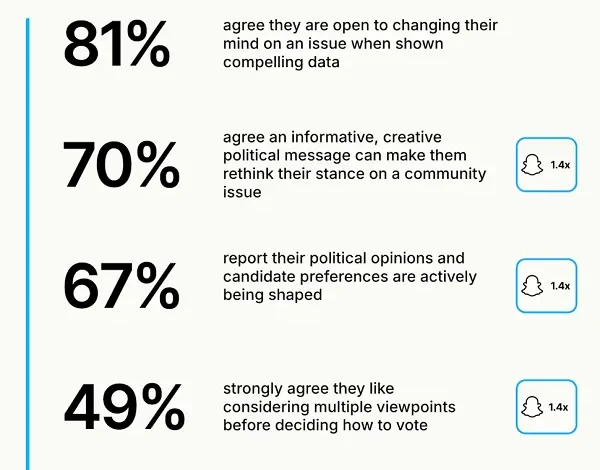
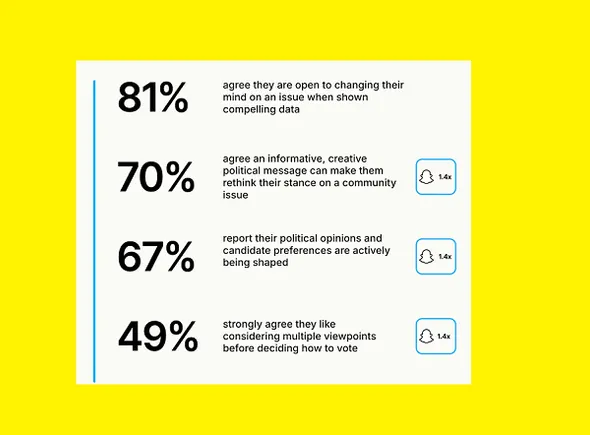
Beyond sheer turnout projections, the study delves into how users consume political information and how digital advertising influences their decision-making processes. In an era dominated by hyper-partisan media silos and echo chambers, Snap’s research highlights a surprising degree of ideological flexibility among its users. According to the platform, Snapchat users are "uniquely open-minded in their political approach, seeking out viewpoints before choosing how to vote and open to changing their positions."
This openness translates directly into how users interact with paid political content. Traditional wisdom often assumes that political ads on social media are universally disliked, ignored, or perceived as invasive. However, the Snapchat study paints a remarkably different picture:
- Candidate Discovery: Eighty percent of respondents indicated that political promotions on Snapchat have successfully introduced them to candidates and political causes of which they were previously unaware.
- Post-Ad Action: Seventy-four percent of surveyed users stated that they are significantly more likely to actively research candidates, review policy platforms, and investigate ballot initiatives after encountering political advertisements on the platform.
- Cause-Based Resonance: The data reveals that users respond with higher frequency to messaging anchored in tangible community causes and social values rather than purely partisan attacks or abstract ideological rhetoric.
These metrics offer a reassuring narrative for political marketers who often struggle to capture the attention of younger generations through television broadcasts, radio spots, or traditional print media.
Implications for Political Advertisers and Campaigns
The implications of Snapchat’s latest research extend far beyond corporate marketing strategy; they signal a fundamental shift in how political campaigns must design and execute their outreach strategies. As media consumption habits continue to fragment away from linear television and desktop computing toward mobile-first, vertical video platforms, campaign managers are forced to adapt or risk obsolescence.
Reaching First-Time and Low-Propensity Voters
One of the most enduring challenges for political campaigns is identifying and engaging first-time voters. These individuals often lack established party loyalties or voting habits, making them critical swing demographics in closely contested elections. Because a significant portion of Snapchat’s user base falls squarely into the 18-to-24 age bracket, the platform offers campaigns a direct pipeline to young adults casting ballots for the first time. By utilizing the platform’s immersive ad formats—such as Story ads, Collection ads, and Augmented Reality (AR) lenses—campaigns can present complex policy positions in formats that feel native and accessible to younger audiences.
The Value of Trust and Context
Trust is a foundational currency in digital advertising. Younger demographics are notoriously skeptical of institutional messaging and traditional political advertising. Platforms like Snapchat, which are deeply integrated into users’ daily social routines, derive a degree of perceived relational trust. When political messaging is delivered within a trusted digital environment alongside educational resources, users appear more willing to engage constructively rather than immediately rejecting the content as propaganda.
Navigating Content Moderation and Political Transparency
While the data presents lucrative opportunities for political ad buyers, it also highlights the delicate balancing act required by platform operators. Political advertising on social media remains a lightning rod for controversy, plagued by concerns over misinformation, foreign interference, and micro-targeting ethics.

Snapchat has historically maintained a rigorous approach to political and advocacy advertising. Unlike some of its competitors, Snap enforces a strict human review process for all political ads, prohibiting content that promotes voter suppression, unverified claims, or misleading information about election procedures. The platform also maintains a publicly accessible political ad library, ensuring transparency regarding who is paying for ads and how much is being spent. By pairing its pitch for increased ad spend with a reaffirmation of these safety protocols, Snap aims to reassure both advertisers and the public that its platform remains a safe and reliable environment for civic discourse.
Industry Reactions and Broad Market Context
The release of the Alter Agents report arrives at a time when the digital advertising market is experiencing broader economic headwinds and structural changes. Privacy updates implemented by major technology companies, such as Apple’s App Tracking Transparency framework, have made traditional audience tracking more difficult across the mobile ecosystem. Consequently, platforms are increasingly emphasizing first-party research, contextual relevance, and direct audience engagement metrics to attract brand and political ad dollars.
Industry analysts note that while platforms like Meta (Facebook and Instagram) and TikTok command massive shares of overall social media usage, Snapchat continues to hold a uniquely sticky, highly engaged audience among Gen Z and Millennials. In the context of the U.S. midterms—where individual congressional races can be decided by razor-thin margins—every single vote carries immense weight. Mobilizing even a fraction of Snapchat’s millions of active users could decisively sway competitive House and Senate races.
Campaign strategists from across the political spectrum have increasingly acknowledged the necessity of meeting voters where they spend their digital lives. While television advertising remains the primary vehicle for high-level branding and senior demographic outreach, digital platforms are recognized as the indispensable engine for mobilization, GOTV (Get Out The Vote) initiatives, and youth engagement.
Looking Ahead to November and Beyond
As the November midterm elections draw closer, the political spotlight will only intensify. Campaigns are finalizing their closing arguments, deploying final waves of advertising, and ramping up grassroots mobilization efforts.
Snapchat’s proactive release of its civic engagement study serves a dual purpose. On one hand, it is a commercial pitch designed to capture a larger share of the lucrative political ad market. On the other hand, it functions as a validation of the political efficacy of younger generations. By demonstrating that nearly 80 percent of its user base is committed to voting—and that digital ads play a tangible role in informing their choices—Snapchat has reinforced the narrative that the future of American democracy is increasingly digital, mobile, and youth-driven.
Ultimately, the success of these in-app initiatives will be measured not just in advertising revenue or impression counts, but in the verified turnout numbers at polling places across the country this November. If the data holds true, millions of young voters will head to the polls, influenced in part by the digital touchpoints, educational resources, and candidate discovery tools encountered on their favorite messaging app.