HoverEcho introduces interactive audio elements to WordPress websites to bridge the engagement gap between user intent and conversion

The digital landscape has long been defined by a rigid, linear user journey: a visitor observes a visual element, clicks it, and only then gains access to further information. For decades, this "click-to-discover" model has served as the foundation of web design. However, analytical data from session recording tools consistently reveals a common friction point in this process. Visitors frequently hover over pricing plans, call-to-action buttons, or promotional banners, only to abandon the page without ever clicking. This behavioral pattern suggests that the information necessary for a conversion was available, yet the barrier of an additional click was sufficient to induce user drop-off. HoverEcho, a newly launched technology, seeks to dismantle this hurdle by enabling individual webpage elements to provide audio-based context upon user interaction.
The Mechanism of Audio-Augmented Interaction
HoverEcho fundamentally alters the standard web interaction sequence from "see, click, discover" to a more nuanced process of "see, hear, decide, click." By attaching audio files to specific page elements, the platform allows site owners to deliver brief, targeted information before a user commits to a page load or a navigation change.
The implementation varies based on the device interface. On desktop environments, the audio triggers upon a standard mouse hover. For mobile users, the interaction is activated via a "touch and hold" gesture. In the context of television-based web browsing, the technology initiates when a user focuses on a specific tile using a remote control.
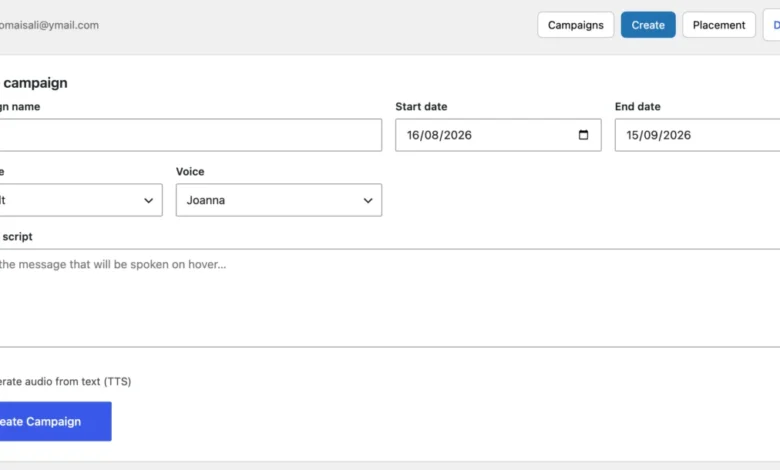
This is not a system of ambient background music or automated video narration. The audio remains silent until the user actively engages with a designated element, ensuring that the message is contextual and intentional. Site administrators can deploy these audio clips either by uploading custom recordings or by utilizing integrated text-to-speech (TTS) engines, which allow for the selection of various voice profiles to match a brand’s tone.
Chronology and Integration within the WordPress Ecosystem
The official release of the HoverEcho WordPress plugin marks a significant shift in the deployment of this technology. Previously, implementing such interactive features required manually embedding scripts, a cumbersome process that hindered scalability for large-scale operations or agencies managing multiple client portfolios.

The timeline of the development reflects a push toward seamless integration. In the months leading up to the plugin launch, the developers focused on refining the backend dashboard to allow for centralized management. With the current iteration, publishers can create, edit, and update spoken campaigns directly from the WordPress interface. This ensures that when a marketing campaign requires a content update, the change propagates across the site automatically, eliminating the risk of "stale" or outdated embed codes—a common issue for agencies managing dozens of client websites.
Statistical Context and Conversion Hurdles
Industry data on user behavior highlights why such an intervention is being introduced. According to recent e-commerce benchmarks, the average cart abandonment rate hovers near 70%. A significant portion of this attrition occurs not at the checkout stage, but during the initial information-gathering phase.
When a user hesitates over a pricing tier or a product specification, they are essentially looking for validation or clarification. Current web architectures force these users to navigate to secondary pages, increasing the load on server resources and increasing the likelihood of user fatigue. By providing a ten-second audio explanation directly at the point of interest, site owners can potentially address specific objections in real-time. Analytical models suggest that even a fractional reduction in "bounce rates"—the percentage of visitors who leave after viewing only one page—can yield significant improvements in overall site conversion rates.
Strategic Applications and Use Cases
The primary utility of HoverEcho lies in its ability to inject clarity into complex user journeys. Three sectors stand to benefit most from this capability:
- Digital Advertising: Display advertisements often struggle to convey value in a limited space. A spoken preview, triggered by a hover, allows advertisers to deliver a compelling pitch without cluttering the visual space of the ad unit.
- E-commerce: Product tiles, size guides, and complex checkout forms are prime candidates for audio-guided interaction. Providing a brief verbal explanation of a product’s features or a clarification on shipping options can reduce hesitation at critical decision points.
- Information Density: For publishers and informational websites, audio can act as a "nudge" to guide users toward relevant content, helping to navigate complex hierarchies without the need for extensive site redesigns.
Accessibility and Ethical Considerations
The developers of HoverEcho have positioned their platform as an accessibility enhancement. When implemented correctly, keyboard-based focus triggers can provide valuable audio context for users with visual impairments, potentially offering a more intuitive browsing experience.
However, technology experts caution that this should be viewed as a complementary layer rather than a replacement for standardized accessibility practices. Proper semantic HTML and ARIA (Accessible Rich Internet Applications) labels remain the industry standard for screen readers and assistive technologies. HoverEcho is designed to function as an enhancement that sits atop these foundations. If used as a substitute for accessibility, the technology could inadvertently create barriers for users who rely on screen readers. When integrated as an additional layer of information, however, it aligns with broader efforts to make the web more inclusive.

Analytical Outlook: Restraint and Optimization
The successful implementation of HoverEcho will likely depend on the principle of restraint. Human-computer interaction research consistently shows that excessive, unexpected auditory input leads to rapid user irritation. A website that triggers audio on twenty different elements would likely result in a poor user experience, potentially damaging brand reputation.
For early adopters, the recommended strategy involves a "test-and-measure" approach. By focusing on a single high-traffic page—such as a pricing matrix or a specific high-converting landing page—site owners can establish a baseline for performance. Key performance indicators (KPIs) to monitor include the duration of the audio played, the subsequent click-through rate (CTR) on the element, and the overall time spent on the page.
Furthermore, the quality of the audio must be strictly managed. The developers acknowledge that while text-to-speech technology has advanced, short, clear sentences are required for optimal results. Complex product names or technical jargon often lead to mispronunciation in synthesized voices. Consequently, the ability to upload professional voice recordings remains a critical feature for businesses that prioritize brand consistency and clarity.
The Future of Interactive Web Design
The emergence of HoverEcho signals a potential shift in how web elements are expected to perform. If the technology gains traction, it may force a re-evaluation of how much information is "hidden" behind clicks. As users become accustomed to more conversational interfaces, the demand for instantaneous, context-aware information is likely to grow.
For developers and site owners, the next 30 days—coinciding with the current free trial period offered by the service—will serve as a trial run for the technology. During this period, the industry will be watching to see whether users find the "speaking element" to be a helpful guide or a disruptive annoyance. The success of this tool will be measured not by the complexity of the implementation, but by its ability to demonstrably improve the user’s journey from curiosity to commitment. As digital environments continue to prioritize speed and clarity, HoverEcho provides a distinct, if experimental, methodology for capturing the attention of a distracted online audience.