AI Startup Gritt Secures 26 Million to Revolutionize Solar Infrastructure with Intelligent Robotics

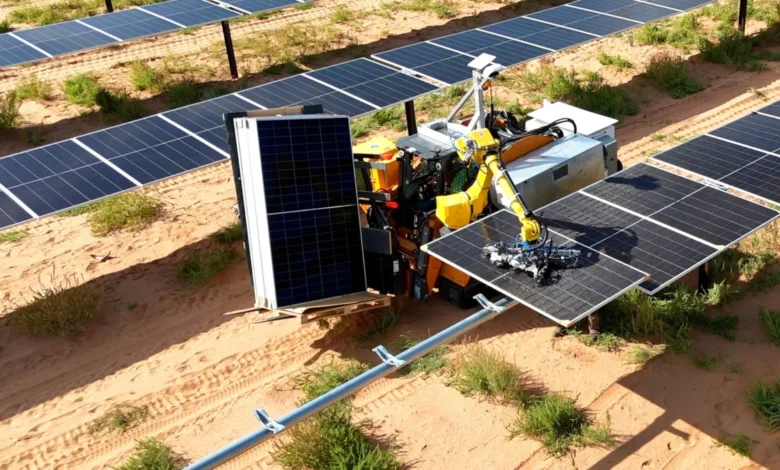
The global transition toward renewable energy has reached a critical inflection point, driven by an urgent need to mitigate the effects of climate change and achieve national energy independence. As countries and private enterprises race to deploy solar arrays and battery storage systems at an unprecedented scale, they have encountered a formidable and unexpected bottleneck: a profound shortage of skilled labor. To address this gap, Gritt, a robotics startup founded by Carnegie Mellon-trained engineers, has emerged from stealth with a $26 million Series A funding round aimed at deploying artificial intelligence to automate the most grueling aspects of solar construction.
The funding round was led by Obvious Ventures, with significant participation from Union Square Ventures and Active Impact Investment. This latest infusion of capital brings Gritt’s total funding to $34 million, following an earlier seed round supported by First Round Capital, Climactic, Congruent Ventures, and VSC Ventures. The startup’s mission is centered on building what CEO Puneet Puri describes as an intelligent system designed to "help civilization build infrastructure faster." By leveraging advanced AI models to navigate the chaotic, unstructured environments of outdoor construction sites, Gritt aims to transform how the world’s largest energy projects are realized.
The Convergence of Climate Goals and Labor Realities
The solar energy build-out is currently one of the most significant industrial undertakings on Earth. In the United States, the Inflation Reduction Act (IRA) has catalyzed a surge in renewable energy projects, providing billions in incentives for domestic production and installation. However, the physical reality of these projects is often at odds with the ambitious timelines set by policymakers. Solar farms are frequently located in remote, arid, or geographically challenging regions where attracting and retaining a consistent workforce is difficult.
The labor market challenge in the solar sector is multifaceted. According to industry reports, the solar workforce needs to grow by hundreds of thousands of workers over the next decade to meet decarbonization targets. However, the work itself is often described as "dirty, dull, and dangerous." It involves the repetitive lifting and positioning of glass panels that can weigh up to 100 pounds, often in extreme heat and high-wind conditions. These factors contribute to high turnover rates and a heightened risk of musculoskeletal injuries among workers.
Historically, industrial robots have been confined to the controlled environments of factory floors, where every movement is programmed and the surroundings are predictable. Construction sites, by contrast, are "unstructured environments" characterized by uneven terrain, variable lighting, and shifting obstacles. Until recently, robotic systems lacked the sensory intelligence and adaptability required to function in such settings. The emergence of a new generation of AI models—specifically those capable of generalizable computer vision and adaptive manipulation—has finally made the automation of outdoor construction a viable reality.
Gritt’s Technological Approach: Intelligence Over Custom Hardware
Founded by CEO Puneet Puri and CTO Vishal Dugar, Gritt distinguishes itself from its competitors through its hardware-agnostic philosophy. While several other startups in the space are focused on designing and manufacturing proprietary, bespoke robots, Gritt utilizes off-the-shelf hardware. This includes rented industrial vehicles like skidders and standard robotic arms manufactured by established players such as Kawasaki.
By focusing on the "intelligence layer" rather than the hardware, Gritt can deploy its systems more rapidly and at a lower cost. The company’s proprietary AI models serve as the "brain" for these machines, allowing them to perform complex tasks with sub-millimeter accuracy. Currently, the system’s primary function involves the logistics of solar panel installation: unloading large panels from delivery vehicles, transporting them to the metal mounting frames (racks), and positioning them precisely so that human workers can secure them.
The results of this collaboration between human labor and robotic precision are stark. In a traditional setup, a typical eight-person crew can install approximately 800 solar panels in a single day. When augmented by Gritt’s robotic systems, the same crew can install between 3,000 and 4,000 panels daily. This represents a nearly five-fold increase in productivity, which is essential for meeting the aggressive installation schedules required for gigawatt-scale projects.
Strategic Growth and Market Traction
The $26 million Series A round comes at a time of rapid commercial expansion for Gritt. The company has already secured contracts to assist in the installation of 2.8 gigawatts (GW) of solar capacity over the next 18 months. To put this in perspective, 2.8 GW is enough energy to power approximately 2.1 million homes. Gritt’s client roster already includes three of the top ten power construction firms in the United States, indicating strong institutional confidence in the startup’s technology.
Andrew Beebe, a partner at Obvious Ventures who led the Series A round, emphasized the importance of the founders’ background and their pragmatic approach to the problem. Beebe noted that while many roboticists focus on high-budget, niche applications like space exploration, Puri and Dugar are focused on the "dirty, dull, and dangerous" jobs that require massive scale. This focus on "physical AI" is what investors believe will allow Gritt to dominate the infrastructure automation market.
The company plans to have 48 of its systems operational in the field within the next six months. This rapid scaling is made possible by the software’s ability to learn and adapt. As the robots operate, they collect data that is used to refine their behavior, making them more efficient with every panel installed.
Improving Worker Safety and Site Management
Beyond pure productivity metrics, Gritt’s technology offers significant benefits for worker safety and project management. One customer, a construction executive who spoke to TechCrunch on the condition of anonymity, highlighted the reduction in physical strain as a primary selling point. By automating the lifting and positioning of 100-pound panels, the system significantly reduces the risk of back injuries and heat exhaustion, which are common on solar sites.
Furthermore, the sensors and AI integrated into Gritt’s platforms provide a level of site oversight that was previously impossible. The founders envision a future where their systems act as a "physical AI layer" for the entire construction site. For example, the system’s computer vision could identify a trench that has been left open ahead of an approaching storm, alerting managers to cover it before rain damages sensitive electrical components. It can also assist in inventory management by automatically flagging missing parts or equipment.
This transition from a task-specific tool to a general-purpose site intelligence platform is a core part of Gritt’s long-term strategy. The founders noted that the same underlying AI pipeline used for solar panel installation can be adapted to other labor-intensive tasks with remarkable speed. In one internal test, training the system to stack cinder blocks took several weeks, but a subsequent demo for tying rebar—a critical and back-breaking task in concrete construction—took only a single day to program using the existing software framework.
Competitive Landscape and the Future of Construction
Gritt enters a competitive field that includes startups like Luminous Robotics, Cosmic, and the Chinese firm Trinabot. However, the decision to avoid custom hardware manufacturing may give Gritt a leaner cost structure and greater flexibility. As the solar industry continues to evolve, with new panel designs and racking systems emerging, a software-centric approach allows Gritt to adapt its systems through over-the-air updates rather than expensive hardware retrofits.
The broader implications of Gritt’s technology extend far beyond the solar industry. The "physical AI" being developed by Puri and Dugar has the potential to revolutionize the entire construction sector, which has historically been one of the least digitized and least automated industries in the world. By proving that AI can handle the "chaotic environments" of outdoor infrastructure projects, Gritt is paving the way for a new era of automated building.
As the company moves forward, it plans to expand its manipulation capabilities to include fastening panels, drilling posts, and building the metal racks themselves. By automating these additional steps, Gritt aims to further reduce the reliance on manual labor in remote areas, ensuring that the global transition to clean energy is not delayed by a lack of human hands.
In the words of CEO Puneet Puri, the goal is to create a system that is generalizable enough to work in any varied environment. If Gritt succeeds, it will not only have solved a major bottleneck for the solar industry but will have also established a new blueprint for how humanity builds the physical world in the age of artificial intelligence. With $34 million in total funding and a multi-gigawatt pipeline, the company is well-positioned to turn this vision into a foundational element of the 21st-century global economy.