The digital landscape has witnessed a significant shift in how narratives are delivered, moving away from static pages toward immersive, high-performance interactive experiences. At the forefront of this evolution is ZERO, a web-based narrative demo that challenges the traditional university degree path through a meticulously engineered 3D environment. Developed over a four-month period, the project represents a technical milestone, successfully condensing over one gigabyte of high-fidelity source assets into a web-ready package of less than 10MB, all while maintaining a consistent 60 frames per second (fps) on devices ranging from flagship desktops to budget Android smartphones.
The Genesis of ZERO: From Concept to Proof of Concept
The project originated from a vision led by Atul Khola’s team to create a "defiant" narrative—one that critiques the modern educational industrial complex. Rather than approaching the client with a traditional slide deck or static wireframes, the development team opted for a high-risk, high-reward strategy: a working proof of concept. Within a 48-hour window, the team built the "draw a zero" interaction, a unique entry mechanic that replaced the standard "Enter" button.
This initial prototype leveraged Artificial Intelligence to accelerate the early coding stages, allowing the developers to focus on the "feel" of the interaction. By the time the pitch occurred, the team had a functional demonstration of the frost-spreading shader and the gesture-recognition logic. This proactive approach not only won the project but also established a development philosophy for the remaining four months: use AI for rapid iteration of foundational code, but rely on human intuition and rigorous engineering for refinement and optimization.

A Narrative Structured in Six Stages
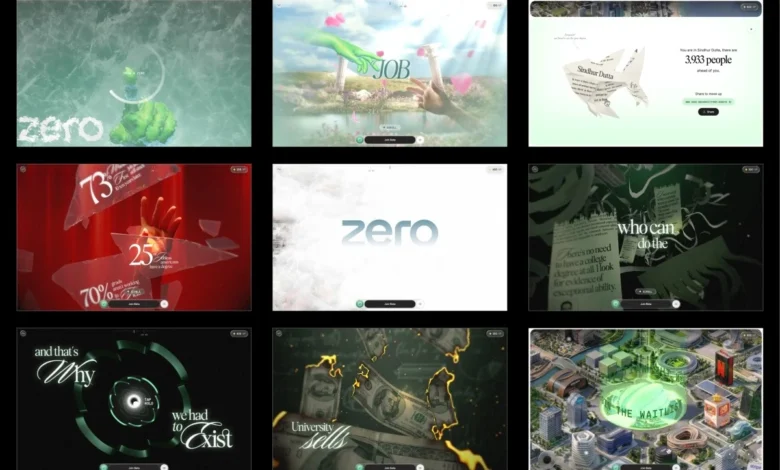
The user journey within ZERO is structured as a linear progression through six distinct scrolling stages, punctuated by five interactive "gates." These gates serve as narrative pauses, requiring the user to interact with the environment to advance.
- The Promise: The experience begins with the conventional promise of higher education—grades, prestige, and corporate placement.
- The Shattering: At the first gate, this promise literally breaks. The user must hold a gesture to shatter a glass pane, revealing sobering unemployment statistics etched into the shards.
- The Devaluation: Stage three depicts the physical destruction of traditional symbols of success. Money burns and certificates are shredded, transitioning the viewer into a tunnel shaped like the ZERO logo.
- The Ascent: Emerging from the tunnel, the user finds themselves above the clouds, looking down at a corporate skyline.
- The Interactive City: The climax of the experience is a fully explorable 3D map where users can pan and zoom to discover different career scenarios and tools.
- The Call to Action: The journey concludes with a "Join Beta" prompt, transitioning the narrative into a functional waitlist signup.
Architectural Innovation: The Virtual Scroll Engine
One of the most critical technical decisions made during development was the abandonment of the browser’s native scroll mechanism. Standard scrolling libraries often rely on an oversized DOM (Document Object Model) to track progress, which can lead to performance bottlenecks in complex 3D scenes.
Instead, the team built a custom virtual scroll engine. In this architecture, mouse wheel and touch inputs update a single numerical value. This value acts as the "master clock" for the entire experience, driving GSAP (GreenSock Animation Platform) timelines, shader uniforms, asset loading sequences, and text reveals.
The codebase was organized into nine self-contained segments. Each segment followed a strict lifecycle: enter (asynchronous building of Three.js objects), scrub (mapping the scroll value to local progress), update (handling idle animations), and teardown (disposing of assets to free up memory). This modularity allowed the team to debug individual stages in isolation and ensured that jumping to a specific point in the narrative would correctly initialize all preceding states.

Asset Engineering: Reducing One Gigabyte to Ten Megabytes
The primary challenge of modern WebGL development is the "weight" of the assets. The source files provided to the team were production-grade Blender scenes featuring uncompressed geometry, 8K textures, and complex baked animations. Transporting these assets over a standard internet connection would have resulted in prohibitive load times.
To solve this, the team implemented a multi-stage compression pipeline:
Geometry and Transcoding
All 3D geometry was compressed using DRACO, an open-source library for compressing and decompressing 3D geometric meshes. Crucially, the team self-hosted the Draco and KTX2/Basis transcoders within their own directory structure. This decision followed a critical failure during development when a third-party Content Delivery Network (CDN) experienced a slowdown, causing local assets to fail because the remote decoder was unreachable.
Texture Optimization via KTX2
While PNG and JPEG formats are common, they are inefficient for the GPU. A PNG file must be fully decompressed into VRAM, meaning a 2048×2048 texture occupies 16MB of memory regardless of its disk size. By using KTX2 with ETC1S compression, the textures remain compressed even within the GPU memory. This drastically reduces VRAM usage and speeds up the "upload" time from the CPU to the GPU.

The Internal Compression Previewer
To balance file size with visual fidelity, the team developed an internal dashboard to preview compression results. Since ETC1S is a lossy format, it can introduce artifacts. The previewer allowed developers to fine-tune settings for each asset—applying heavy compression to background elements like clouds while preserving high detail for "hero" assets like the burning money.
Overcoming the "Main Thread" Bottleneck
A common issue in WebGL sites is "stuttering" during transitions. This is often caused by the browser uploading large textures to the GPU on the main thread, which blocks rendering for several frames. To eliminate this, the ZERO team implemented a sophisticated upload queue.
Using the requestIdleCallback API, the engine monitors when the browser has spare processing cycles. It then "drains" the texture queue bit by bit, ensuring that assets are uploaded before they are needed on screen. If a user scrolls quickly toward a new stage, the system synchronously flushes the remaining queue during the transition to ensure a smooth visual experience.
Furthermore, an "Adaptive Quality Manager" was integrated to handle device fragmentation. The manager tracks frame times in a rolling buffer. If the average frame time exceeds 22ms (indicating a drop below 45fps), the engine automatically downgrades visual parameters such as pixel ratio, blur samples, and geometry complexity. Conversely, if the device maintains stable performance, the engine scales the quality back up.

The Art of the Shader: Visual Storytelling through GLSL
The visual impact of ZERO is largely driven by custom GLSL (OpenGL Shading Language) shaders. These programs run directly on the GPU to create effects that would be impossible with standard materials.
- The Frost Effect: This uses a "ping-pong" buffer to propagate pixels. When a user draws the zero, the stroke expands in an octagonal pattern, modulated by a frost-luma texture to create a crystalline growth appearance.
- Lighting without Lights: Real-time lighting on skinned meshes is computationally expensive. To save resources, the team baked various lighting states into textures and used a shader to crossfade between them based on the user’s scroll position.
- The Burning Money: This effect utilizes a noise-driven distance field. A "Fractional Brownian Motion" (FBM) algorithm sweeps across the bill, creating an HDR ember rim just before discarding the "burnt" pixels.
- Hexagonal Blur Text: To make the narrative text feel integrated into the 3D space, the team developed a seven-tap hexagonal blur. This allows the text to "pull into focus" as the user reaches a specific scroll threshold, rather than simply fading in.
Broader Implications and Technical Analysis
The release of ZERO serves as a case study for the future of the "Interactive Web." It demonstrates that the limitations of web browsers—often cited as the reason for subpar mobile experiences—can be overcome through disciplined asset management and custom architectural solutions.
The project also highlights the evolving role of AI in the creative industries. While AI was used to generate initial code fragments, the "last mile" of development required human expertise to solve complex issues like shader precision bugs on mobile GPUs (Adreno and Mali). These chips often treat mediump floats as 16-bit, leading to banding and animation errors that do not appear on desktop hardware. The team’s insistence on testing on real-world budget devices was ultimately what ensured the project’s universal accessibility.
In an era where digital attention spans are shrinking, ZERO uses high-performance engineering to buy those few extra seconds of user engagement. By replacing the static "click" with a meaningful "draw," and the standard scroll with a cinematic progression, the project sets a new benchmark for how brands and organizations can tell defiant, impactful stories in a browser.

The success of ZERO suggests a shift away from "heavy" web frameworks toward leaner, more specialized stacks where performance is treated as a core feature of the narrative itself. As web technologies continue to mature, the gap between native applications and browser-based experiences continues to close, driven by the type of engineering rigor showcased in this defiant interactive demo.