STRG Offers a Cost-Effective S3-Compatible Alternative for Modern Cloud Object Storage

As web applications evolve from simple static sites to complex, data-intensive platforms, the architecture governing digital asset management has become a focal point for infrastructure engineers. The exponential growth in file sizes, ranging from high-definition media assets to expansive user-generated content, has placed a significant burden on organizational budgets. Historically, developers have relied upon the "big three" cloud providers—Amazon Web Services (AWS), Google Cloud Platform (GCP), and Microsoft Azure—to manage this storage. However, the complexity of these proprietary ecosystems, combined with escalating egress fees and opaque pricing structures, has led many enterprises to seek leaner, more transparent alternatives.
The emergence of STRG, a modern cloud object storage platform, marks a shift in how developers approach object storage. By providing an S3-compatible interface, STRG aims to lower the barrier to entry for teams looking to migrate away from high-cost legacy providers without the necessity of rewriting their existing codebase.
The Evolution of Cloud Storage Economics
The cloud storage market has undergone a significant transformation over the last decade. In the early 2010s, storage was a commodity sold as a utility. As the web matured, storage became an integrated component of larger "serverless" ecosystems. While this offered unparalleled convenience, it also locked developers into specific vendor architectures.
According to recent industry reports, data egress costs—the fees charged by cloud providers for moving data out of their network—now account for an average of 15% to 25% of total cloud infrastructure spending for mid-to-large-sized web enterprises. For companies managing petabytes of image or video data, these costs are often unpredictable. This economic climate has fueled the rise of the "S3-compatible" movement, which focuses on providing an interoperable API that mimics the de facto standard set by AWS while offering lower storage rates and more predictable billing cycles.
Chronology of the S3-Compatible Standard
The dominance of the Amazon Simple Storage Service (S3) API began with its launch in 2006. Over the following two decades, it became the ubiquitous language of cloud storage.
- 2006: AWS launches S3, setting the technical standard for object-based storage via RESTful APIs.
- 2012–2015: The rise of open-source storage solutions like MinIO begins to challenge the proprietary dominance of public cloud providers by allowing for private cloud deployment.
- 2018–2022: The "Cloud Repatriation" trend gains momentum as organizations realize that multi-cloud or hybrid-cloud strategies require an abstraction layer to avoid vendor lock-in.
- 2024–2026: Specialized storage providers emerge, focusing on "commodity-plus" services, where S3 compatibility is treated as a foundational requirement rather than an afterthought.
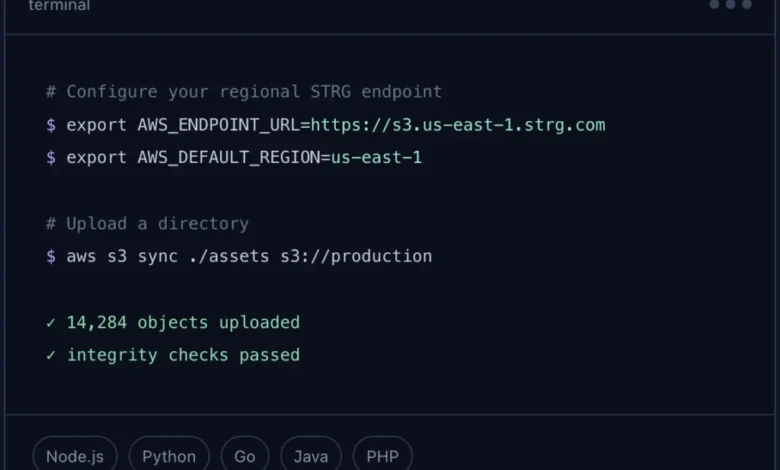
STRG enters this market at a time when the demand for high-performance, S3-compatible infrastructure has reached an inflection point. By implementing the same API structure, STRG enables developers to swap their storage backend with minimal friction, often requiring only a change in the endpoint URL within their SDK configurations.
Technical Implementation and Interoperability
One of the primary technical challenges when switching storage providers is the refactoring of application logic. STRG addresses this by mirroring the S3 protocol, which allows for the use of the standard AWS SDKs for languages such as JavaScript, Python, and Go.
For instance, a development team currently using the AWS SDK for JavaScript can integrate STRG by simply modifying the S3Client configuration. By setting the endpoint to the regional STRG URL, the existing PutObjectCommand, ListObjectsV2Command, and GetObjectCommand logic remains fully functional. This design choice effectively eliminates the "switching cost" that has traditionally kept companies tethered to legacy cloud giants.
Beyond the basic API compatibility, STRG incorporates enterprise-grade features that modern applications require:
- Lifecycle Policies: Automated rules that transition objects between storage tiers or delete them after a set period, optimizing cost based on access frequency.
- Cross-Origin Resource Sharing (CORS): Essential for web applications that need to serve assets directly from the storage bucket to a user’s browser.
- Object Locking: A security feature that prevents the deletion or modification of data for a specific duration, critical for regulatory compliance and ransomware protection.
The Role of AI Agents in Infrastructure Management
The integration of artificial intelligence into DevOps workflows represents the next frontier of infrastructure management. STRG has positioned itself within this ecosystem by providing a Model Context Protocol (MCP) server. This allows AI agents—such as those built using Anthropic’s Claude—to interface directly with the storage platform.
By utilizing the command claude mcp add --transport http strg https://mcp.strg.com/mcp, a developer can grant an AI agent the ability to manage assets, query bucket contents, or automate file organization. This integration is governed by granular access control lists (ACLs). The scope of the AI’s capability is strictly limited by the permissions assigned to the API key, ensuring that an agent cannot perform administrative actions outside the scope of its defined role. This implementation mitigates the security risks often associated with giving AI autonomous access to infrastructure.
Economic and Strategic Implications
For the modern CTO or lead engineer, the decision to migrate to a platform like STRG is not merely a technical choice but a strategic one. The primary implication is the reduction of vendor lock-in risk. When an application is built on a proprietary cloud service, the cost of migrating away grows as the application scales. Conversely, by adopting an S3-compatible standard, organizations maintain the flexibility to pivot between providers as market conditions change.
Furthermore, the simplified pricing model often associated with specialized storage providers allows for more accurate financial forecasting. Traditional cloud providers often include complex, tiered pricing structures that vary based on the specific region, the type of request, and the volume of data retrieved. STRG’s focus on affordability and predictability suggests a market shift toward transparent, utility-like pricing.
Analysis of Future Market Trends
Looking ahead, the market for object storage is expected to become increasingly fragmented as specialized providers compete on specific niches such as latency, geographical availability, and AI-agent compatibility. While AWS, Google, and Azure will likely retain the majority of the market due to their broad ecosystems (compute, networking, and machine learning services), the "storage-only" sector is becoming a competitive battleground.
The success of STRG will depend on its ability to maintain high availability and reliability as it scales to meet the needs of larger enterprises. If the service can prove that its uptime and security posture are equivalent to the legacy providers, it will likely see rapid adoption among startups and mid-market companies that are currently feeling the pressure of cloud cost optimization.
In summary, the transition toward standardized, interoperable storage solutions is a logical response to the challenges of the modern web. By lowering the cost of storage and providing the tooling necessary for both human developers and AI agents to interact with data seamlessly, platforms like STRG are providing the necessary infrastructure to support the next generation of web applications. The emphasis on ease of migration—highlighted by the ability to utilize existing AWS SDKs—ensures that infrastructure teams can focus on application development rather than the intricacies of proprietary cloud vendor migration.
Related posts: