Google Analytics Rolls Out Advanced AI, Attribution, and Budgeting Tools to Shift Focus from Retrospective Reporting to Predictive Strategy

Digital analytics has historically functioned as a retrospective mechanism—a tool designed to catalog user interactions, tally traffic anomalies, and explain historical conversions after budgets have already been exhausted. However, a recent suite of feature rollouts by Google Analytics (GA) aims to fundamentally alter this paradigm. By integrating automated channel groupings for Answer Engines, advanced conversion attribution models, cross-channel budget simulation, and conversational AI querying, the analytics platform is positioning itself as a predictive engine for enterprise decision-making.
Industry analysts note that these updates arrive at a critical juncture for digital marketers. As traditional search engine optimization (SEO) yields ground to artificial intelligence-driven discovery and multi-touch customer journeys grow increasingly complex, enterprises are facing mounting pressure to justify marketing expenditures with granular precision. The newly deployed features are designed to bridge the chasm between raw metric collection and high-level corporate strategy, providing finance and marketing departments with actionable foresight rather than mere post-mortem reports.
Evolution of Digital Discovery and the Rise of AEO Tracking
The digital landscape has experienced a profound structural shift over the past twenty-four years, characterized by the rapid adoption of Answer Engines (AEs) such as ChatGPT, Claude, Microsoft Copilot, and emerging LLM platforms. Industry data underscores this transformation: retail metrics from early 2026 indicate that AI-referred traffic converts significantly better than conventional traffic streams, generating higher average order values and extended site engagement. Despite these high-value interactions, AI-driven referrals historically lacked native categorization within standard analytics frameworks, frequently misattributing traffic or burying it within direct and unassigned channels.
To address this visibility gap, Google Analytics introduced the AI Assistant default channel group. Located within the standard traffic acquisition reports, this forward-looking feature automatically aggregates and categorizes incoming sessions from major conversational platforms under the medium ai-assistant. While early data suggests that Answer Engine traffic typically represents a modest 1% to 5% of total session volume for most enterprises, its disproportionate conversion efficacy makes it a vital metric for margin analysis rather than raw traffic volume.
Nevertheless, digital analytics professionals must navigate several operational nuances. Because the AI Assistant channel collects data prospectively without backfilling historical logs, organizations activation timelines dictate their data availability. Furthermore, the fluid nature of LLM platforms—where specific models frequently cycle in and out of active API integrations—requires monthly audits of analytics definitions. Industry experts recommend that organizations supplement native GA tracking with custom regex channel groupings and reconciliation frameworks to account for dark traffic originating from mobile and desktop applications.
Unlocking Multi-Touch Attribution and Assisted Conversions
For years, digital marketers debated the limits of last-click attribution models, which frequently discount the foundational role played by upper-funnel and mid-funnel awareness channels. In response, Google Analytics has re-engineered its Conversion Attribution Analysis suite, restoring prominence to assisted conversions within the Advertising workspace.
By comparing the blue bars of assisted touchpoints against the green bars of last-click conversions, analysts can uncover counterintuitive consumer behavior. For instance, channels historically deemed inefficient under last-click models—such as paid social media or organic search sub-segments—frequently appear on over a third of multi-touch conversion paths. This granular visibility allows marketing teams to transition away from subjective budget allocation toward data-driven funnel optimization.
The platform’s refined funnel analysis further classifies owned, earned, and paid touchpoints into early, mid, and late stages, alongside isolated single-touch pathways. This classification enables organizations to distinguish between intent-driven channels that capture existing demand and awareness channels that actively construct it. However, practitioners emphasize that attribution does not equate to incrementality. Enterprises are advised to pair assisted conversion metrics with rigorous macro-outcomes and micro-conversions, preventing data inflation caused by over-stuffed event lists.
Predictive Budgeting and Scenario Planning for Executives
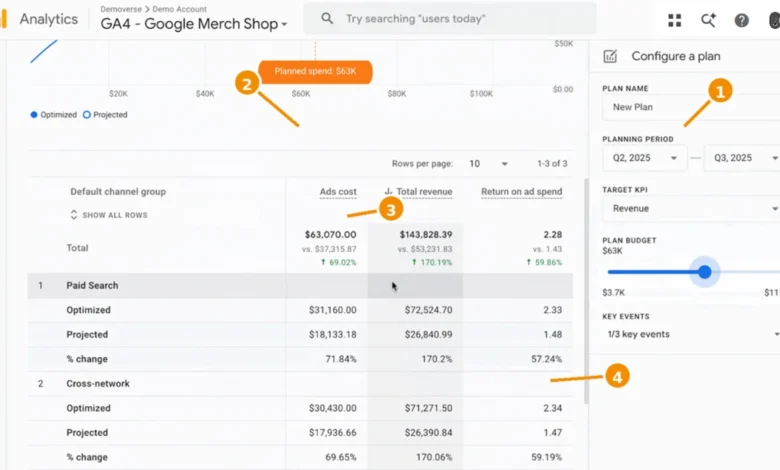
Moving from descriptive analytics to prescriptive strategy requires predictive modeling capabilities capable of forecasting financial outcomes prior to capital deployment. The newly introduced Cross-Channel Budgeting tool within Google Analytics addresses this requirement by providing two core capabilities: project plans to evaluate spending pacing, and scenario plans to simulate budgetary reallocation.
Trained on historical institutional data while accounting for seasonality and external variables, these planning modules allow marketing leaders to test hypothetical adjustments—such as transferring capital from paid social channels to paid search—before executing them in the market. Initial implementations across various enterprises have revealed that minor budgetary shifts between major channels frequently yield negligible differences in projected revenue. This insight challenges long-held assumptions regarding channel substitutability and encourages organizations to direct their focus toward broader structural levers and user experience enhancements.
To maximize the efficacy of these budgeting models, complete and accurate cost data ingestion is mandatory. Enterprises are increasingly required to import historical campaign expenditures from alternative platforms, including Meta Ads and TikTok Ads, directly into the analytics environment. Without comprehensive cost inputs, predictive revenue models risk providing skewed optimization recommendations.
Conversational Analysis and the Integration of Model Context Protocols
The democratization of data access has long remained an administrative bottleneck for enterprise analytics teams. Executives and senior leadership frequently struggle to navigate complex reporting interfaces, relying instead on data analysts to extract recurring performance metrics. To mitigate this friction, Google Analytics has introduced Ask Advisor, a conversational query tool accessible via the platform’s interface.
Ask Advisor allows users to pose complex analytical questions in natural language, automating multi-variable data retrieval across traffic channels, device categories, and geographic segments. By enabling leadership to query performance trends directly, the tool reduces the administrative burden on analytics teams, allowing them to focus on high-value strategic initiatives.
For advanced technical teams seeking integration beyond the standard user interface, Google has released a first-party Model Context Protocol (MCP) server. This infrastructure allows organizations to bridge their Google Analytics data warehouse directly with enterprise-approved Large Language Models such as Claude and ChatGPT. By connecting external media plans, promotional calendars, and offline sales data into a unified LLM environment, enterprises can perform cross-functional analyses that extend far beyond traditional web telemetry.
Broader Implications and Strategic Outlook
The cumulative effect of these feature rollouts represents a fundamental shift in how organizations utilize web and marketing analytics. By combining automated Answer Engine tracking, multi-touch attribution, predictive cross-channel budgeting, and conversational AI interfaces, Google Analytics has evolved from a simple reporting utility into a strategic advisory platform.
Industry observers note that while these tools significantly enhance analytical capabilities, their ultimate success depends on proper technical configuration and rigorous governance. Organizations must ensure data hygiene, maintain accurate cost imports, and carefully evaluate the underlying assumptions of predictive models. As enterprises continue to adapt to an AI-driven digital economy, the ability to transition from historical reporting to predictive decision-making will remain the defining characteristic of high-performing marketing and analytics organizations.