Getting Reliable Structured Outputs from LLMs: Validation, Retries and Constrained Decoding

The core of the problem lies in the distinction between syntactic correctness and semantic integrity. A JSON object may perfectly conform to a schema, possess the correct data types, and contain valid key-value pairs, yet still be logically incorrect. For instance, in an automated invoice processing system, an LLM might generate a JSON object identifying the total amount as 12,500 cents—a perfectly valid integer—while the source document clearly states 1,250.00 EUR. Because this error exists within the realm of logic rather than syntax, standard schema validators will pass the object, allowing erroneous data to propagate into downstream financial systems.
The Anatomy of a Robust Extraction Pipeline
To mitigate these risks, developers must shift from viewing LLM outputs as final products to treating them as unverified candidates. A mature architecture for reliable extraction typically involves three distinct layers: rigorous contract-based validation, intelligent retry logic, and constrained decoding at the token level.
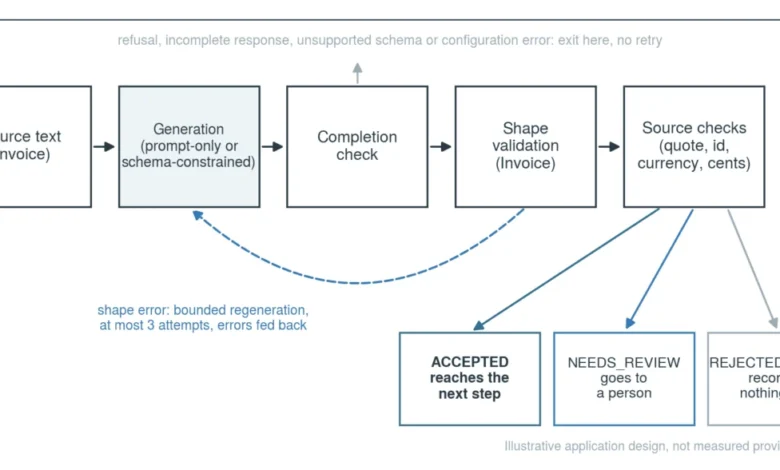
The validation layer begins with the definition of a strict contract, typically implemented via Pydantic models in Python. By leveraging "strict mode" and enforcing a "no-extra-fields" policy, developers can ensure that the model does not hallucinate undocumented keys or coerce data types in ways that introduce subtle bugs. However, this is only the entry ticket. Once the object is parsed, it must be cross-referenced against the original source text. This secondary validation step checks for verbatim quotes, confirms that extracted identifiers match the expected inputs, and verifies that numerical calculations are derived directly from the source material rather than generated through probabilistic hallucination.
A Chronology of Failures and Resolution
When an extraction fails, the system must differentiate between failures that can be repaired and those that are terminal. The following hierarchy of failure management is increasingly adopted by engineering teams:
- Shape Errors: These occur when the model fails to produce valid JSON or violates the defined schema. These are considered transient failures.
- Logic Errors: These occur when the JSON is perfectly valid but contradicts the source text. These are considered terminal failures, as re-prompting the model rarely corrects a logical misunderstanding of the source data.
- Refusals and Policy Blocks: When an LLM triggers a safety filter or a refusal to process, the system must halt immediately.
- Ambiguity: If the source document lacks the required information, the system should return a "needs_review" status rather than allowing the model to "guess" or populate fields with placeholders.
The timeline for a typical request, from initial generation to final commitment, involves an iterative loop limited by a pre-defined budget—usually three attempts. If a shape error occurs, the system feeds the specific validation error—such as an incorrect data type or a missing field—back into the model as context for the next attempt. By limiting this feedback to the most critical error messages, developers avoid "prompt pollution," where an overly verbose list of errors degrades the model’s performance.
Data Integrity and the Role of Constrained Decoding
Constrained decoding represents the most advanced frontier in this field. Unlike standard prompting, which asks the model to "please behave," constrained decoding acts at the tokenizer level. By masking out tokens that would lead to invalid JSON during the generation process, the system makes it physically impossible for the model to produce malformed output.
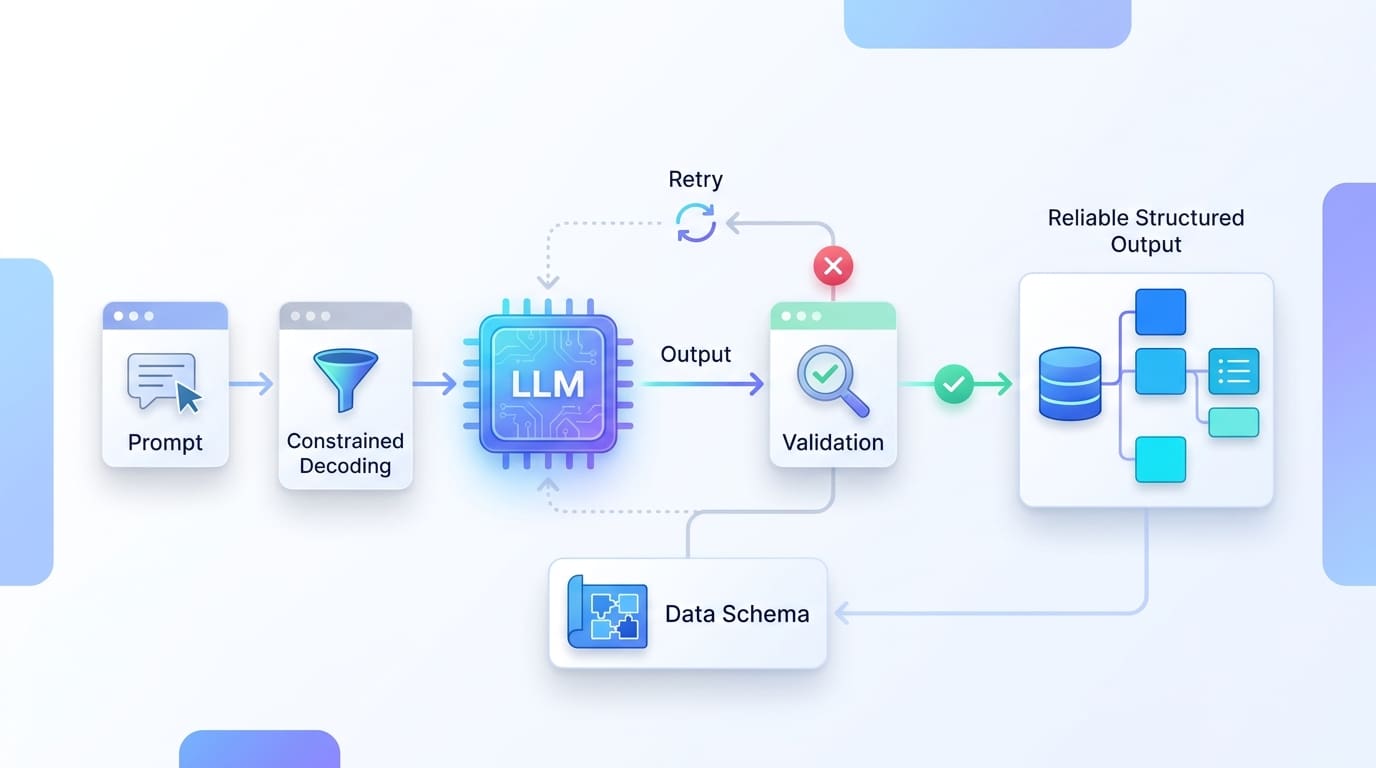
Industry benchmarks suggest that implementing constrained decoding can reduce the rate of shape errors by over 90% in complex document processing tasks. However, even with this safeguard, the "logical" validation—ensuring the total amount matches the invoice line—remains mandatory. Even if the decoder guarantees the output is a valid integer, it cannot guarantee that the integer is correct.
Broader Implications for Enterprise AI
The shift toward these validation-heavy architectures has profound implications for the enterprise AI sector. According to recent surveys by machine learning infrastructure providers, the "last mile" of LLM integration—ensuring the data is ready for database insertion—remains the most time-consuming phase of development.
The industry is currently moving away from monolithic, black-box prompts toward modular pipelines where the LLM is merely a component within a larger, deterministic system. This shift reduces the reliance on "prompt engineering" as a panacea and places more weight on traditional software engineering principles: unit testing, contract enforcement, and robust error handling.
Legal and financial departments, which were previously hesitant to adopt generative AI due to concerns over accuracy, are now finding common ground with engineers through these validation frameworks. By creating a system that acknowledges the probabilistic nature of LLMs while enforcing deterministic business rules, organizations can finally automate tasks like invoice reconciliation, contract review, and data entry with a high degree of confidence.
Future Perspectives
As models like GPT-6-Astra and future iterations continue to improve, the need for these defensive layers will not disappear; it will simply evolve. While future models may demonstrate higher reasoning capabilities and lower error rates, the requirement for an "audit trail" and a "source of truth" will remain constant.
The most successful implementations in the coming years will be those that prioritize "review-by-exception." By routing only the most ambiguous cases—those that fail the secondary source-check or trigger a "needs_review" status—to human operators, companies can maintain high throughput while keeping the error rate within acceptable financial tolerances.
Ultimately, the goal is to transform the LLM from a loose generator of text into a reliable tool for data processing. This is achieved by embracing the reality of the model’s limitations and wrapping its output in a cage of code that ensures every digit, currency, and identifier is verified, cross-referenced, and ready for the enterprise. In this context, success is not defined by how well the model generates text, but by how effectively the surrounding infrastructure manages the inevitable inaccuracies of the generative process.