Organic Answers Optimization OAO Unifying Search and Answer Engines for the Future of Digital Marketing

The digital marketing landscape is undergoing a fundamental structural shift, prompting
industry experts to introduce a unifying framework known as Organic Answers Optimization (OAO). As consumer habits migrate away from traditional keyword-based web searches toward conversational artificial intelligence and automated task completion, marketing executives face a bifurcated reality. Traditional Search Engine Optimization (SEO) remains the dominant engine for raw traffic and immediate revenue generation, yet Answer Engine Optimization (AEO) has quietly captured significant consumer-influencing market share, altering how brands are discovered and evaluated.
This convergence of search and answer methodologies forces enterprises to reconsider how they measure digital visibility. Rather than managing SEO and AEO as disparate silos fought over by competing internal teams and external agencies, modern marketing philosophy dictates that these disciplines must operate as a unified front. The core objective remains singular: influencing machine recommendations to capture consumer intent and converting that digital influence into measurable business outcomes.
The Evolution of Consumer Intent: From Search to Answer to Completion
To understand the necessity of OAO, industry analysts point to a clear chronological evolution in consumer behavior over the past decade. For years, the standard consumer journey followed a linear path of active search. Users relied on major search engines, inputting fragmented keyword strings, evaluating a mix of paid advertisements and organic blue links, and subsequently conducting independent research across multiple publisher websites.
However, a demographic and technological pivot has accelerated the rise of answer engines. Approximately half of younger demographics, including Generation Z, routinely bypass traditional search engines entirely. Instead, they interact with Large Language Models (LLMs) and conversational interfaces, presenting complex, highly contextualized prompts. For instance, rather than querying keywords like lightweight carry-on luggage, consumers now ask conversational agents to recommend specific products tailored to multi-variable constraints, such as airline restrictions, dimensional limits, and budget parameters.
This behavior is further transitioning into the phase of automated completion. A growing percentage of digitally native consumers now delegate the purchasing process directly to AI agents. These agents do not merely suggest products; they execute transactions, verify shipping timelines, and navigate return policies autonomously. Consequently, a traditional website visit is no longer a complete record of brand influence. When an AI agent recommends an unfamiliar brand discovered through third-party data ecosystems, the traditional web analytics trail is disrupted, necessitating a broader measurement framework.
The Data Reality: Declining Search Traffic Versus High-Value AI Conversions
The empirical data underpinning this technological shift highlights the urgency for strategic unification. Industry data consistently shows double-digit year-over-year declines in traditional organic search traffic for many legacy brands, driven in part by search engines answering queries directly on the results page without requiring outbound clicks. According to aggregate industry observations from analytics firms like SparkToro, a substantial majority of web searches now conclude without a single click to an external site.
Conversely, traffic originating from LLMs and answer engines demonstrates exceptional commercial value. Retail analytics from platforms such as Adobe and Shopify indicate that visitors arriving via generative AI channels convert at significantly higher rates and generate higher average order values compared to conventional organic search traffic. While overall organic traffic volumes may appear compressed on standard dashboards, the monetization efficiency of answer-driven discovery is proving to be a critical profit driver.
Establishing the OAO Scorecard and Methodology
Because modern consumers do not distinguish between traditional search engines and conversational AI when fulfilling their intent, corporate financial and marketing leadership must adopt a consolidated evaluation metric. Chief Financial Officers evaluate digital channels based on revenue acquisition and profitability rather than technical nomenclature. To bridge the gap between legacy SEO reporting and emerging AEO metrics, strategists recommend establishing an integrated OAO scorecard built upon robust analytical methodologies.
A primary challenge in establishing this scorecard lies in data reliability. While owned enterprise systems such as Google Analytics, customer relationship management platforms, and enterprise resource planning software accurately record internal user behavior and sales, third-party competitive intelligence tools often rely on proprietary estimation models. Industry experts warn against treating vendor visibility scores and estimated traffic metrics as absolute ground truth, as many third-party platforms attempt to model the vast expanse of long-tail queries without direct access to proprietary LLM prompt logs.
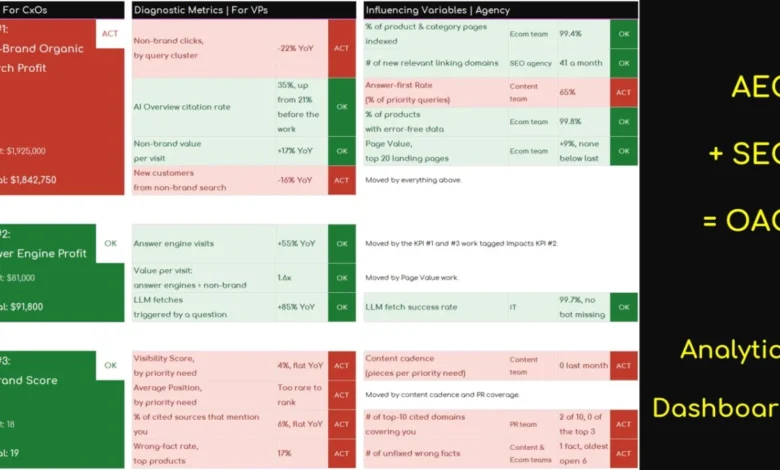
To navigate these analytical limitations, organizations are advised to focus on high-impact Key Performance Indicators that directly correlate with financial health:
Non-Brand Organic Search Profit: This metric isolates revenue and profit derived from unpaid search visits initiated by users who did not explicitly search for the brand name. Because brand-name searches exhibit low incrementality, capturing net-new demand through non-brand optimization remains the true test of organic marketing efficacy.
Answer Engine Profit: Quantifying the commercial return generated from conversational AI referrals helps justify ongoing investments in content diversification, particularly across video, audio, and third-party authority channels.
AI Brand Score: Representing the probabilistic frequency and prominence with which answer engines recommend a brand when queries exclude brand names, this metric serves as the digital equivalent of unaided brand awareness. It measures a brand’s share of voice within an LLM’s recommendation ecosystem.
Implications for Marketing Organizations and Agency Structures
The integration of SEO and AEO under the OAO umbrella carries profound implications for internal marketing teams and external agency partnerships. Historically, SEO practitioners focused heavily on first-party text and image optimization, whereas AEO demands a sophisticated strategy emphasizing third-party validations, multi-format media assets, and technical accessibility for automated web agents.
When organizations maintain siloed structures, critical opportunities are lost. Technical teams may inadvertently block AI crawlers and automated agents due to outdated security configurations, thereby blinding answer engines to relevant product inventory. Unifying these functions under a single leadership framework incentivizes technical compliance, content diversification, and a comprehensive approach to digital visibility.
Furthermore, industry leaders emphasize that proactive adaptation is essential to prevent unexpected financial shocks. As demographic shifts continue and older, high-spending cohorts increasingly adopt conversational discovery tools, brands that fail to optimize for machine recommendation will experience a compounding loss of market share.
By combining strategic foresight with rigorous, data-driven methodologies, enterprises can successfully navigate the transition from keyword dominance to conversational authority. The establishment of Organic Answers Optimization marks a maturing of digital marketing—one where the underlying technology may continuously evolve, but the fundamental objective of capturing human intent remains constant.