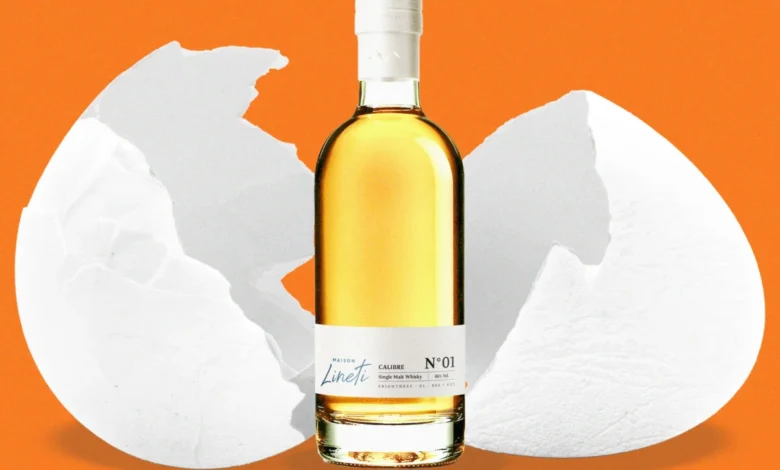
Deep in the heart of Bordeaux, a region synonymous with the ancient, terrestrial elegance of viticulture, a quiet disruption is unfolding within the walls of a facility that eschews traditional grape-pressing for the precision of a laboratory. While the Dordogne valley has been celebrated for its Merlot-dominant blends since the Roman era, Maison Lineti—a boutique distillery located in Les Artigues-de-Lussac—has inverted the regional paradigm. By applying rigorous oenological science and molecular analysis to the production of single malt whisky, the distillery is effectively rewriting the rules of spirit maturation and challenging the centuries-old orthodoxy of the Scotch and Irish whisky industries.
The Genesis of a Scientific Approach
The project began in 2018, founded by Magali Picard, a chemical engineer with a doctorate in oenology from the University of Bordeaux, and her partner Alex Cosculluela. They were joined by Xavier Payan, who brought extensive experience in wine and spirits management. The trio sought to solve a persistent issue in the spirits world: the reliance on long-term barrel aging to mask the deficiencies of a poorly crafted spirit.

During the global lockdowns of 2020 and 2021, while much of the world remained stagnant, Picard leveraged her experience as a project manager at Demptos—a prestigious barrel-maker—to conduct an exhaustive study on fermentation. Her goal was to determine whether a superior flavor profile could be achieved through pre-distillation manipulation rather than relying on the unpredictability of cask aging. She documented her findings in an open-access logbook, creating a transparent, peer-reviewed atmosphere for her experiments that is rarely seen in the secretive world of distillery production.
Rethinking Fermentation: The Winemaking Paradigm
Maison Lineti’s methodology relies on a "wine-first" philosophy. The distillery utilizes seven giant, egg-shaped concrete fermenters that serve as the focal point of their production floor. Unlike stainless steel, which is standard in most distilleries, the thick concrete walls provide superior thermal mass, allowing for the precise temperature control required to manipulate yeast activity. The "egg" geometry, devoid of internal ridges, facilitates a natural convection current, ensuring the wash remains in constant motion.
The process begins with organic French barley, which undergoes a specialized cold-soaking phase to extract lighter, brighter flavor compounds. Fermentation is extended to seven days—more than double the industry standard for traditional Scotch—allowing for complex ester development. Perhaps most controversially to traditionalists, Lineti employs malolactic fermentation. By introducing lactic acid bacteria, they convert sharp, tart malic acids into creamy lactic acids, a technique common in Chardonnay production but largely absent in whisky manufacturing. This, combined with a two-week "lees aging" process where the liquid remains in contact with dead yeast cells, results in a spirit that is remarkably textured and floral before it even touches a barrel.

A Chronology of Innovation and Crisis
The path to the commercial launch of Maison Lineti’s spirits has been characterized by both technological success and financial volatility:
- 2018: Maison Lineti is founded by Picard, Cosculluela, and Payan.
- 2020–2021: Picard conducts large-scale experiments during pandemic lockdowns, digitizing 10,000 lines of data per batch.
- July 2024: The distillery faces liquidation after a primary wine-industry backer withdraws support.
- Late 2024: A new investor, a French entrepreneur from the luxury sector, rescues the company, providing the capital necessary for market entry.
- June 2025: Maison Lineti hosts the prestigious World Whisky Forum, signaling its arrival as a serious contender in the global spirits market.
- September 2025: The first range, consisting of the core "Calibre No1" and two "Complication" limited editions, is released in the UK market.
Economic and Environmental Implications
One of the most compelling arguments for Lineti’s process is the mitigation of the "angel’s share." In traditional whisky production, spirits lose approximately 2 percent of their volume annually to evaporation through the wood of the cask. For a 10-year-old whisky, this requires producers to manufacture 20 percent more liquid than they intend to sell, leading to massive energy and material waste.
By optimizing the wash through scientific intervention, Lineti claims its spirits reach a state of "maturity" in three and a half years that would typically require five to seven years under standard conditions. By reducing the duration of barrel aging, the company not only improves its yield and reduces the angels’ share, but it also drastically lowers the energy footprint required for warehouse storage and temperature regulation.

Industry Reception and the Future of the Spirit
The release of the "Calibre No1" and the "Complication" series has generated significant interest among industry experts. Drinks writer Becky Paskin, a leading authority on global spirits, describes the methodology as "the most innovative thing to happen to whisky in decades." The consensus among those who have tasted the product is that the distillery has established a unique "DNA"—a signature floral undertone that persists regardless of the specific cask influence.
Dave Broom, an award-winning author on the subject of spirits, suggests that the industry is at an inflection point. "In terms of flavor production and the interaction between wood and air at a molecular level, that is innovation," Broom notes. "Maison Lineti is one of the most important distilleries in the world at the moment because they are proving that quality is not purely a function of time."
Data-Driven Scalability
What separates Lineti from craft distilleries that rely on "gut feeling" or traditional recipes is their reliance on raw data. Every batch is tracked via comprehensive Excel documentation that monitors fermentation variables every 20 minutes, including temperature, pump yield, ABV, and distillation speed. This allows Picard and Cosculluela to isolate variables and conduct controlled experiments. If they wish to test a new fermentation strain or a different malolactic technique, they can analyze the resulting data within two weeks—a stark contrast to maturation studies, which require years of patience.

The Road Ahead: Global Expansion
Following its successful UK launch, Maison Lineti is positioning itself for a broader international rollout. The US market, which remains the largest consumer of premium single malt whisky, is currently slated for a 2028 entry. The naming convention of their product line—"Calibre" and "Complication"—draws a clear parallel to the high-end Swiss watchmaking industry, signaling their intent to occupy the luxury, high-complexity tier of the spirits market.
As the industry grapples with the impacts of climate change on traditional grain crops and the rising costs of energy, the Lineti model offers a compelling, if disruptive, alternative. By moving the heavy lifting of flavor development from the cask to the fermenter, they have created a proof of concept for "precision distilling." Whether this approach will be adopted by legacy distilleries remains to be seen; however, the presence of Maison Lineti has undeniably forced a conversation about the limitations of tradition.
The success of the brand rests on the premise that consumers are increasingly seeking transparency and scientific rigor in their luxury goods. As Picard and Cosculluela continue to refine their parameters, they are not merely producing a spirit; they are documenting the evolution of a craft that had remained largely stagnant for centuries. For the global whisky community, the "egg box" in Bordeaux is no longer just an experiment—it is a blueprint for the future.