Navigating the Operational Realities of High-Volume GenAI Publishing on WordPress


The democratization of Generative Artificial Intelligence (GenAI) has fundamentally transformed digital publishing, allowing enterprises and independent creators alike to scale content outputs to unprecedented levels. Recent industry data indicates that human-written and AI-generated articles now occupy a roughly equal share of the modern web. However, while the generation phase has become frictionless, the underlying publishing workflow frequently breaks down when subjected to high-frequency cadences. Unlike traditional publishing pipelines designed for deliberate, human-paced output, automated and high-volume GenAI pipelines introduce unique vulnerabilities—ranging from subtle hallucinations and formatting errors to catastrophic caching and database failures.
To maintain editorial integrity and protect search engine visibility, organizations must pivot from treating content publishing as a purely administrative task to treating it as a rigorous software deployment process. This paradigm shift requires robust hosting infrastructure, strict staging environments, precise user permissions, and programmatic backup protocols.
The Strains of Scaled Output on Infrastructure
Large Language Models (LLMs) and automated generation tools are inherently susceptible to factual inconsistencies, outdated statistics, and contextual errors. When publication volumes accelerate from a handful of articles per week to dozens per day, these errors multiply rapidly. Concurrently, search engine algorithms—such as Google’s continuous core updates and heightened enforcement against "scaled content abuse"—have grown increasingly sophisticated at penalizing unedited, mass-produced material.
These editorial challenges immediately intersect with technical infrastructure. For instance, when an editor identifies an AI-induced error and approves a factual correction, the updated copy must propagate instantly to the live site. If server-side caching mechanisms fail to clear, or if edge-caching layers retain the outdated version, visitors continue to consume erroneous information. Furthermore, if a batch-publishing script corrupts a database or introduces widespread formatting bugs, the absence of an immediate, reliable rollback mechanism leaves web administrators stranded.
Treating Content Like Code: The Necessity of Staging Environments

In software engineering, the principle of staging is non-negotiable. Developers routinely test code changes in an isolated sandbox or staging environment that mirrors production before deploying updates to live users. Yet, historically, content publishing workflows have bypassed this safeguard, pushing newly minted articles straight to live, indexed production environments.
In a high-volume GenAI workflow, skipping the staging phase exposes visitors to unverified formatting, broken shortcodes, and subtle layout anomalies caused by conflicting plugins. Implementing a strict staging protocol provides an identical mirror of the live site where automated outputs can be reviewed, formatted, and tested against active site elements.
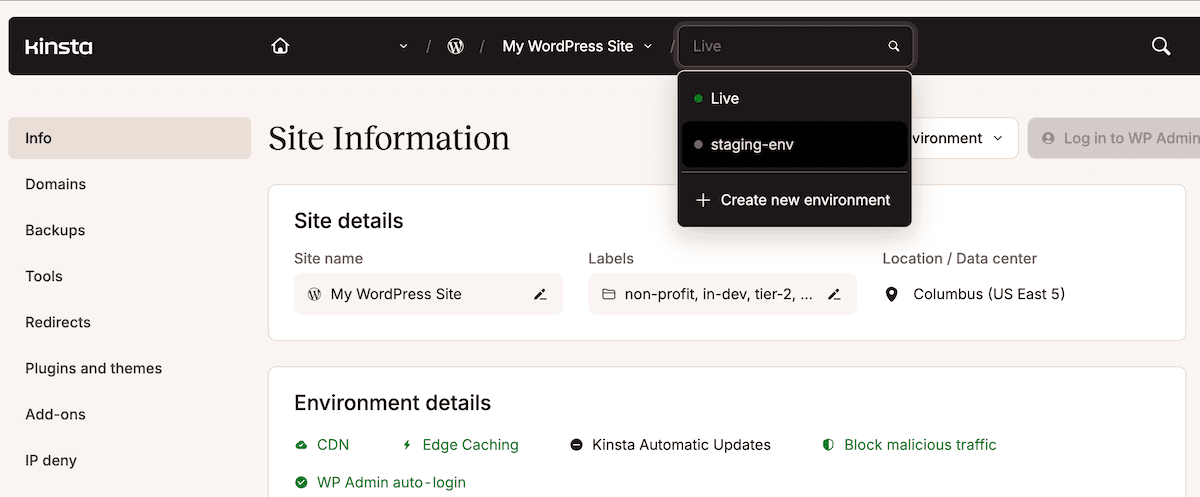
Managed hosting providers have begun adapting to this need by offering rapid staging deployment features. Platforms like Kinsta, for instance, provide native staging environments accessible directly through control dashboards, allowing teams to test database changes and file modifications independently. Crucially, features such as "selective push" enable administrators to deploy specific files or database tables without overwriting concurrent web development work, bridging the gap between editorial updates and technical maintenance.
Enforcing Accountability Through Role-Based Access Control
Even the most sophisticated staging infrastructure fails if internal teams bypass procedural checks. To ensure that content governance is structurally enforced, organizations must implement strict user permissions and multi-tiered access controls.
Standard WordPress user roles often prove insufficient for high-volume AI workflows. By integrating platform-level user management with content management system (CMS) permissions, organizations can restrict who holds the ultimate authority to push content live. For example, copywriters and teams utilizing GenAI prompting tools can be designated with restricted author or developer roles, ensuring that only designated Site Administrators hold the cryptographic keys or administrative permissions required to deploy batches to production.
Additionally, baseline security measures such as mandatory Two-Factor Authentication (2FA) help mitigate the risk of compromised credentials, ensuring that every batch-publishing action or API request originates from a verified source.
Mitigating AI Hallucinations with Strategic Backups
Visual layout errors on a website are immediately obvious, triggering browser warnings or obvious graphical anomalies. In contrast, AI-generated hallucinations—such as fabricated case studies, incorrect product specifications, or obsolete pricing data—frequently evade detection. These errors linger quietly on indexed pages until shared by readers or flagged by disgruntled clients weeks after publication.
When an organization discovers widespread factual discrepancies across dozens of automated posts, manual post-by-post editing becomes inefficient and prone to human oversight. A more reliable remediation strategy involves rolling back the affected environment to a clean, pre-publishing state via comprehensive system backups.
Advanced hosting environments provide multiple backup layers, including automated daily increments, hourly snapshots, and manual tagged backups. Utilizing programmatic interfaces—such as the Kinsta API—allows DevOps and editorial teams to integrate backup creation directly into their deployment scripts. By executing commands such as:
curl -i -X POST
‘https://api.kinsta.com/v2/sites/environments/env_id/manual-backups‘
-H ‘Authorization: Bearer ‘
-H ‘Content-Type: application/json’
-d ‘
"tag": "pre-batch-publish"
‘
teams can automatically tag a stable restoration point immediately prior to launching a high-volume AI content batch. If errors surface downstream, the environment can be restored programmatically within moments, bypassing the need for tedious manual corrections.
The Critical Role of Cache Management in Content Corrections
A persistent frustration in modern web management is the disparity between the backend editor and the frontend user experience. An editor may successfully revise a flawed AI-generated paragraph in the CMS, yet find that the live site stubbornly displays the original, unedited text.
This phenomenon is almost invariably the result of aggressive caching. In high-volume GenAI workflows where human oversight is minimized, relying on assumptions about live updates can severely damage a brand’s credibility and search engine optimization (SEO) standing. Search engine crawlers indexing cached, outdated pages will continue to record flawed data long after the editorial team believes the issue has been resolved.
Consequently, clearing the cache must be codified as an obligatory step at the conclusion of any content correction pipeline. Modern hosting architectures offer granular control over site caches, CDN caches, and edge caching via both dashboard tools and programmatic API endpoints. Automating cache-clearing operations ensures that frontend verification occurs in real-time, aligning the live user experience with the latest database records.
Tracing Accountability via Activity Logs
When errors inevitably infiltrate a high-volume publishing pipeline, diagnosing the root cause can be complex. In environments where multiple authors, automated scripts, and third-party APIs interact simultaneously, determining who—or what—introduced a specific error requires robust auditing capabilities.
Comprehensive activity logs serve as the forensic backbone of a secure publishing workflow. By utilizing administrative dashboards or querying activity log APIs, system administrators can filter actions by user roles, specific API keys, timestamps, and flagged warnings.
const getActivityLogs = async (companyId, category = 'siteActions', limit = 10, offset = 0) =>
  const resp = await fetch(
    `https://api.kinsta.com/v2/company/$companyId/activity-logs?limit=$limit&offset=$offset&category=$category`,
     method: 'GET', headers
  );
  const data = await resp.json();
  return data.company.activity_logs.items;
;
This level of operational transparency allows technical leads to isolate whether an inconsistency stems from a rogue prompt, a misconfigured automation script, or a human error, thereby streamlining troubleshooting and reinforcing accountability across the organization.
Broader Implications and Long-Term Strategy
The advent of accessible Generative AI has permanently lowered the economic barrier to content creation, but it has simultaneously exposed the fragility of traditional publishing governance. Organizations that treat AI-generated content merely as text to be copied and pasted into a CMS risk severe reputational damage, algorithmic penalties from search engines, and operational paralysis when errors require remediation.
By integrating software deployment methodologies—staging environments, strict user permissions, automated programmatic backups, mandatory cache invalidation, and detailed activity auditing—into the content lifecycle, digital publishers can safely harness the velocity of AI. Ultimately, a sustainable publishing pipeline must be robust enough to withstand high-volume output at both ends of the pipeline, ensuring that speed never supersedes accuracy, security, and editorial integrity.