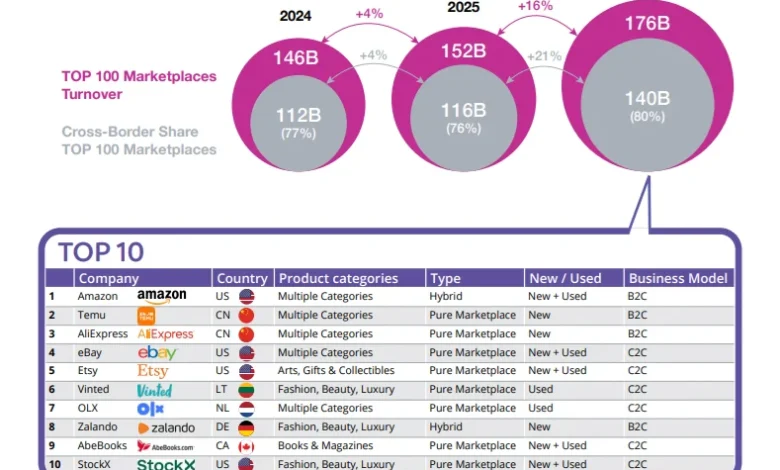
By 2026, the report anticipates that cross-border sales generated by these top 100 players will reach 139.8 billion euros, accounting for nearly 80 percent of their total volume. This shift is not merely a consequence of consumer habit, but a reflection of a strategic pivot by global marketplaces to capture European demand through advanced logistics and localized infrastructure.
The Trajectory of European Marketplace Growth
The growth metrics for the coming years are significant. Total GMV for the top 100 marketplaces is expected to expand by approximately 8 percent in the next calendar year, pushing the total valuation to roughly 190 billion euros. Within that expansion, the cross-border component is forecast to outpace general growth with a 10 percent increase, reaching 154 billion euros. Consequently, the share of cross-border revenue relative to total GMV is expected to reach 81 percent by the end of 2027, signaling that international trade is becoming the primary engine for marketplace sustainability in the region.
This growth is set against a backdrop of increasing regulatory scrutiny and a shifting competitive landscape. As marketplaces scale, they are forced to navigate the complexities of the European Union’s Digital Services Act (DSA) and other regional trade regulations. These legal frameworks aim to standardize consumer protection, data privacy, and environmental standards across all member states, adding layers of operational complexity that favor platforms with the capital to invest in robust compliance infrastructure.
A Chronology of Marketplace Evolution in Europe
The evolution of the European marketplace sector can be segmented into distinct phases. In the early 2010s, the market was characterized by localized, national players who dominated their respective domestic territories. The entry of global giants, led primarily by Amazon, disrupted these traditional retail environments, forcing a consolidation of digital services.
By 2018, the conversation shifted toward "cross-border" as the standard for success. CBCommerce began tracking these trends in their inaugural report, highlighting the inefficiencies in the fragmented European logistics network. Between 2020 and 2022, the COVID-19 pandemic served as a massive catalyst for e-commerce, forcing even the most hesitant consumers to adopt online purchasing habits. This period saw a surge in the adoption of marketplace models, where third-party sellers could access a wider European customer base without the need for physical store footprints in every country.
The current period, from 2024 to 2026, represents the "Era of Consolidation and AI Integration." The focus has moved from simple geographic expansion to the optimization of the user experience through algorithmic product discovery and the integration of social commerce.
Leading Players and the Ranking Methodology
At the pinnacle of the current rankings stand Amazon, Temu, and AliExpress. The inclusion of these three reflects the diverse nature of the European marketplace ecosystem. Amazon continues to leverage its mature logistics network and Prime membership model to maintain its lead. Meanwhile, the rapid rise of Temu and AliExpress underscores the success of direct-to-consumer models from Asia, which utilize aggressive pricing, social media marketing, and sophisticated supply chain efficiencies to penetrate the European market.
The ranking methodology employed by CBCommerce is multi-dimensional. It is not merely based on revenue, but on a holistic assessment of performance metrics:

- Cross-Border Sales: The total volume of transactions occurring outside the marketplace’s country of origin.
- SEO and Organic Reach: The ability of the platform to capture search traffic across multiple languages and regions.
- Geographic Coverage: The breadth of the European market, including the number of countries where the platform is fully operational.
- Website Traffic and Engagement: High-frequency metrics that indicate consumer loyalty and brand penetration.
Technological Drivers: AI and Social Commerce
The rapid shift toward cross-border dominance is heavily supported by advancements in technology. AI-driven product discovery has replaced traditional search bars as the primary tool for conversion. These algorithms allow marketplaces to offer personalized recommendations that transcend language barriers, enabling a seller in Italy to effectively market to a buyer in Sweden.
Furthermore, social commerce—the integration of shopping directly into social media feeds—is blurring the lines between content consumption and purchase intent. Platforms that integrate these features are seeing higher engagement rates among younger demographics, who are increasingly comfortable purchasing from international vendors. This convergence of social media and e-commerce is expected to remain a critical competitive differentiator for the remainder of the decade.
Official Perspectives and Market Implications
While official spokespersons from the major platforms often remain tight-lipped regarding specific regional GMV targets, their investment patterns tell the story. Major international players are pouring billions into European infrastructure, including local fulfillment centers and regional distribution hubs. This strategy is essential to counter the "long-distance" disadvantage, where shipping times and return logistics have historically been the primary pain points for cross-border shoppers.
Market analysts suggest that this fierce competition has significant implications for local European retailers. The "marketplace-first" economy presents both an opportunity and a threat. Small and medium-sized enterprises (SMEs) can now reach millions of customers by listing their products on these top-tier platforms, yet they also face intense price pressure from high-volume international competitors. The result is a polarized retail environment where brands must either differentiate themselves through unique value propositions or leverage the scale of the top 100 platforms to survive.
Regulatory Complexity and the Cost of Doing Business
The report highlights that regulation is no longer a peripheral concern but a core component of business strategy. With the implementation of the Digital Services Act, marketplaces are now held to higher standards regarding the moderation of illegal content, the transparency of algorithmic ranking, and the verification of third-party sellers.
These regulations create a high barrier to entry for new, smaller marketplaces. Established giants have the resources to absorb the costs of compliance, whereas newcomers may struggle to align their operations with the stringent requirements of the European Commission. Consequently, the "Top 100" list is becoming more stable, with fewer new entrants capable of disrupting the established order. The future of European e-commerce will likely be defined by a "winner-take-most" dynamic, where the top 100 platforms consolidate their influence through scale, compliance, and technological superiority.
The Road Ahead: 2027 and Beyond
Looking toward 2027, the outlook remains positive for the digital retail sector, provided that these platforms can navigate the geopolitical and regulatory risks inherent in cross-border trade. The expected 10 percent growth in cross-border GMV is a clear indicator of the resilience of the digital single market.
However, the industry must also contend with rising consumer expectations for sustainability. As European policy moves toward the "Green Deal" and more circular economic models, marketplaces will be increasingly required to provide transparency regarding the carbon footprint of their supply chains and the ethical sourcing of products. This shift will likely necessitate a new wave of innovation, as platforms look for ways to offset the environmental impact of long-distance logistics.
In conclusion, the European marketplace landscape is currently in a state of advanced maturity. The shift toward cross-border dominance is an irreversible trend, driven by a combination of digital infrastructure, AI, and changing consumer behavior. As we move into the latter half of the decade, the primary focus for these top 100 platforms will be on sustaining their growth while adapting to an increasingly complex and regulated environment. For the consumer, this translates into greater choice and convenience, while for the industry, it necessitates a relentless pursuit of efficiency and regulatory excellence to stay ahead in a fiercely competitive, pan-European arena.