Google Analytics Rolls Out Advanced AI, Attribution, and Budgeting Tools to Elevate Enterprise Decision-Making

Over the past year, the development team at Google Analytics (GA) has introduced a robust cluster of advanced features designed to transition enterprise analytics from retrospective reporting to proactive, high-altitude strategic decision-making. These updates arrive at a critical juncture for digital marketers, financial analysts, and corporate leadership teams seeking to harness predictive data for margin expansion rather than simple traffic counting.
Industry analysts note that while traditional web analytics tools have long excelled at explaining historical user behavior—documenting what happened after the fact—the newest iterations of Google Analytics aim to predict and influence future commercial outcomes. By integrating artificial intelligence, cross-channel budgeting models, and refined attribution frameworks, the platform bridges the longstanding gap between tactical marketing metrics and executive-level financial strategy.
Evolution of the Analytics Landscape: From Reporting to Prediction
Historically, digital analysts spent the majority of their time acting as "reporting squirrels," gathering fragmented data points, building manual spreadsheets, and answering ad-hoc queries from senior leadership. The introduction of Google Analytics’ latest capability suite is intended to convert these professionals into "analysis ninjas" capable of engaging directly with Extremely Senior Leaders (ESLs) on strategic resource allocation.
The rollout includes a mix of forward-looking capabilities that begin processing data from the moment of activation, alongside retroactive data harmonization tools designed to clean up decades of messy campaign tagging. Because several of these features do not backfill historical data, digital infrastructure teams have been urged to audit and activate the tools immediately to begin capturing valuable telemetry.
AEO and the Rise of AI Assistant Channels
One of the most significant structural shifts addressed in the recent GA updates is the explosive growth of Answer Engine Optimization (AEO) and Large Language Model (LLM) traffic. As users increasingly rely on AI conversational assistants—such as OpenAI’s ChatGPT, Anthropic’s Claude, Microsoft Copilot, and emerging platforms—traditional search engine optimization (SEO) traffic patterns have experienced measurable compression, with industry models predicting organic search declines between 20% and 30%.
To address this shift, Google Analytics has introduced a default "AI Assistant" channel within its Traffic Acquisition reports. The metric identifies traffic originating from recognized AI conversational tools, setting the medium to ai-assistant without requiring manual regex setup from webmasters.
While initial data indicates that Answer Engine traffic typically accounts for a modest 1% to 5% of total site sessions, commercial performance metrics reveal a vastly higher-value user. Empirical studies published by Adobe and Shopify in early 2026 demonstrate that AI-driven traffic converts up to 42% to 50% better than traditional organic search, features significantly higher average order values (AOV), and generates superior revenue per visit. Consequently, digital strategists emphasize that AEO is fundamentally a margin story rather than a pure volume story, necessitating a reallocation of resources toward content optimized for LLM synthesis and retrieval.
However, data collection nuances remain. Industry observations note that Google currently categorizes traffic from its own AI Overviews and AI Mode directly under traditional Organic Search, potentially masking the true volume of AI-assisted discovery. Furthermore, traffic originating from mobile and desktop applications often defaults to "Direct" due to missing referrer headers. Analytics professionals are advised to supplement default GA reports with custom channel groupings to capture the full scope of dark LLM traffic.
Advanced Conversion Attribution and Multi-Touch Realities
The debate over marketing accountability has long centered on the limitations of last-click attribution, which frequently undervalues upper-funnel and mid-funnel acquisition channels. Google Analytics has revived and refined Assisted Conversions within its Advertising and Conversion Attribution Analysis sections, offering a clearer picture of how individual media channels influence the broader consumer journey.
By utilizing multi-touch attribution (MTA) frameworks within GA, organizations can evaluate channels not merely by direct conversions closed, but by their frequency of appearance along multi-touch conversion paths. For instance, a paid social channel that appears to drive a negligible number of last-click conversions may actually assist upwards of 30% to 50% of total conversions.
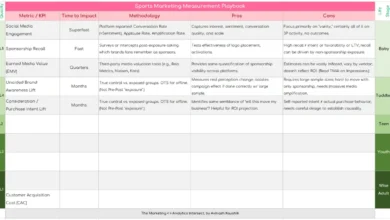
Refined funnel analysis tools further categorize touchpoints into early, mid, and late stages, alongside single-touch paths. This granular visibility allows marketing directors to identify undervalued prospecting channels and prevent premature budget cuts. Nevertheless, analytics experts caution that attribution is not synonymous with incrementality, and users must pair multi-touch analytics with Marketing Mix Modeling (MMM) and Brand Lift Studies (BLS) to measure true business lift accurately.
Cross-Channel Budgeting and Predictive Scenario Planning
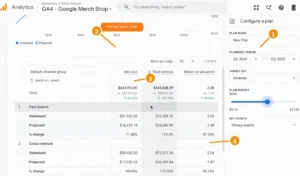
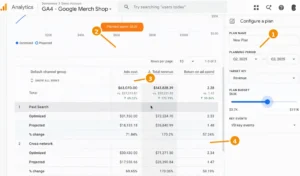
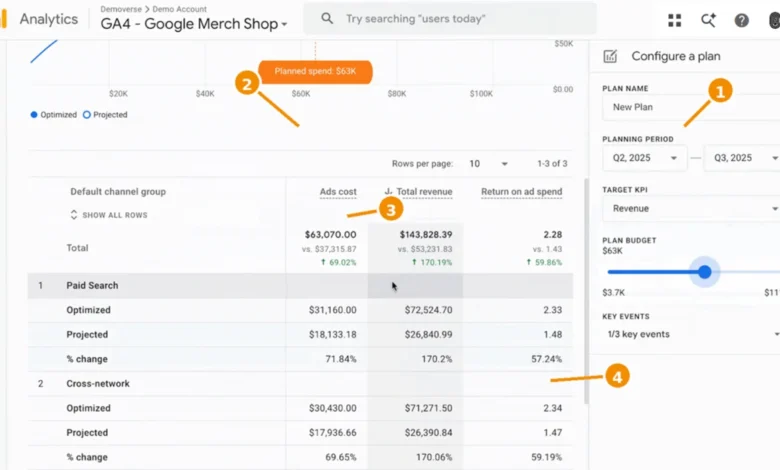
Bridging the gap between statistical insight and executive decision-making requires predictive financial modeling. The newly deployed Cross-Channel Budgeting tools within Google Analytics leverage historical performance data, seasonality, and algorithmic forecasting to help organizations answer complex resource allocation questions.
The system provides two primary planning instruments: Project Plans, which track spending pacing against expected outcomes, and Scenario Plans, which model the financial impact of shifting capital between disparate channels, such as reallocating funds from paid social to paid search. These models expose diminishing return curves, helping finance and marketing teams discover whether current channel splits genuinely impact revenue or if media channels are largely substitutable.
For these predictive models to function with maximum efficacy, organizations must feed complete campaign cost data into the platform. Google has streamlined this process by introducing native data import capabilities for major ad networks, including Meta and TikTok. Without verified cost inputs, predictive budgeting models lose predictive accuracy.
Conversational Analysis via AI Advisors and MCP Integration
To democratize data access for non-technical executives, Google Analytics has introduced "Ask Advisor," a conversational analytics interface accessible via the platform’s top navigation bar. The tool allows users to pose complex natural-language queries—such as analyzing traffic, pricing, and promotional shifts for top revenue-generating products over a rolling 30-day window—without manually navigating multiple reporting views.
For advanced enterprise use cases, Google has also released a first-party Model Context Protocol (MCP) server. This open-source connector allows technical teams to link their Google Analytics data directly with approved enterprise Large Language Models, such as ChatGPT or Claude. By connecting GA data to external LLMs, organizations can cross-reference web analytics with offline sales data, media planning calendars, and competitor content strategies in a single analytical pass.
Retrogressive Cleanup: Source Group Consolidation and LTV Percentiles
Rounding out the recent updates are two foundational administrative features designed to simplify data hygiene. Source Group Consolidation automatically aggregates fragmented traffic sources—such as variations of Meta, Facebook, and Instagram traffic—into cohesive parent channels retroactively, eliminating the need for complex regular expression rules.
Additionally, the integration of Lifetime Value (LTV) Percentile fields allows marketers to identify top-tier users based on predicted long-term value without executing complex SQL queries in BigQuery. By isolating the top 5% of customers responsible for an outsized share of enterprise profit, organizations can build custom audience segments in Google Ads to acquire statistically similar high-value prospects.
Broader Implications and Strategic Outlook
Industry observers view the cumulative rollout of these features as a pivotal evolution in digital measurement. By combining AI-driven traffic tracking, predictive budgeting, natural-language interfaces, and advanced attribution, Google Analytics has repositioned itself from a retroactive diagnostic scoreboard into an active engine for corporate growth and resource optimization.
As enterprises adopt these capabilities, the role of the digital analyst is expected to elevate correspondingly, shifting away from manual data extraction toward high-level strategic orchestration and cross-departmental leadership.