The Evolving Landscape of Community Building on WordPress: A 2026 Comparative Analysis of BuddyPress, BuddyBoss, and PeepSo.

Building robust online communities on the WordPress platform has undergone a significant transformation, moving from a singular, dominant solution to a diversified ecosystem offering specialized tools. In the early days, creating a social network on WordPress was largely synonymous with BuddyPress, often paired with bbPress for forum functionality, forming a de facto standard. However, the digital landscape of 2026 presents a far more complex and feature-rich environment, with three names consistently emerging in discussions about serious community development: BuddyPress, BuddyBoss, and PeepSo. This analysis delves into the current state of these platforms, examining their architectural foundations, feature sets, pricing structures, and strategic implications for various types of online communities, with all cost projections reflecting 2026 figures.
A Historical Perspective: The Shifting Sands of WordPress Community Platforms
The journey of community building on WordPress began with BuddyPress, an open-source project launched in 2009. It quickly became the go-to solution for developers and site owners seeking to add social networking features like member profiles, activity streams, and groups to their WordPress installations. Its open-source nature fostered a vibrant, albeit often fragmented, ecosystem of add-ons and themes. For over a decade, BuddyPress, often combined with bbPress for forums, provided the bedrock for countless online communities, from niche interest groups to internal company intranets.
However, as the demands for online communities grew more sophisticated, and commercial solutions emerged with dedicated development teams, the landscape began to shift. The inherent challenges of a volunteer-led open-source project, such as slower development cycles and the reliance on third-party developers for advanced features, became more apparent. This evolution paved the way for more integrated and commercially supported alternatives.
One of the most significant shifts occurred in 2019 when the BuddyBoss team, which had initially built themes and add-ons for BuddyPress, made a strategic decision to fork the BuddyPress and bbPress codebases. This led to the creation of the BuddyBoss Platform, a standalone product that no longer required BuddyPress or bbPress installations. This fork marked a clear divergence, creating two distinct paths for developers: the open-source, community-driven BuddyPress, and the commercially developed, integrated BuddyBoss. Simultaneously, PeepSo entered the market with a completely independent architecture, built from the ground up, aiming for a modern, cohesive experience without the legacy constraints of older systems.
The Contenders: An Overview of Architectural Philosophies
Understanding the core philosophy behind each platform is crucial to appreciating their strengths and weaknesses.
- BuddyPress: Remains a free, open-source project, maintained by the WordPress community. Its strength lies in its modularity and flexibility, offering a lightweight core that can be extended with various plugins. It appeals to developers who desire maximum control and are comfortable assembling a bespoke feature set.
- BuddyBoss: Emerged as a commercial, premium solution, having forked from BuddyPress and bbPress. It emphasizes a polished, integrated user experience, particularly strong in its bundled features and deep integrations with Learning Management Systems (LMS). It targets users seeking an "out-of-the-box" comprehensive solution, often for educational or membership sites.
- PeepSo: Developed as an independent, commercial plugin from scratch. Its architectural independence means it carries no legacy code from BuddyPress, allowing for a modern data model and a highly cohesive user experience. PeepSo aims to provide a robust, all-in-one community solution with a focus on ease of use and a tightly controlled ecosystem.
This fundamental difference in genesis and ongoing development strategy underpins their respective feature sets, pricing, and long-term implications for site owners.
Deep Dive: BuddyPress – The Open-Source Pioneer
BuddyPress continues to serve a significant segment of the WordPress community, boasting over 100,000 active installations. Its enduring appeal lies in its fundamental principles: it is free, open-source, and entirely maintained by a dedicated community of volunteers. This ensures no vendor lock-in, providing site owners with complete control over their plugin stack. Every component within BuddyPress is optional, allowing for highly customized and lightweight installations tailored to specific needs.
For developers, BuddyPress represents a credible foundation. Its transparent codebase allows for deep customization, and its long history means there’s a wealth of documentation and community support available through forums. For projects with dedicated technical resources and a clear vision for a custom community, BuddyPress offers unparalleled flexibility. A basic BuddyPress community site can be set up relatively quickly, as demonstrated by various tutorials available online.
However, BuddyPress’s volunteer-led nature also presents its primary challenges. Development cycles are inherently slower, with major releases occurring less frequently compared to commercial alternatives. This can lead to a lag in incorporating modern social networking features that users have come to expect, such as native media uploads (photos, videos), rich link previews, or follow relationships. These often require third-party add-ons, which can introduce compatibility issues, maintenance overhead, and a fragmented user experience. The administrative and front-end interfaces, while functional, can appear dated compared to the sleek designs of newer platforms. The long-term sustainability of volunteer-led projects in a rapidly evolving tech landscape remains a recurring topic within the BuddyPress contributor meetings.
BuddyPress is best suited for projects where technical expertise is readily available, budget constraints are paramount, and the desire for absolute control over every aspect of the community platform outweighs the need for out-of-the-box polish and rapid feature deployment. It is less ideal for non-technical users seeking a quick, modern, and comprehensive solution.
Deep Dive: BuddyBoss – The Integrated Premium Solution
BuddyBoss represents a paradigm shift from the open-source model, offering a highly polished, integrated experience. Following its 2019 fork from BuddyPress and bbPress, the BuddyBoss Platform has evolved into a comprehensive community solution with a distinct focus on professional learning and membership sites. Its administrative interface is unified, and its front-end design is modern and intuitive, providing an experience akin to contemporary social networks.
A significant differentiator for BuddyBoss is its deep integration with popular Learning Management Systems (LMS) such as LearnDash, Tutor LMS, LifterLMS, and MemberPress. For course creators and educational institutions, BuddyBoss streamlines the process of embedding community features directly within the learning environment, fostering a cohesive experience where curriculum and social interaction reside in the same UI. This makes it an opinionated but highly effective choice for building engaging online academies with integrated community layers.
Another key offering is its companion mobile application. Recognizing the increasing importance of mobile engagement, BuddyBoss has heavily invested in native iOS and Android apps. These branded mobile applications are crucial for communities that rely on push notifications, high user retention, and on-the-go access, such as fitness communities, cohort-based courses, or high-engagement membership sites. The app is offered as a separate, yearly product, reflecting its premium nature and the significant development resources required.
However, the comprehensive nature and premium features of BuddyBoss come with a higher cost of ownership. The Pro plan, which bundles the premium BuddyBoss Theme with Platform Pro, starts at $299 per year (launch pricing, renewing at $399). The Plus plan, adding gamification and engagement tools, is $349 per year (renewing at $599). Should a project require the mobile app, the cost escalates significantly, with the App Lite Edition adding $948 per year and the App Full Edition costing $2,148 per year. A fully-featured BuddyBoss build with the Plus plan and App Full Edition could reach approximately $2,497 per year, excluding hosting and any LMS licenses.

Vendor lock-in is another consideration. While BuddyBoss asserts compatibility with many BuddyPress add-ons, six years of independent development have naturally reduced real-world compatibility. The platform is optimized for the BuddyBoss Theme, making transitions to other themes or platforms potentially complex and costly. BuddyBoss is ideal for well-funded course platforms, agency-built community projects, and operators prioritizing a native mobile app and deep LMS integration. It is less suitable for budget-constrained projects or those simply seeking a lightweight community layer on an existing content site.
Deep Dive: PeepSo – The Cohesive Independent Alternative
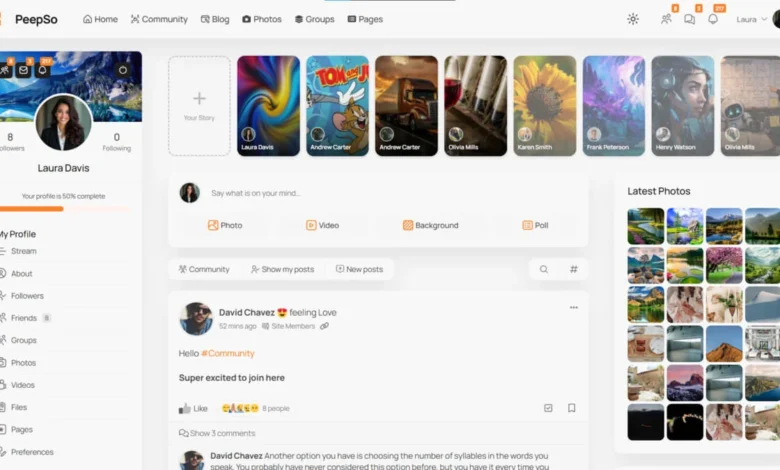
PeepSo distinguishes itself through its independent architecture, having been built from the ground up without relying on pre-existing solutions like BuddyPress. This architectural freedom means PeepSo operates with its own modern data model, activity stream, user profiles, and messaging system, unburdened by legacy code or database structures dating back to BuddyPress’s 2009 release. This approach enables a more cohesive, optimized, and consistently updated product.
PeepSo is distributed directly from peepso.com, rather than the WordPress.org plugin directory, which means its adoption figures are not publicly reflected in the same way as BuddyPress. However, its free core plugin offers substantial basic community functionality, with paid tiers unlocking a full suite of advanced features. The Community Bundle is priced at $124.50 for the first year (renewing at $249), while the Ultimate Bundle, providing full feature parity, costs $249.50 in year one (renewing at $499).
A notable aspect of PeepSo is its native real-time chat, a feature often lauded even by competitors. If immediate, member-to-member communication is a core requirement for a community, PeepSo offers a well-engineered and integrated solution. The platform also includes a Photos plugin in its Community Bundle and a unique "Stories" plugin (part of the Ultimate Bundle), offering Instagram-style ephemeral posts – a content format not natively offered by BuddyBoss or BuddyPress.
PeepSo also provides a bespoke white-label mobile app option, available as a separate subscription or bundled into its comprehensive Power Suite. These apps are fully customizable with the client’s branding and are handled by PeepSo for submission and deployment to the Apple App Store and Google Play Store. For clients seeking a truly hands-off, all-in-one solution, the PeepSo Power Suite bundles the plugin, mobile app, premium hosting, updates, and maintenance into a single managed package, with pricing starting at $7,000+ per year. This caters to operators who prefer to outsource the entire technical layer.
The primary limitation of PeepSo is its comparatively smaller third-party ecosystem. While this means fewer extensions from outside developers, it also implies a more controlled and generally more reliable set of integrations. For projects requiring highly niche integrations not supported by PeepSo or its existing add-ons, custom development might be necessary. However, for most content-led sites adding a community layer, the existing feature set and integrations are typically sufficient.
PeepSo is an excellent fit for publishers, content businesses, and creators looking to integrate a robust community layer into an existing audience. Its focus on product cohesion, modern features, and competitive pricing make it a strong contender, particularly for those for whom total annual spend is a significant consideration. The Power Suite offers an enterprise-grade managed solution for clients who prioritize convenience and reliability above all else.
Key Differentiators: A Feature-by-Feature Analysis
While all three platforms provide core community functionalities like activity feeds, member profiles, groups, private messaging, and notifications, their implementations and native inclusions vary significantly. The "meaningful differences" lie in what comes bundled versus what requires additional effort or third-party solutions.
-
Native Media (Photos, Videos, Documents):
- BuddyBoss: Offers the strongest out-of-the-box experience, handling native uploads of photos, videos, and documents within groups, profiles, and activity feeds.
- PeepSo: Includes a dedicated Photos plugin within its Community Bundle, and the Ultimate Bundle adds a "Stories" plugin for ephemeral content, providing robust media capabilities as add-ons.
- BuddyPress: Lacks native media support beyond basic text and profile photos, requiring third-party add-ons which can lead to a fragmented experience and inconsistent maintenance.
-
Native Forums:
- BuddyBoss: Features a deeply integrated, forked version of bbPress, seamlessly tying forums into groups, profiles, and activity streams. This offers a unified forum experience.
- BuddyPress: Relies on a separate bbPress plugin installation. While functional, the integration is less cohesive, with a visible separation between the two plugins.
- PeepSo: Does not natively support forums but offers a workable third-party integration with wpForo via Wbcom Designs, though this is not as deeply integrated as BuddyBoss’s solution.
-
Real-time Chat:
- PeepSo: Excels here with genuinely well-engineered real-time chat built into its core product, offering a significant advantage for communities where instant member-to-member communication is critical.
- BuddyBoss: Provides modern private messaging that mimics contemporary social networks, offering a strong communication tool that is sufficient for most communities, though not strictly "real-time chat" in the same vein as PeepSo.
- BuddyPress: Includes basic, functional messaging, but it lacks the modern interface and real-time capabilities of its commercial counterparts.
-
LMS Integration Depth:
- BuddyBoss: Offers the deepest integrations with major LMS platforms (LearnDash, Tutor LMS, LifterLMS, MemberPress), rendering course content directly within the BuddyBoss UI, fostering a truly unified learning and community experience. This is a primary draw for educational platforms.
- PeepSo: Integrates effectively with LearnDash and Tutor LMS, positioning the community alongside the course area. This works well for creators seeking a complementary community layer without the deep intertwining of BuddyBoss.
- BuddyPress: Requires bridge plugins for LMS integration, leading to a more fragmented experience that demands technical proficiency to assemble and maintain.
-
Gamification, Moderation, and Mobile App:
- BuddyBoss: Bundles GamiPress on its Plus plan for gamification, offers comprehensive native moderation tools (block, report, suspend), and provides a separate native iOS and Android mobile app.
- PeepSo: Includes native moderation, integrates with GamiPress for gamification, and offers a bespoke white-label mobile app as a separate subscription or within the Power Suite.
- BuddyPress: Relies entirely on third-party plugins for gamification and moderation, and lacks any first-party mobile app options, requiring significant assembly work.
This pattern reveals a consistent trend: BuddyBoss bundles the most features natively, justifying its premium price. PeepSo bundles less than BuddyBoss but significantly more than BuddyPress, with a distinct advantage in real-time chat. BuddyPress, by design, remains the lightest, requiring users to assemble additional features independently. The choice among these approaches ultimately depends on the project’s specific needs and the available technical resources.
The Ecosystem Question: Quantity Versus Quality
The size and reliability of a platform’s plugin ecosystem are critical considerations. Both BuddyPress and BuddyBoss often highlight their extensive third-party add-on ecosystems as a key selling point. While true in terms of sheer numbers, this quantity does not always equate to long-term reliability or security.
A significant portion of BuddyPress and even some BuddyBoss-compatible add-ons are either lightly maintained, effectively abandoned, or only tested against outdated WordPress versions. For hobby projects, this might be an acceptable risk. However, for businesses relying on their community for engagement, retention, and revenue, such vulnerabilities can be detrimental. Compatibility issues following core WordPress updates, unaddressed security flaws, and features that cease to function can quickly erode a business’s operational stability and user trust.

PeepSo, by contrast, operates with a smaller, more controlled ecosystem. While this means fewer third-party extensions, the ones that exist are typically more centrally maintained and developed by PeepSo itself or trusted partners. This unified codebase from a single vendor, coupled with centrally maintained integrations, translates into greater predictability and reliability over time. For businesses prioritizing stability and a predictable update path over a vast, potentially unreliable array of options, PeepSo’s approach presents a compelling asset. The choice here hinges on whether a site needs a niche, obscure integration (favoring BuddyPress’s wider universe) or robust, dependable performance over several years (favoring PeepSo’s curated ecosystem).
Total Cost of Ownership: Beyond the Sticker Price
Evaluating the true cost of a community platform requires looking beyond initial sticker prices and considering the three-year total, accounting for launch pricing, standard renewal rates, and the inclusion of necessary add-ons and services.
- BuddyPress: While free at the plugin level, a "real-world" BuddyPress build typically necessitates purchasing two to three premium add-ons to fill feature gaps (e.g., media, advanced moderation) and a community-compatible theme. This usually results in an annual spend of $200–$500, leading to a 3-year total of $600–$1,500, plus separate hosting costs.
- BuddyBoss:
- Pro Plan (Theme + Platform Pro): $299 in year one, renewing at $399. 3-year total: $1,097.
- Plus Plan (Pro + Engagement Tools): $349 in year one, renewing at $599. 3-year total: $1,547.
- Plus Plan + App Full Edition: $2,497 in year one, then $2,747 for years two and three. 3-year total: $7,991.
- BuddyBoss also offers a "Done For You Bundle" at $4,999 in year one, which includes Theme, Platform Pro, App Full Edition, and implementation services. All BuddyBoss pricing is exclusive of hosting.
- PeepSo:
- Community Bundle: $124.50 in year one, renewing at $249. 3-year total: $622.50.
- Ultimate Bundle: $249.50 in year one, renewing at $499. 3-year total: $1,247.50.
- PeepSo’s standalone bespoke app subscription is priced privately.
- PeepSo Power Suite: This fully managed package, bundling the plugin, mobile app, and premium managed hosting, starts at $7,000+ per year. This tier often comes in below an equivalent BuddyBoss-plus-App-plus-managed-hosting stack for comparable feature parity.
Across comparable tiers, PeepSo generally presents a more affordable option. The Community Bundle is less expensive than BuddyBoss Pro, and the Ultimate Bundle aligns closely with BuddyBoss Plus but often includes more features. The Power Suite, while a significant investment, consolidates multiple services, offering a cost-effective alternative to assembling a similar stack with BuddyBoss and external hosting/app services. For projects where budget is a strict constraint, PeepSo’s pricing model offers a defining advantage.
Strategic Considerations: Vendor Relationships and Development Pace
Beyond features and cost, the strategic implications of vendor relationships and development velocity are crucial for long-term project success.
-
Vendor Relationships:
- BuddyPress: Involves the most fragmented vendor relationships. The core is free, but themes, forums (bbPress), media support, gamification, and other crucial elements often come from separate developers. This means juggling multiple renewal cycles and support channels.
- BuddyBoss: Narrows this to two or three vendors. The Theme and Platform Pro are bundled, and LMS integrations are built-in. However, the mobile app is a separate yearly subscription, and hosting remains the client’s responsibility, still requiring management of multiple renewals.
- PeepSo Power Suite: Consolidates everything into a single vendor relationship: plugin, app, hosting, updates, and maintenance. The standard PeepSo plugin, without Power Suite, is closer to BuddyBoss in vendor count, with core and add-ons from one source, plus optional separate app and hosting.
-
Plugin Ecosystem Reliability:
- BuddyPress: Offers the largest third-party add-on universe due to its longevity. However, this comes with the caveat that many add-ons are poorly maintained or abandoned, posing significant risks to reliability and security.
- BuddyBoss: Sits in the middle. Its third-party add-on ecosystem is smaller than BuddyPress’s, especially post-fork, but its comprehensive first-party feature set reduces the need for external plugins.
- PeepSo: Has the smallest but arguably most reliable add-on universe. Fewer abandoned add-ons, a unified codebase, and centrally maintained integrations lead to more predictable and dependable behavior.
-
Development Pace:
- BuddyPress: The slowest-moving due to its volunteer-led nature. Major releases are infrequent, prioritizing stability and openness over rapid feature deployment. Modern community features tend to arrive late or via third-party solutions.
- BuddyBoss: Moves the fastest, driven by a dedicated paid product team. Aggressive feature releases and new capabilities are introduced throughout the year. This pace, however, reinforces lock-in to the BuddyBoss ecosystem and theme, and its renewal pricing reflects this continuous development.
- PeepSo: Maintains a steady and predictable release schedule, with updates typically every few weeks, as evidenced by its changelog. Its focused product surface area and unified nature make updates and support more streamlined than BuddyPress’s fragmented model.
Verdict: Which Community Plugin Fits Your Site?
The ultimate choice among BuddyPress, BuddyBoss, and PeepSo is less about a simple feature checklist and more about aligning with a project’s core objectives, available resources, and tolerance for complexity.
-
BuddyPress is the logical choice for projects with a dedicated developer or technical team capable of assembling, customizing, and maintaining a stack of plugins. Its appeal lies in its free, open-source foundation, offering complete control and avoiding vendor lock-in. It suits highly bespoke projects where specific, granular control is paramount, and the project team is comfortable with the assembly and ongoing maintenance effort. It is not recommended for non-technical users or projects requiring rapid deployment and out-of-the-box polish.
-
BuddyBoss is ideal for course platforms requiring deep integration with Learning Management Systems like LearnDash, Tutor LMS, or LifterLMS. It is also the go-to solution for communities where a branded native mobile app is a central component of the engagement strategy. While it demands a higher budget to cover the premium theme, platform, and app subscriptions, it delivers a highly polished, opinionated, and quickly shippable experience from day one, making it a strong choice for agency-built projects and well-funded membership sites.
-
PeepSo best serves publishers, content businesses, and creator-led sites looking to add a robust community layer to an existing audience. Its standalone architecture, focused product development, and smaller but more centrally maintained ecosystem contribute to a reliable and cohesive user experience. For projects with real budget constraints seeking an affordable yet feature-rich option across comparable tiers, PeepSo is highly competitive. Its strong native real-time chat and unique "Stories" feature offer distinct advantages for certain types of communities.
-
PeepSo Power Suite stands as a distinct offering for operators who desire a single vendor to manage the entire technical stack: plugin, branded mobile app, and premium managed hosting. This enterprise-grade solution caters to those who prioritize ultimate convenience, reliability, and peace of mind, preferring to offload all technical management and renewal cycles to a single, trusted provider.
The Decision Behind the Decision
Ultimately, the choice among these three powerful WordPress community builders transcends mere feature comparisons. It boils down to a strategic decision about trade-offs and priorities. The user who opts for BuddyPress prioritizes openness, ownership, and maximum flexibility. The user who chooses BuddyBoss values polish, deep integration with learning platforms, and the power of a native mobile application. The user who selects PeepSo seeks product cohesion, a focused feature set, and a reliable, often more affordable, managed ecosystem. None of these choices are inherently "wrong"; they are simply different answers to varying project requirements and business philosophies. The most suitable plugin is the one that most effectively addresses the specific questions and challenges posed by the project at hand.