The Architecture Behind Trionn: Coordinating GSAP, Three.js, Lenis, and Web Audio Demo

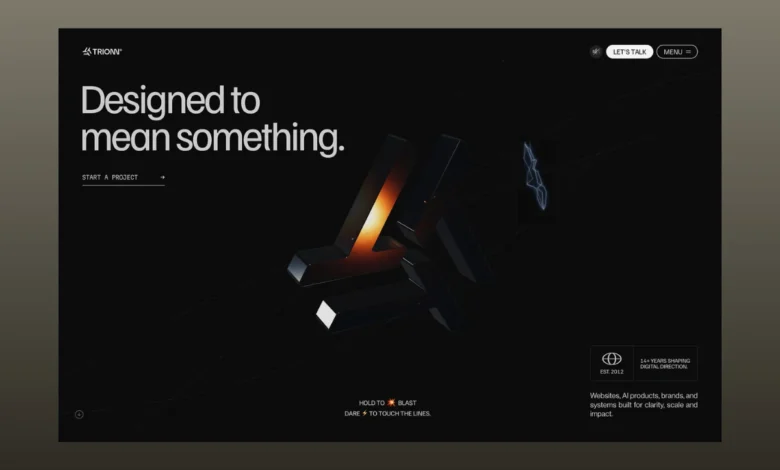
The digital landscape has witnessed a significant shift toward high-performance, immersive environments that challenge the traditional boundaries between web design and software engineering. Trionn, a studio website developed over a rigorous four-month production cycle, serves as a benchmark for this evolution, treating animation, WebGL rendering, and interactive audio as a singular, unified system. Unlike conventional web builds where visual effects are often treated as tertiary layers, the architecture behind Trionn was conceived as a holistic framework where every interaction is synchronized through a centralized state management system. By coordinating industry-standard tools such as the GreenSock Animation Platform (GSAP), Three.js, Lenis, and the Web Audio API, the development team has created a responsive digital experience that balances creative ambition with the technical constraints of modern hardware.
The Evolution of Creative Development: Context and Background
In the contemporary web development industry, the "studio website" has transitioned from a simple portfolio into a high-stakes demonstration of technical prowess. For Trionn, the project was not merely about displaying past work but about exploring the limits of browser-based interaction. The project emerged during a period where users increasingly expect seamless transitions and "app-like" fluidity on the web. To achieve this, the developers moved away from modular, isolated features in favor of a connected animation framework.
The project’s significance is underscored by its widespread recognition within the international design community. Following its launch, the site secured accolades from prestigious bodies including the FWA, GSAP, Orpetron, CSS Design Awards, and CSS Winner. These awards reflect a broader industry trend: the prioritization of performance-oriented "creative coding" that does not sacrifice accessibility or load times for visual spectacle.
Chronology of Development: From Concept to Optimization
The creation of Trionn followed a structured four-month timeline, characterized by iterative prototyping and a focus on solving the inherent conflict between heavy WebGL rendering and smooth scroll performance.
- Phase One: Conceptualization and Stack Selection (Month 1): The team evaluated various technologies, ultimately selecting a stack that offered the highest degree of control. While React-based abstractions like React Three Fiber are popular, the team opted for raw Three.js to maintain direct control over the render loop and resource management.
- Phase Two: Building the Animation Framework (Month 2): GSAP was established as the central "brain" of the site. This phase involved creating reusable components like
BlurTextRevealand integratinguseGSAPfor efficient lifecycle management within the Next.js environment. - Phase Three: Interactive Systems and Audio Synthesis (Month 3): The development of the "Hold-to-Blast" hero interaction and the Web Audio API integration took center stage. This period focused on the "feel" of the site—ensuring that haptic-like visual feedback was perfectly paired with real-time synthesized sound.
- Phase Four: Performance Tuning and Launch (Month 4): The final month was dedicated to optimization. Techniques such as
requestIdleCallbackfor non-critical assets, image decoding viaimg.decode(), and GPU-layer management were implemented to ensure the site remained performant across a wide range of devices.
The Technical Backbone: Centralizing Animation and Scroll
At the core of Trionn’s architecture is a sophisticated synchronization layer. GSAP serves as the primary driver for page transitions, scroll-driven sequences, and component-level animations. By utilizing gsap.matchMedia(), the developers ensured that desktop and mobile experiences remained distinct, with logic specifically tailored to the hardware capabilities of each platform.
Scroll management was handled via Lenis, a smooth-scrolling library that was integrated directly into the gsap.ticker. This integration is critical for maintaining "scroll-jacking" parity; it ensures that ScrollTrigger-based animations remain perfectly in sync with the user’s physical input. For text-heavy sections, the team developed a custom BlurTextReveal component utilizing the SplitText plugin. This component manages character-, word-, and line-based animations while automatically handling GPU layer cleanup to prevent memory leaks during long browsing sessions.
Detailed Analysis of Interactive Sections
The Hero System and State-Driven Interactions
The hero section is perhaps the most technically dense portion of the site. It utilizes a shared state to bridge the gap between the DOM and the WebGL canvas. The central "brand symbol" in the Three.js scene responds to mouse movement through raycasting, which detects which specific panel of the 3D geometry is being hovered.
A unique feature of this section is the "Hold-to-Blast" interaction. By clicking and holding, users trigger a multi-stage sequence: a charge-up phase characterized by CSS-driven vibrations in the surrounding UI, followed by a deterministic explosion of the 3D model. This is driven by a single explodeAmt value, allowing the transition from idle to explosion to feel fluid regardless of the user’s scroll position or previous mouse interactions.
The Services Sequence: High-Volume Asset Management
The "Services" section utilizes a 371-frame WebP image sequence to create a cinematic scroll-driven background. To manage the performance overhead of such a large asset pool, the team implemented a "chunked" loading strategy. Frames are preloaded in batches of 20 during idle browser time. By updating the src of a standard <img> tag and utilizing img.decode(), the site avoids the "jank" often associated with large canvas-based video players, ensuring a smooth 60-FPS scrubbing experience.
Procedural Geometry in the Dribbble Helix
The Dribbble Helix Gallery demonstrates the power of parametric equations in web design. Rather than loading a heavy 3D model, the helix structure is generated mathematically at runtime. Each card in the gallery is a single mesh that is deformed via a vertex shader to follow the curve of the helix. To further optimize the experience, the fragment shader handles rounded corners procedurally, avoiding the need for transparent alpha-map textures which can be taxing on GPU memory.
Web Audio: A Shift from Samples to Synthesis
One of the most innovative aspects of Trionn is its approach to sound. While many interactive sites rely on pre-recorded MP3 or WAV files, Trionn utilizes the Web Audio API to synthesize sounds in real time. In the footer section, the SVG wordmark behaves like a set of plucked guitar strings.
When a user "plucks" a letter, the system triggers three slightly detuned sine-wave oscillators and a feedback delay loop. This creates a "flute-like" sound that is unique to the speed and intensity of the user’s interaction. Furthermore, the site’s "Footer Fog" is audio-reactive; it utilizes an AnalyserNode to read frequency data from the synthesized pluck sounds, causing the visual smoke (rendered via Fractal Brownian Motion in a fragment shader) to morph in direct response to the audio.
Performance Metrics and Optimization Strategies
The complexity of Trionn necessitated a rigorous approach to performance. Supporting data from the development process indicates several key strategies used to maintain stability:
- GPU Management: The use of
will-change: filter, opacitywas strictly limited to active animation windows to prevent excessive GPU memory consumption. - Scene Warm-ups: The Dribbble Helix section includes a "warm-up" phase where shaders are compiled and textures are uploaded to the GPU before the section enters the viewport. This prevents the "initial frame drop" common in WebGL-heavy sites.
- Batched Loading: Non-critical assets are deferred using
requestIdleCallback, ensuring that the "Time to Interactive" (TTI) metric remains low for the initial hero section.
Broader Impact and Industry Implications
The architecture of Trionn represents a significant milestone for creative development. By proving that complex WebGL scenes, real-time audio synthesis, and intricate scroll sequences can coexist without compromising performance, the project sets a new standard for studio portfolios.
Industry analysts suggest that the "Trionn model"—where different technical layers (DOM, WebGL, Audio) share a centralized state—is likely to become the blueprint for future high-end digital brand experiences. As browsers continue to improve their handling of the Web Audio API and offscreen canvas rendering, the techniques pioneered here will likely filter down into more mainstream e-commerce and corporate environments.
In conclusion, the success of Trionn lies not in any single effect, but in the meticulous coordination of its various systems. The project demonstrates that when developers treat the browser as a holistic performance environment rather than a collection of isolated parts, the result is a digital experience that feels alive, responsive, and profoundly immersive. The integration of GSAP for logic, Three.js for rendering, and Web Audio for atmosphere creates a trifecta of interaction that defines the current state of the art in web development.