DiffusionGemma: Exploring the Paradigm Shift from Autoregressive to Diffusion-Based Language Modeling

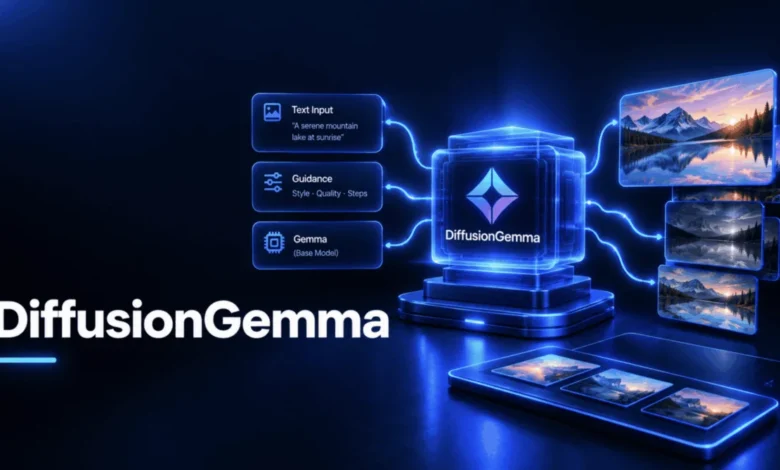
The landscape of generative artificial intelligence witnessed a significant shift on June 10, 2026, when Google DeepMind unveiled DiffusionGemma, an experimental open-model architecture that challenges the long-standing dominance of autoregressive text generation. While traditional Large Language Models (LLMs) such as GPT-4, Claude, and the standard Gemma series rely on sequential, left-to-right token prediction, DiffusionGemma applies the principles of diffusion—a technique previously confined largely to the domain of image and video synthesis—to the generation of text. By conceptualizing text blocks as fields to be refined rather than sequences to be built, this model introduces a fundamental change in how hardware compute is utilized during inference.
The Mechanism of Diffusion-Based Language Generation
To understand the significance of DiffusionGemma, one must first recognize the structural limitations of contemporary autoregressive models. Standard LLMs operate on a "token-by-token" basis. During each inference step, the model must read its entire weight matrix from VRAM to compute a single probability distribution for the next token. This creates a severe memory bandwidth bottleneck; the GPU’s high-speed compute cores often remain underutilized while the hardware waits for data to traverse the bus. Furthermore, because these models are strictly sequential, they are incapable of revising previously generated text, often leading to logical inconsistencies or "hallucinations" that cannot be corrected once the token is committed to the context window.
DiffusionGemma, built upon the 26-billion-parameter Gemma 4 architecture, utilizes a Mixture-of-Experts (MoE) design that activates 3.8 billion parameters per token. Its primary innovation lies in its "Uniform State Diffusion" process. Instead of predicting a sequence, the model initiates the generation process with a 256-token canvas composed of latent, noisy data. Through a series of iterative denoising passes, the model refines the entire block simultaneously. In this paradigm, tokens with high confidence levels provide context that helps resolve less certain tokens within the same block. This bidirectional attention mechanism allows the model to "self-correct" during the generation phase, as tokens are not fixed until the final convergence of the denoising loop.
Chronology and Development Roadmap
The development of DiffusionGemma follows a strategic trajectory by Google DeepMind to optimize model performance for local and edge computing environments. Following the initial release of the Gemma model family, researchers sought to mitigate the memory bandwidth issues inherent in sequential decoding.
- Q1 2026: Research into "block-autoregressive denoising" reaches maturity, demonstrating that causal attention for past history combined with bidirectional attention for active blocks maintains coherence in long-form generation.
- June 10, 2026: Google DeepMind officially releases DiffusionGemma 26B-A4B-it under the Apache 2.0 license, positioning it as a research-oriented preview.
- Late June 2026: Integration work with the vLLM serving engine is completed, allowing developers to deploy the model in production environments with specific configuration flags for entropy-bound sampling.
Technical Specifications and Hardware Requirements
DiffusionGemma is designed to balance high-level reasoning capabilities with accessibility for high-end consumer hardware. The model, when quantized, occupies approximately 18GB of VRAM, making it a viable candidate for enthusiasts and researchers utilizing NVIDIA RTX 4090 or 5090 GPUs.
The architecture is explicitly multimodal, capable of ingesting text, images with variable aspect ratios, and video sequences. However, it is essential to note that the diffusion process is applied exclusively to the text output. The model’s "Thinking Mode"—a configurable reasoning channel—allows it to perform multi-step internal logic before producing a finalized answer. This feature addresses a common pain point in LLM deployment, where complex problems require scratchpad-style processing that is usually hidden from the user.
Implementation and Integration
Deploying DiffusionGemma requires a departure from standard transformer workflows. The reliance on the DiffusionGemmaForBlockDiffusion class is mandatory, as it includes the necessary logic for managing the denoising loop. Developers must use the Hugging Face transformers library, version 5.11.0 or later, to ensure compatibility with the block-diffusion architecture.
For those looking to observe the model in action, the TextDiffusionStreamer utility provides a real-time window into the refinement process. By intercepting the state of the 256-token canvas after each denoising step, developers can visualize how the text "snaps" into focus, moving from chaotic noise to coherent linguistic output. This provides a clear pedagogical tool for understanding how the model prioritizes information and resolves ambiguity.
Production Serving and Performance Optimization
For enterprise-scale applications, Google has collaborated with the vLLM project to ensure that DiffusionGemma can be served efficiently. The integration allows for high-throughput serving while maintaining the integrity of the diffusion process. Key configuration parameters for vLLM include:
--max-model-len: Set to 262,144 for high-context applications.--diffusion-config: Allows fine-tuning of the canvas length (default 256).--hf-overrides: Facilitates the adjustment of thediffusion_sampleranddiffusion_entropy_bound, which control how the model commits to specific tokens.
The recommended sampling configuration involves a linear temperature schedule (0.8 to 0.4) to encourage creative exploration in the initial denoising phases while ensuring deterministic, high-confidence results in the final steps. The use of an entropy threshold (0.005) for adaptive early stopping ensures that the model does not waste compute cycles once a consensus has been reached within a specific canvas.
Analysis of Implications
The emergence of DiffusionGemma represents a shift in the philosophy of AI hardware utilization. While traditional autoregressive models have seen significant optimization through KV-caching and speculative decoding, they remain fundamentally hampered by their serial nature. By shifting the bottleneck from memory bandwidth to raw compute, DiffusionGemma aligns better with the architectural strengths of modern GPUs, which are optimized for parallel processing.
However, the industry consensus remains cautious. For massive, cloud-based deployments where concurrent requests number in the thousands, traditional autoregressive models retain a significant advantage due to their mature batching strategies. DiffusionGemma’s true value proposition lies in low-concurrency, local, or edge environments where the idle time of a high-performance GPU can be repurposed for the parallel denoising of text blocks.
Furthermore, the capability for self-correction—the ability to "re-noise" a token if confidence drops during the denoising process—opens new avenues for improving factuality and reducing hallucination. By treating text generation as a refinement process, DiffusionGemma potentially offers a more robust framework for complex reasoning tasks, where the model can iterate toward a solution rather than being forced to commit to a potentially flawed path.
Future Outlook
As Google continues to develop the DiffusionGemma experimental line, the industry will be watching to see if this approach can be scaled to larger parameter counts or applied to other domains beyond text. The open-source nature of the model, combined with the comprehensive documentation provided via Google’s developer guides, ensures that the research community will play a pivotal role in testing the limits of diffusion-based language generation. Whether this approach eventually supersedes autoregressive models or remains a niche, high-performance alternative for local inference, it marks a vital step forward in the diversification of generative AI architectures.