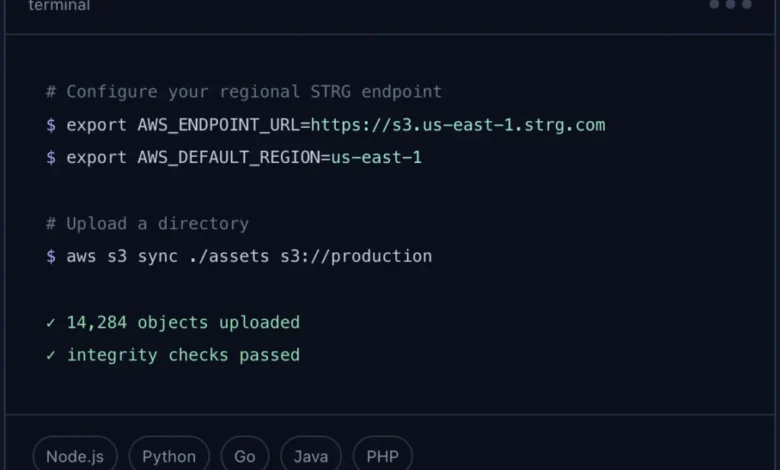
The emergence of alternative storage providers, such as STRG, signals a pivot toward S3-compatible, vendor-agnostic infrastructure. By leveraging existing protocols, these services aim to provide a seamless transition for development teams currently entrenched in the AWS, Google Cloud, or Azure ecosystems, offering a more predictable economic model without sacrificing the robustness required for production-grade web applications.
The Scaling Challenge of Modern Asset Management
In the early stages of a web application’s lifecycle, asset storage is rarely the primary focus. Developers typically rely on local storage or basic cloud buckets to host images and files. However, as user bases scale into the millions, the architectural requirements change. Performance, latency, and global availability become critical. According to recent industry reports on cloud spending, infrastructure costs associated with storage and data egress account for nearly 30% of total cloud expenditure for SaaS companies.
The complexity is further exacerbated by the need for regulatory compliance, data residency requirements, and security protocols like Object Locks. Large-scale applications must manage not only the raw files but also the metadata, versioning, and lifecycle policies that dictate how long data remains in high-performance tiers before being moved to cold storage or archived. This operational burden often forces teams to choose between the proprietary convenience of major cloud providers and the cost-efficiency of custom-built, open-standard solutions.
The Shift Toward S3-Compatible Interoperability
The Amazon Simple Storage Service (S3) API has effectively become the lingua franca of object storage. By adopting this standard, newer platforms like STRG allow developers to interact with their storage buckets using the same command-line interfaces (CLI) and Software Development Kits (SDKs) they are already accustomed to. This interoperability is a strategic design choice, as it significantly lowers the barrier to entry for migration.
For instance, the ability to configure an environment using standard AWS CLI tools—such as aws configure --profile strg—enables engineering teams to pivot their backend infrastructure without refactoring large segments of their codebase. This compatibility extends to programmatic access, where standard JavaScript SDKs (e.g., @aws-sdk/client-s3) can point to a different endpoint while utilizing the same underlying logic for PutObjectCommand, ListObjectsV2Command, and GetObjectCommand. This architectural parity ensures that developers do not have to learn new proprietary APIs, effectively neutralizing the "learning curve" associated with switching infrastructure providers.
Technical Implementation and Operational Control
Modern storage platforms are increasingly defined by their developer-centric toolsets. The integration of advanced features such as customizable lifecycle policies—which automatically transition objects between storage tiers based on age or access frequency—allows for automated cost optimization. Furthermore, the inclusion of robust CORS (Cross-Origin Resource Sharing) management and object locking mechanisms provides the granular control necessary for enterprise security standards.
The integration of Machine Context Protocol (MCP) support represents a significant advancement in the automation of storage tasks. By enabling AI agents to manage assets directly through a standardized transport layer, organizations can reduce the manual overhead of file organization and retrieval. This capability allows an AI to perform routine tasks such as checking bucket contents or verifying file integrity, provided it is granted the necessary scope-limited permissions. This ensures that while AI is empowered to act, it remains constrained by the principle of least privilege, preventing unauthorized access or accidental deletion.
Data-Driven Analysis of Cloud Storage Trends
The current landscape of cloud storage is characterized by a "multi-cloud" strategy. Research indicates that approximately 80% of organizations now utilize multiple cloud providers to avoid vendor lock-in and to capitalize on regional pricing discrepancies. This trend is driven by three key factors:
- Egress Fee Volatility: Major cloud providers have historically charged significant fees for data leaving their network. New market entrants are positioning themselves by offering lower or zero-rated egress, which can represent a 40% to 60% reduction in monthly infrastructure bills for high-traffic applications.
- Regional Compliance: Global data privacy regulations, such as GDPR in Europe and CCPA in California, require companies to store data in specific geographic locations. Providers that offer distributed, region-specific S3-compatible endpoints facilitate compliance without requiring complex multi-region management tools.
- Developer Velocity: The time-to-market for new features is directly tied to the ease of infrastructure deployment. By adopting S3-compatible services that require no specialized training, companies can deploy storage resources in minutes rather than days.
The Role of AI in Infrastructure Management
The integration of AI-ready interfaces like the MCP (Model Context Protocol) is indicative of a broader shift in how DevOps and infrastructure teams will interact with their environments in the coming decade. As AI agents become more deeply integrated into the software development lifecycle, the ability to grant these agents secure, auditable access to object storage will become a requirement rather than a feature.
When an AI agent is configured to interact with a bucket, the security model relies on the granular definition of API keys. By defining specific scopes for the agent, administrators can ensure that an agent tasked with, for example, logging or cleanup, cannot inadvertently modify critical production data. This separation of concerns is fundamental to modern "infrastructure-as-code" (IaC) principles.
Implications for Future Architecture
The transition toward commoditized, S3-compatible storage services is likely to continue as more developers prioritize cost predictability and portability. The implications for the industry are twofold:
First, there is a clear move toward a modular stack. Developers are moving away from monolithic cloud platforms in favor of a "best-of-breed" approach, where they select specialized services for compute, database, and storage. This modularity reduces the risk of vendor lock-in and allows for greater technical flexibility.
Second, the focus is shifting from "storage as a service" to "storage as an API." The value proposition is no longer just the durability and availability of the bits stored on disk, but the ease with which those bits can be manipulated, analyzed, and moved across the global internet. The ability to programmatically control storage lifecycle, security, and access through standard protocols has become the baseline expectation for any professional-grade platform.
In conclusion, as applications continue to scale and data requirements become more complex, the choice of storage provider becomes a foundational decision. Platforms that prioritize S3-compatibility, offer transparent pricing, and integrate seamlessly with modern AI-driven workflows are well-positioned to become the standard infrastructure for the next generation of web applications. For engineering teams, the shift to these services is not merely a cost-saving exercise, but a strategic move toward a more resilient, manageable, and agile technical architecture. By standardizing on established protocols and leveraging automated, policy-driven storage management, organizations can ensure their infrastructure remains an enabler of growth rather than a bottleneck.
Related posts: