Shaping the Future: rtCamp’s AI-First Strategy Redefines Enterprise WordPress Agencies

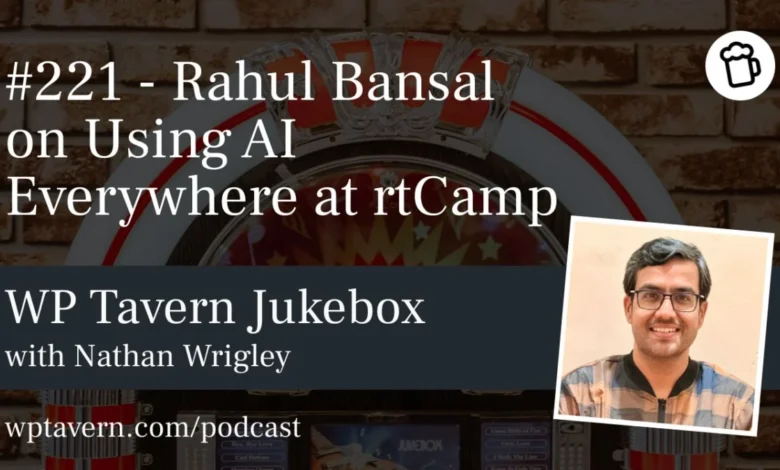
In a pivotal discussion on WP Tavern’s Jukebox Podcast, Nathan Wrigley hosted Rahul Bansal, the visionary founder and CEO of rtCamp, to delve into the evolving landscape of enterprise WordPress agencies. The conversation, drawing heavily from Bansal’s recent presentation at WordCamp Asia, unveiled a bold strategy for future growth, fundamentally reshaped by the advent of artificial intelligence. Bansal, whose agency has a 17-year history of serving giants like Google, Fortune 500 companies, and major publishers, articulated a future where AI is not merely an enhancement but the operational backbone of the entire business, promising unprecedented efficiencies and a paradigm shift in how agencies deliver value.
WordCamp Asia Insights: A New Playbook for Enterprise WordPress Agencies
Rahul Bansal’s presentation at WordCamp Asia, titled "How to Start an Enterprise WordPress Agency in 2026," deviated from a retrospective success story to offer a pragmatic roadmap for future agency founders. Recognizing the dramatic shifts propelled by technology, particularly AI, Bansal emphasized that strategies that once fueled rtCamp’s rise would no longer suffice. His revised playbook focused on real-world lessons adapted for a rapidly changing technological environment.
The Evolution of rtCamp: From Blog Network to Enterprise Powerhouse
rtCamp’s journey began in 2006/2009, not as an agency, but as a technology blog network. This origin story highlights a crucial element of its early success: an intimate, hands-on understanding of WordPress. Bansal recounted how the decision to focus solely on WordPress, at a time when platforms like Joomla held significant market share and India was a burgeoning outsourcing hub, was less about strategic foresight and more about utilizing what they knew best. This "dogfooding" approach — building on and customizing WordPress extensively for their own high-traffic blog — inadvertently positioned them as experts in scaling and optimizing the platform. Clients, initially competitors or fellow tech bloggers, sought their expertise, leading to a gradual transition from media company to a WordPress custom development agency. Bansal candidly admitted that luck played a significant role in WordPress’s eventual dominance, acknowledging the inherent uncertainties in early entrepreneurial choices.
Strategic Pillars for Success: Hiring and Client Acquisition
Central to Bansal’s advice for new agencies is a philosophy of building complementary teams. Eschewing the common tendency to hire individuals with similar skill sets, he advocated for seeking out those who possess strengths that offset one’s own weaknesses. For rtCamp, this meant a partnership between Bansal, strong in engineering, and a co-founder adept at sales and communication. This approach, rooted in set theory, ensures a well-rounded foundation capable of adapting to diverse challenges and filling expertise gaps.
This principle extends to client acquisition. Bansal advised targeting clients who do not possess deep WordPress expertise. These clients are more likely to value and depend on an agency’s specialized knowledge, preventing the commoditization of services and fostering higher-margin engagements. This contrasts sharply with competing for clients who already have internal expertise, often leading to price-driven negotiations.
The Imperative of Specialization in a Crowded Market
In 2006, merely focusing on WordPress was a differentiator. Today, with WordPress powering over 40% of the internet and thousands of agencies globally, such a broad focus is no longer viable. Bansal stressed the critical need for "niches within niches." Instead of simply being a "WordPress agency," future agencies must drill down into highly specific areas such as WooCommerce, payment gateway integrations, or ERP connectors. By becoming recognized experts in these micro-niches, agencies can carve out a unique identity and thrive in an increasingly competitive landscape. This strategic specialization allows for deeper expertise, more targeted marketing, and ultimately, a stronger value proposition for enterprise clients.
AI Everywhere: rtCamp’s Bold Operational Mandate
The most revolutionary aspect of Bansal’s vision is rtCamp’s unequivocal commitment to an "AI Everywhere" mandate: "If something in rtCamp can be done by AI, it will be." This aggressive stance positions rtCamp at the forefront of AI adoption within the agency world, moving beyond superficial integrations to a complete operational overhaul.
The Genesis of the AI Shift: Pre-emptive Internal Unification
Bansal revealed that rtCamp’s readiness for this AI-first approach was serendipitous, stemming from a strategic decision made three to four years prior to the public AI boom. Post-COVID, as rtCamp experienced significant growth, the need for robust internal tooling became paramount. Inspired by the "McDonald’s of consulting business" concept, they embarked on an ambitious project to unify their disparate internal systems. They adopted Frappe ERPNext, an open-source platform, to consolidate accounting, payroll, project management, and CRM into a single, comprehensive "source of truth."
This foresight created a clean, unified data environment, an invaluable asset when AI capabilities rapidly advanced. With all operational metadata – from lead generation to project execution and financial tracking – residing in one integrated system, rtCamp was uniquely positioned to leverage AI effectively. This first-party data, unconstrained by proprietary SaaS limitations, became the foundation for their radical AI integration.
AI’s Transformative Impact on Operations
The "AI Everywhere" strategy is fundamentally about dramatic cost reduction and efficiency gains across all business processes. Bansal detailed how AI is being deployed:
- Sales and Proposal Writing: AI automates initial lead qualification, enriching inquiries with detailed background information and generating action items. This significantly reduces the manual effort in pre-sales, accelerating the proposal submission process by as much as two-thirds.
- Technical Proof of Concept (PoC) Builds: Instead of static mockups or Figma designs, rtCamp is now using AI to generate "vibe coded" WordPress demo sites and playgrounds for clients. This allows clients to interact with a functional prototype early in the sales cycle, boosting confidence and significantly shortening discovery phases.
- Project Management and Delivery: AI is used to streamline data mapping, automate QA testing, and optimize project timelines. Bansal cited an instance where a complex migration project, typically requiring 10 days, was completed in just five, including data migration and automated testing.
- Cost Reduction and Pricing: By dramatically reducing operational costs and project timelines, rtCamp can offer more competitive fixed-output bids. Bansal expects build times to fall by 70% within two years due to AI, enabling them to lower price points and attract a wider range of clients who previously found enterprise solutions cost-prohibitive. This shift moves agencies away from hourly billing to value-based pricing, focusing on committed outcomes.
Redefining Agency Value: From Hours to Outcomes
The core implication of AI for agencies, as articulated by Bansal, is a fundamental shift in value proposition. Rather than being paid for hours spent, agencies will increasingly be compensated for the output delivered and the efficiency with which it’s achieved. This means focusing on "boring things" – common, repeatable tasks like migrations – and making them exceptionally affordable and fast through AI. Bansal posits that by making such services more accessible, the overall market for these solutions will expand, benefiting agencies that embrace efficiency. This approach turns AI into a tool for market expansion rather than just internal optimization.
The Shifting Workforce Landscape
The "AI Everywhere" mandate inevitably impacts human resources. While rtCamp’s headcount grew significantly post-COVID, Bansal noted a slowdown in engineering hires. Traditionally, the agency business model scaled with human capacity; more projects meant more hires. However, AI’s efficiency means that tasks previously requiring multiple engineers can now be handled by fewer. Bansal projected a significant shift in team composition: while engineering roles might plateau, there will be a surge in demand for sales and marketing professionals. He anticipates that future hires will be predominantly in these growth-oriented roles, moving from a 90:10 engineering-to-sales ratio to potentially 70:30.
Furthermore, the nature of engineering roles is evolving. rtCamp is cultivating "Growth Engineers" – highly skilled coders who, instead of writing production code, engage in pre-sales consulting, building AI-assisted prototypes, and defining practical solutions. The value is shifting from pure coding ability to imaginative problem-solving, prompt engineering, and contextual understanding. Bansal acknowledged the anxiety this causes for traditional developers but emphasized that agencies must adapt to these new skill requirements.
Broader Implications for the WordPress Ecosystem
rtCamp’s aggressive AI strategy has profound implications for the entire WordPress ecosystem and the broader agency landscape.
WordPress as an AI-Ready Platform
Bansal sees WordPress emerging as a major winner in the AI era. Its open-source nature and inherent ability to expose structured data without proprietary barriers make it highly compatible with AI tools. As AI drives demand for efficient content management and robust digital experiences, WordPress’s flexibility and vast ecosystem position it as a prime platform for AI-powered solutions. The increasing number of migration inquiries rtCamp is receiving, directly linked to the AI boom, underscores this trend.
Optimism Amidst Disruption: Solving Existing Problems More Efficiently
While many in the industry view AI with apprehension, Bansal maintains an optimistic outlook. He urges agencies not to focus on inventing new AI algorithms – that’s the domain of companies like OpenAI – but rather on applying existing AI technologies to solve client problems more cheaply, efficiently, and with higher quality. The opportunity lies in making established services more accessible and faster, thereby expanding the market rather than simply competing for existing slices.
The Call to Action for Agencies: Adapt or Risk Obsolescence
The clear message from rtCamp’s experience is that adaptation is no longer optional. Agencies must confront the uncertainty of AI with a blend of optimism and realism. Embracing AI as an operational backbone, rather than a mere bolt-on feature, will be crucial for survival and growth. This involves re-evaluating business models, investing in unified internal systems, and rethinking workforce skills. Agencies that proactively integrate AI to reduce costs and accelerate delivery will be best positioned to capture market share in this new era, transforming the "movers and packers of the internet" into highly efficient, value-driven partners.
Rahul Bansal’s insights offer a compelling vision for the future of enterprise WordPress agencies. By leveraging a unified operational platform and an "AI Everywhere" philosophy, rtCamp is not just navigating the disruption but actively shaping a new paradigm for efficiency, affordability, and growth in the digital services sector. The success of this bold experiment will undoubtedly serve as a crucial case study for agencies worldwide contemplating their own AI-driven transformation.