Royally Launches to Centralize AI-Driven WordPress Management Across Multiple Agency Portfolios

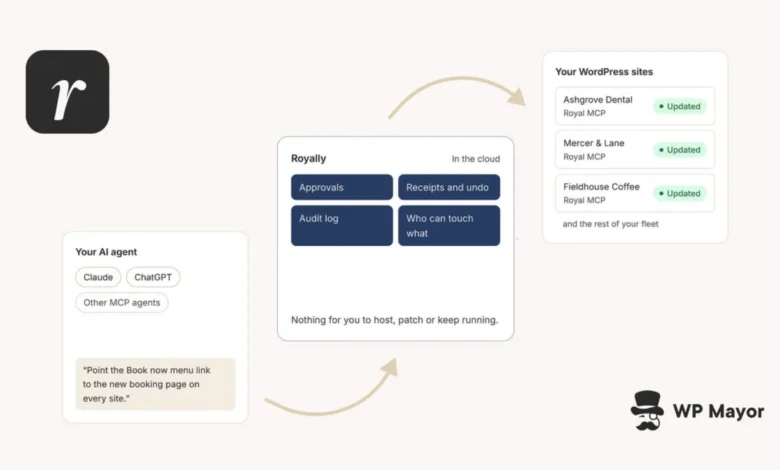
The landscape of WordPress site management underwent a significant shift on November 1, 2026, with the public release of Royally, a cloud-based orchestration platform designed to bridge the gap between individual AI-enabled WordPress sites and large-scale agency infrastructure. Developed by Royal Plugins, the service acts as a centralized command center for users of the Royal MCP Pro plugin, addressing the growing complexity of managing dozens or even hundreds of installations simultaneously through AI agents like Claude or ChatGPT. While the initial introduction of Model Context Protocol (MCP) servers allowed for individual site optimization, the industry-wide challenge has remained the friction of managing site portfolios at scale—a hurdle Royally aims to clear by providing a unified governance and execution layer.
The Evolution of AI Integration in WordPress
To understand the significance of Royally, one must look at the recent timeline of WordPress automation. Throughout 2025 and early 2026, the adoption of MCP servers—a standard that allows AI models to securely interact with external software—transformed the way developers interacted with their CMS. However, the limitation of early MCP implementations was their site-centric architecture. A developer managing a fleet of 50 client websites was forced to interact with each instance individually, creating a fragmented workflow that negated the efficiency gains promised by AI automation.
Royal Plugins entered this space with the Royal MCP Pro plugin, which established a secure, granular link between AI models and WordPress core functions. Recognizing that agencies were burdened by the manual oversight required for batch updates and site-wide configuration changes, the development team transitioned to a hybrid model. By creating a cloud-based intermediary, they effectively turned individual WordPress plugins into nodes within a larger, manageable network. This development reflects a broader industry trend where the "plugin-first" approach is evolving into a "platform-first" approach, prioritizing centralized dashboard management over decentralized, site-specific tasking.
Technical Architecture and Operational Governance
Royally operates as the cloud-based "brain" that connects to the Royal MCP Pro plugin installed on individual WordPress instances. When an AI agent is connected to the Royally dashboard, it gains the capability to execute commands across an entire portfolio through a single interface. This eliminates the need for repeated authentication and context-switching.

The system is built on a "Human-in-the-Loop" architecture. Crucially, the platform does not grant AI agents unilateral autonomy. Instead, it employs a mandatory preview-and-approval mechanism. When an agent suggests a change—such as updating a plugin, modifying a theme, or adjusting security settings—it generates a staging preview of the modification across all target sites. These changes remain in a "pending" state until the administrator reviews and authorizes them. Once approved, the changes are pushed, and the system generates a comprehensive, tamper-evident audit log. This feature is particularly vital for agencies bound by Service Level Agreements (SLAs) or strict data compliance requirements, as it provides a permanent record of every automated action taken by an AI model.
Addressing the Security and Compliance Gap
One of the most pressing concerns for agencies adopting AI in their workflow is the risk of "hallucination-driven" errors or unauthorized configuration drift. The industry has seen a marked increase in demand for tools that prioritize visibility. According to recent surveys of web development agencies, over 65% of firms report that their primary hesitation regarding AI deployment is the lack of oversight.
Royally addresses this by integrating real-time monitoring directly into its management suite. The platform conducts uptime checks every five minutes, monitors for suspicious administrative activity, and performs vulnerability scans. If an AI agent attempts to perform an action that violates established security protocols, the Royally governance layer is designed to intercept and flag the request. By consolidating security alerts, uptime data, and configuration logs into a white-labeled reporting module, the platform allows agencies to provide transparency to their clients without exposing the backend complexity of the maintenance process.
Multi-Protocol Compatibility and Integration
A notable aspect of the Royally ecosystem is its interoperability. The platform does not limit its users to the Royal MCP Pro plugin. It supports a variety of existing MCP implementations, including those from AI Engine and Easy MCP AI. This modularity allows developers to mix and match tools depending on the specific requirements of a site.
For instance, an agency might use an AI Engine for content generation while utilizing Royal MCP Pro for database maintenance and security updates. Because Royally acts as the orchestrator, it enforces a consistent set of rules across these diverse tools. The audit logs and approval requirements remain uniform, ensuring that the agency’s standard operating procedures are maintained regardless of which specific AI agent or underlying plugin performs the technical task. This approach mitigates the risk of "platform lock-in," a frequent concern among agencies that manage diverse stacks for different clients.

Market Implications for Agencies and Freelancers
The release of Royally signals a maturation point for the WordPress agency market. As the cost of labor for routine maintenance increases, the ability to scale operations through AI is no longer a competitive advantage but a necessity for survival. By automating the identification and remediation of security vulnerabilities across a portfolio, agencies can shift their focus from reactive maintenance to proactive value creation.
The pricing model reflects a move toward accessibility, starting at $9 per month for three sites, scaling up to $79 for larger portfolios. This tiered structure acknowledges the varying needs of freelance developers and larger digital marketing firms. The inclusion of the Royal MCP Pro plugin within the subscription fee effectively bundles the utility with the management infrastructure, reducing the friction for adoption.
Industry Outlook and Future Trajectory
Looking forward, the success of platforms like Royally will likely be measured by their ability to integrate with the broader ecosystem of hosting providers and security services. The current trajectory suggests that the "governance layer" will become the most valuable component of the AI-WordPress stack. As AI agents become more sophisticated, the focus of developers will likely shift from "how do I make the AI do this" to "how do I ensure the AI does this safely."
The launch of Royally establishes a clear standard for this governance. By providing a centralized, audit-friendly, and scalable interface, Royal Plugins has provided a roadmap for how enterprise-grade AI management can be delivered to the WordPress market. The implication is clear: the future of web management is not in the hands of the AI alone, but in the hands of the human administrator who manages the AI’s reach through robust, cloud-governed frameworks.
As of early November 2026, the industry is closely monitoring the adoption rates of these orchestration platforms. If agencies demonstrate significant efficiency gains in patch management and site monitoring, it is highly probable that other plugin developers will pivot toward similar cloud-integrated architectures, potentially leading to an ecosystem where decentralized site management is entirely replaced by centralized, AI-augmented administration. For now, Royally serves as the primary example of this shift, offering a bridge between the promise of AI and the practical reality of maintaining a healthy, secure, and performant web portfolio.