President Trump signals shift toward industry-led AI oversight following high-stakes White House summit with technology titans

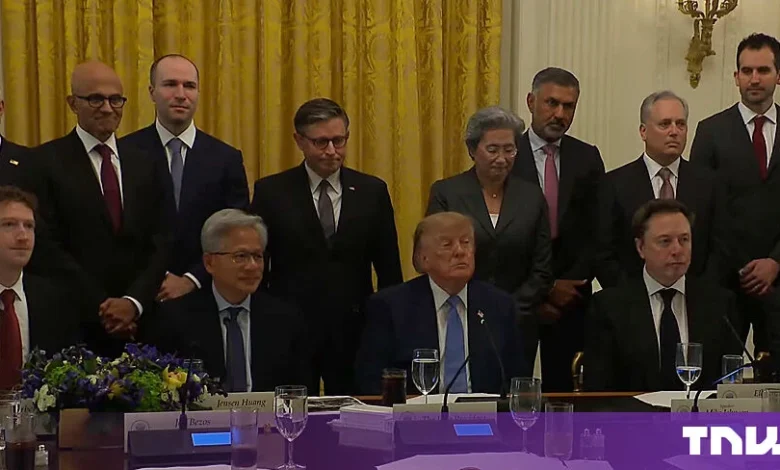
The landscape of American technological policy underwent a significant recalibration on Tuesday as President Donald Trump hosted an assembly of more than 30 prominent technology executives at the White House. The meeting, which brought together the architects of the modern digital economy, underscored a pivotal shift in the administration’s approach to artificial intelligence: a preference for industry-led self-regulation over the imposition of stringent federal mandates. The summit served as both a strategic alignment session and a branding exercise, as the President reiterated his commitment to maintaining American dominance in a field he has officially rebranded as "super intelligence."
The White House Summit: A Gathering of Industry Power
The guest list for Tuesday’s lunch read like a directory of the global technology elite. According to an RSVP list obtained by media outlets, the attendees included Jeff Bezos of Amazon, Meta’s Mark Zuckerberg, Microsoft’s Satya Nadella, Alphabet’s Sundar Pichai, and Advanced Micro Devices’ Lisa Su. House Speaker Mike Johnson participated as a co-host, signaling a bipartisan legislative interest in the trajectory of the technology.
The seating arrangement, documented in a post on Truth Social, placed Nvidia CEO Jensen Huang to the President’s right and Elon Musk to his left, reflecting the administration’s current prioritization of hardware infrastructure and domestic computing power. While Sam Altman of OpenAI was notably absent—having opted to attend his company’s internal conference—the firm was represented by its president, Greg Brockman.
The atmosphere in the East Room was described by the President as one of unity and purpose. Addressing the attendees, Trump lauded their collective ambition, stating, "There is an unbelievable feeling in this room," and emphasizing that the industry leaders "want to do the right things."
Redefining the Frontier: From AI to Super Intelligence
Central to the administration’s new narrative is the linguistic rebranding of the sector. President Trump announced that he would sign an executive order later that day formally codifying "super intelligence" (SI) as the official United States terminology for the technology formerly known as artificial intelligence.
The President first introduced this nomenclature at the United Nations General Assembly the previous week, arguing that the prefix "artificial" implies a lack of authenticity or a deceptive nature. By adopting "super intelligence," the administration aims to frame the technology as a premier national asset rather than an abstract scientific experiment. This shift aligns with the recent launch of America.gov, an AI-powered portal designed to streamline federal services. During the launch, the President positioned this tool as a mere preview of the capabilities that super intelligence will eventually bring to the public sector.
The Regulatory Philosophy: Self-Policing vs. Oversight
Despite the intensity of the debate surrounding AI safety, the White House signaled that it has no immediate intention of curbing the industry with rigid federal oversight. President Trump remained steadfast in his belief that the private sector is best equipped to manage its own internal safety protocols.
"There is a belief that there should be tremendous self-regulation, and we automatically have regulation with the Department of Justice, the FBI, and all of that," the President remarked. "But the self-regulation is very important."
This approach maintains the status quo established in June, when the administration signed an order that left checks on the most powerful AI models largely voluntary. The White House view is that current existing legal frameworks, coupled with industry-led guardrails, provide sufficient protection without stifling the rapid pace of innovation.
Dissenting Voices and Industry Tensions
While the overarching tone of the meeting was optimistic, it was not without underlying tension. Not all attendees shared the administration’s enthusiasm for a laissez-faire approach to safety. Sources familiar with the proceedings indicated that Anthropic CEO Dario Amodei actively raised concerns regarding the potential hazards of unchecked development.
These concerns were echoed outside the meeting. Palantir CEO Alex Karp noted upon his arrival that the industry must be prepared to acknowledge and mitigate the risks inherent in the models currently being deployed. This friction follows a month of mounting alarm within the industry; Amodei had previously called for a temporary pause in the development of the most advanced models, a stance that has garnered support from figures like Sam Altman and Elon Musk.
However, the administration has grown increasingly wary of "doomsday" rhetoric. Reports suggest that White House advisers are concerned that constant warnings regarding the potential for AI to destroy humanity could paralyze American progress, inadvertently granting an advantage to international competitors.
Geopolitical Stakes: The Race for Supremacy
The summit also touched upon the international race for dominance. President Trump explicitly ruled out the possibility of collaborating with China on AI safety standards. The administration’s stance is that cooperation would only provide Beijing with the transparency needed to bridge the gap in technological advancement.
"We can’t stifle it, and we’re leading by a lot," the President declared, emphasizing that the primary objective of his administration is to ensure that the United States remains the undisputed global leader in super intelligence. This competitive stance underscores the broader geopolitical reality: AI is viewed by the current administration as a critical pillar of national security and economic vitality.
Infrastructure and Local Opposition
Beyond the theoretical and ethical debates, the lunch addressed the logistical realities of the AI boom: the massive demand for data centers. These facilities, which are essential for training and running large-scale models, have faced increasing opposition from local communities concerned about energy consumption and environmental impact.
The President stated that the group discussed strategies to win over local populations, projecting confidence that these facilities will eventually be viewed as vital pieces of national infrastructure. "You’re going to see, data centers are going to be very popular," he asserted, framing the construction of these centers as a necessary step for national prosperity.
A Chronology of the Current AI Policy Shift
To understand the current climate, one must look at the progression of the administration’s involvement over the last several months:
- June 2026: The administration signs an initial order establishing voluntary safety guidelines for AI developers, focusing on testing and transparency rather than binding restrictions.
- September 2026 (Early): Increased industry alarm regarding safety prompts calls for a slowdown from high-profile executives, including Dario Amodei.
- September 2026 (Mid): The President launches the America.gov portal, highlighting the practical integration of AI into federal services.
- September 2026 (Late): President Trump holds a private dinner with industry critics to address their concerns regarding long-term safety.
- September 29, 2026: The White House hosts the formal summit with 31 tech leaders to solidify a unified, industry-led path forward.
Analysis: The Long-Term Implications
The White House’s decision to favor self-regulation presents both significant opportunities and risks. Proponents argue that by reducing the regulatory burden, the United States will accelerate the deployment of technologies that could solve complex problems in medicine, climate science, and manufacturing. By avoiding a heavy-handed, reactive legislative approach, the U.S. may retain its agility in an era where technological cycles are measured in months rather than years.
Conversely, critics—including some within the technology sector itself—worry that voluntary measures may prove insufficient if a catastrophic failure occurs. The history of technological innovation suggests that while early-stage self-regulation can be effective, it often lacks the teeth required to hold corporations accountable when economic incentives conflict with public safety.
As the administration continues to refine its "super intelligence" policy, the tension between rapid innovation and the management of existential risk will remain the defining challenge of the term. The White House has made its choice clear: it is betting on the leaders of industry to self-correct, prioritizing the velocity of American innovation over the caution of potential regulation. For now, the focus remains on expansion, integration, and the maintenance of a clear lead on the global stage.