Navigating the EU AI Act: What the New Transparency and Labelling Mandates Mean for Product Design and Global Tech Operations

The introduction of sweeping new regulatory frameworks regarding artificial intelligence has routinely sparked industry-wide panic, with corporate legal teams and product developers bracing for catastrophic fines, administrative burdens, and restrictive operational mandates. However, a closer examination of the European Union’s latest transparency guidelines—which officially took effect on August 2, 2026—reveals a much narrower, highly pragmatic approach. Rather than paralyzing innovation, the mandate primarily aims to establish crystal-clear visibility for artificial intelligence, ensuring that users can easily identify when they are interacting with machine-generated or manipulated content.
As of August 2026, mandatory AI labelling has transitioned from a theoretical concept into a strict legal requirement for any enterprise serving European Union citizens. Mirroring the broad jurisdictional reach of the General Data Protection Regulation (GDPR) and the European Accessibility Act (EAA), these transparency rules do not apply exclusively to EU-headquartered corporations. Instead, they capture any commercial entity, software developer, or digital platform worldwide that deploys AI-generated outputs consumed by individuals within the European Union.
Core Legal Obligations: Understanding Article 50 of the AI Act
To grasp the full weight of the new regulatory environment, organizations must look closely at Article 50(4) of the EU AI Act. The primary objective of these transparency measures is to empower everyday consumers, professionals, and citizens to recognize artificial content in a clear, unambiguous, and distinguishable manner.
The legal burden falls onto two distinct actors within the AI supply chain: providers, who build, train, or supply the foundational AI systems, and deployers, who integrate and operate these systems within commercial products, enterprise software, or public-facing applications. Much like liability frameworks established under data privacy laws, a company cannot evade its responsibilities under Article 50 simply by licensing a third-party model or embedding an external AI API into its proprietary platform. If the end product interacts with EU citizens and presents synthetic content, the compliance burden rests firmly on the shoulders of the organization facing the consumer.
Despite the broad scope of these obligations, the legislation does not subject every single instance of machine-assisted work to mandatory disclosure. The vast majority of day-to-day productivity enhancements—such as AI-driven code completion, minor background optimizations, and automated data structuring—fall entirely outside the scope of the transparency rules.

Demarcating the Boundaries: What Requires Disclosure and What Does Not
The distinction between mandatory labelling and exempt activity hinges primarily on human intervention and the potential for public deception. Under the official guidelines issued by the European Commission, disclosure obligations are heavily triggered when AI-generated text addresses matters of public interest. This encompasses critical domains such as public health, safety, environmental protection, economic policy, financial markets, political discourse, scientific research, and cultural affairs. If an automated content generation tool produces claims, summaries, or analyses that touch upon these sensitive sectors, explicit labelling is compulsory.
Furthermore, commercial content creators, advertisers, and public relations teams face rigorous disclosure standards. According to guidance issued by prominent technology and intellectual property law practices, any realistic AI-generated illustration, synthetic photograph, or promotional poster that resembles a genuine person, physical location, real-world object, or historical event must feature a prominent disclosure notice.
Conversely, the regulations offer vital breathing room for routine human-editorial workflows. If AI-generated text undergoes substantial review, modification, and editing by a human professional who formally assumes editorial responsibility, the disclosure obligation is typically lifted. However, the European Commission has explicitly clarified that a superficial "human skim" right before publication does not constitute adequate editorial control. The human intervention must be substantive, traceable, and tied to a named individual or legal entity willing to stand behind the published material.

The Technical Gray Area: Edited Versus Generated Content
One of the most complex challenges facing product designers and software engineers is determining the exact threshold where an edited piece of digital media ceases to be a human-authored work and legally becomes AI-generated content. While the European Commission’s Code of Practice provides substantial clarity, certain operational scenarios remain ambiguous.
Minor assistive edits implemented during standard digital workflows—such as automated spellcheck, grammar correction, text formatting, image cropping, color balancing, and machine translation—do not trigger AI generation mandates. These tools are viewed as mechanical enhancements rather than generative creation.
On the other hand, heavy automated interventions are firmly classified as AI generation. These include the automatic drafting of full paragraphs, AI-generated summaries, composite image generation, and programmatic manipulation that adds, removes, or alters significant visual elements within a photograph. For instance, fine-tuning a sentence originally written by a human copywriter is generally permissible without a label, but publishing a paragraph generated autonomously by a large language model requires transparent disclosure.

The fundamental legal dividing line rests between intentional manual creation supplemented by minor assistive tools and fully automated generation. Unless operating within a strictly closed business-to-business (B2B) environment where all participants are fully aware of the underlying technology, automated generation must always be clearly disclosed to the end user.
Why Visual Sparkles and Hidden Footnotes Fall Short
In their rush to embrace the generative boom, many product design teams have relied heavily on generic aesthetic markers—most notably, the ubiquitous "sparkle" icon—to signal the presence of artificial intelligence within their software interfaces. However, recent regulatory guidance and comprehensive user experience research indicate that sparkles are no longer sufficient to achieve legal compliance.
The European Commission has published an official set of standardized "AI" icons as part of its Code of Practice. These explicit marks are designed to be distinct and unambiguous, moving far beyond the decorative sparkle symbol. Usability research conducted by organizations like the Nielsen Norman Group has repeatedly demonstrated that the sparkle icon suffers from severe ambiguity. Users frequently interpret sparkles as a general indicator of a "smart" or AI-powered interface feature, rather than a specific factual disclosure that the precise content on their screen was artificially generated.

To address this shortcoming, the EU guidelines stipulate that utilizing an icon alone does not establish legal compliance. Transparency mechanisms must meet rigorous standards of visibility and accessibility. A disclosure that is hidden in a remote footer, flashed for a fraction of a second, or displayed with insufficient contrast fails to satisfy the law.
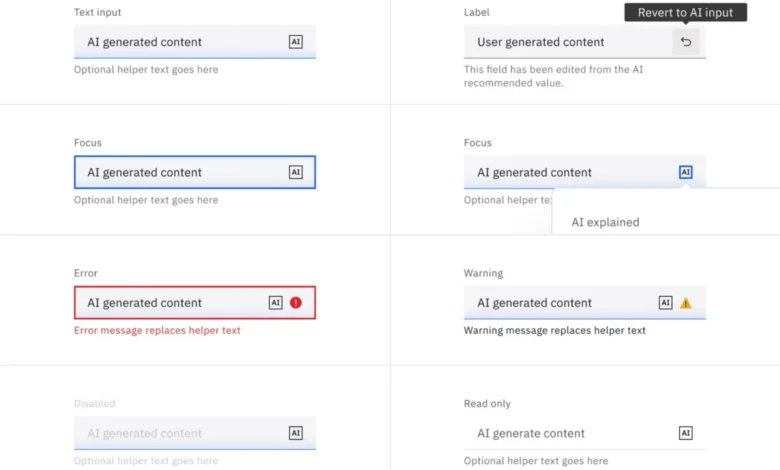
UX experts recommend pairing official AI icons with plain-text disclosures—such as explicit labels reading "AI-generated"—and ensuring that these labels persist even when the underlying media is downloaded, shared, or republished across external platforms. Digital design systems, such as IBM’s Carbon Design System, have begun pioneering comprehensive UI components that feature inline text tags, persistent icons, and expandable explainability panels to meet these exact interface demands.
A Global Regulatory Pattern
While European regulatory mandates often attract skepticism regarding administrative overreach, the EU AI Act is far from an isolated legislative anomaly. A synchronized global regulatory pattern is rapidly taking shape across major international markets.

In the United States, a patchwork of state-level legislation has emerged to govern synthetic media. California, Texas, and New York have enacted targeted statutes addressing the use of synthetic human performers, deceptive deepfakes in political advertising, and algorithmic transparency in consumer-facing platforms. Similar regulatory frameworks are advancing across major Asian and Latin American economies, signaling a unified international consensus that digital consumers possess a fundamental right to know the origin of the content they consume.
For product managers, UX designers, and software development teams shipping AI-powered features, this global shift transforms transparency from an afterthought into a foundational design pillar. Proactive organizations are currently conducting comprehensive audits of their product lines to categorize which features generate autonomous content requiring labelling, and which operate safely within human-edited parameters.
Implications for the Future of Digital Interfaces
Ultimately, the implementation of the EU’s transparency obligations should be viewed not as an administrative hurdle, but as an essential maturation phase for the digital economy. As the internet experiences an unprecedented influx of synthetic text, imagery, and video, distinguishing authentic human expression from automated output has become a critical societal necessity.

By mandating that AI content resembling human work be clearly, obviously, and unambiguously disclosed, regulatory bodies are fostering greater digital trust. For designers and developers, mastering the integration of compliant, accessible, and user-friendly AI disclosures will soon be just as vital as optimizing conversion rates or enhancing user engagement. The era of hidden algorithms and ambiguous sparkles is drawing to a close, replaced by an ecosystem where clarity and transparency define the standard for responsible artificial intelligence.
Related posts: