Meta Expands Forum App Capabilities to Transform Facebook Groups Into Interactive Q&A Hubs

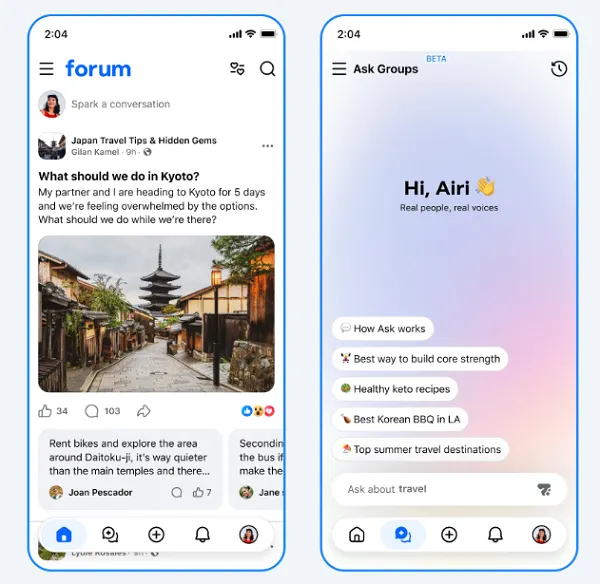
Meta has officially rolled out a substantial update to its standalone community and chat application, Forum, introducing new engagement features designed to fundamentally reshape how users interact within interest-based digital spaces. Originally launched earlier this year in May, the Forum app was conceptualized to pivot traditional Facebook Groups away from casual chronological feeds and toward structured, question-and-answer formats reminiscent of platforms like Quora and Reddit. The latest wave of updates includes recognition badges for top contributors, cross-group answer aggregation, and comprehensive topic labels intended to streamline content discovery.
While the tech giant is marketing these features as direct enhancements to user experience and community value, industry analysts suggest that the overarching strategy aligns with a broader industry race: harvesting human-generated conversational data to train and refine artificial intelligence systems. As the digital landscape shifts increasingly toward AI-driven search and conversational assistants, structured knowledge repositories have emerged as some of the most valuable commodities in the technology sector.
Evolution and Background of the Forum App
The introduction of the Forum app in May marked a strategic shift for Meta’s product development teams. For nearly two years, internal metrics indicated that users increasingly utilized Facebook Groups as localized search engines, turning to peer communities for troubleshooting, travel recommendations, product reviews, and lifestyle advice. However, the traditional architecture of Facebook Groups—built primarily around a continuous, scrollable feed of mixed media, announcements, and threaded commentary—frequently buried valuable resolutions to specific queries.

Recognizing this friction, Meta engineered Forum as a dedicated ecosystem separating deep-dive community inquiries from general social networking. The platform borrows heavily from the structural successes of long-established text-based forums. By prioritizing explicit questions followed by ranked, peer-reviewed answers, Meta sought to capture a demographic of internet users who bypass conventional search engines in favor of crowdsourced human wisdom.
The strategy closely mirrors the trajectory of Reddit, which has evolved over the past several years into one of the most vital data assets on the internet. As artificial intelligence companies race to feed large language models (LLMs) with high-quality, conversational, human-vetted text, platforms populated by authentic user experiences have achieved unprecedented strategic importance. Reddit’s multi-million-dollar licensing agreements with major AI developers highlighted the immense commercial and operational value of structured community Q&A data. Meta’s continued investment in the Forum app indicates a deliberate effort to cultivate an equivalent internal knowledge graph, minimizing reliance on external data sources while strengthening the proprietary training pipeline for Meta AI.
Key Features of the Latest Forum Update
The newly announced feature set is engineered to incentivize high-value participation, improve information retrieval, and organize disparate conversations across distinct online communities.
1. Recognition Badges for Top Contributors
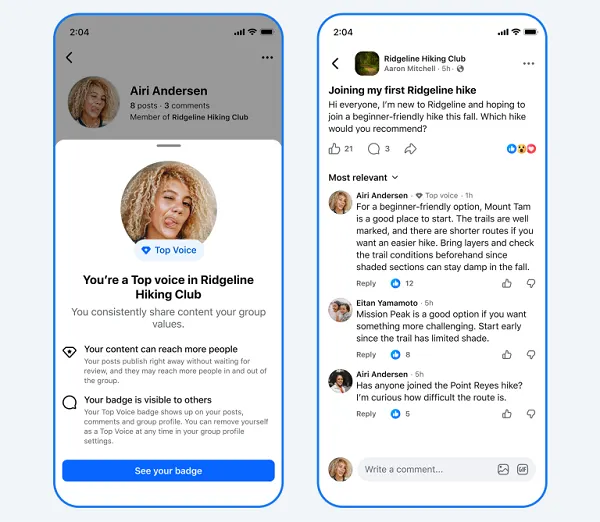
To combat the perennial challenge of community engagement—specifically, the burden placed on a small minority of active power users—Meta is rolling out official recognition badges. These visual markers will be awarded to recognized experts and top community voices who consistently provide constructive, empathetic, and factually accurate assistance.

According to guidelines released by Meta, these roles are earned exclusively through demonstrable contributions that actively elevate the community standard. This includes answering complex user queries, sharing verifiable firsthand experiences, offering practical recommendations, and initiating discussions that foster constructive dialogue. Beyond mere digital prestige, top contributors will receive tangible platform benefits, such as expedited post-publishing times that bypass standard moderation queues. By streamlining the workflow for trusted participants, Meta hopes to accelerate the velocity of accurate feedback across the entire application ecosystem.
2. Cross-Group Answer Aggregation
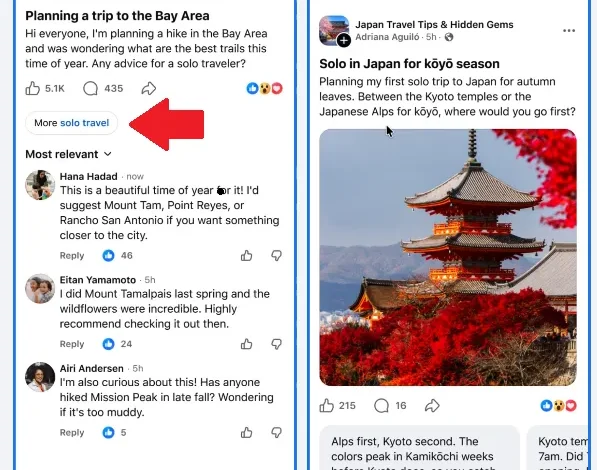
One of the most technically ambitious features in the new update is the implementation of cross-group answer displays. Historically, digital communities operate as isolated silos; a question asked in a specific cooking group remains confined to that group, even if a nearly identical query was comprehensively answered in a separate culinary forum a week prior.
Under the new system, when a user posts a query, Forum will test the display of relevant answers pulled from various related groups across the platform. This aggregation layer allows the user to evaluate and select the optimal response from a wider pool of community insights, bypassing the need to post duplicate questions or manually search multiple distinct groups. This functionality drastically reduces redundancy while surfacing the highest-quality consensus available within the broader Meta ecosystem.
3. Topic Labels for Enhanced Discovery
To support the cross-pollination of content and improve content discoverability, Meta is introducing granular topic labels. These tags categorize posts and questions by subject matter, allowing users to navigate through vast archives of historical discussions with minimal friction. As topic trees become more robust, the platform will be uniquely positioned to map user intent directly to established community knowledge bases.
Strategic Implications for Meta AI and the Broader Tech Landscape
While Meta continues to pitch the Forum app through the lens of human empowerment—emphasizing community building, collective intelligence, and peer-to-peer connection—independent technology analysts point out that the architecture serves a dual purpose. The true beneficiary of structured, categorized, and peer-vetted Q&A data is not necessarily the human user browsing the app, but rather the machine learning algorithms indexing the platform in real time.
For conversational AI assistants to remain competitive, they must move beyond generic summaries of web pages and provide nuanced, contextual, and human-validated answers to complex, subjective questions. When a top-tier contributor provides a detailed, upvoted troubleshooting guide for a specific household appliance within a Meta Forum, that text represents pristine training data. It is contextual, explicitly tied to a question-and-answer format, and socially validated by the community.
By gamifying participation through recognition badges and streamlining data aggregation across groups, Meta is effectively building an automated intake funnel for human intelligence. Users supply the labor of curation, moderation, and expertise for free, driven by social recognition and platform utility, while Meta captures the resulting semantic mapping to enhance its AI infrastructure.
Industry Context and Competitive Dynamics
Meta is far from alone in its pursuit of community-driven AI training data. The convergence of social media and search has accelerated rapidly over the past twenty-four months. Google has increasingly integrated Reddit and forum content directly into its primary search engine result pages (SERPs) via its "Discussions and forums" feature, acknowledging that modern internet users actively seek out peer-reviewed experiential data over corporate marketing copy.
At the same time, platforms like Discord, Geneva, and specialized Discord-style servers have fragmented online communities into private, encrypted, or semi-private channels that traditional search engines cannot index. By keeping its Forum app within its proprietary ecosystem, Meta ensures that valuable conversational data remains locked within its walled garden, simultaneously feeding its social graph and its artificial intelligence models.
Whether everyday users will embrace the Forum app as a permanent replacement for traditional Facebook Groups remains to be seen. Facebook Groups have long enjoyed massive legacy adoption, largely due to their integration with the primary social network’s notification and friend-graph infrastructure. Transitioning users to a specialized, Q&A-focused workflow requires a significant shift in user habits. However, by sweetening the experience with faster publishing times, expert recognition, and cross-group knowledge sharing, Meta is systematically removing the friction that typically hinders standalone app adoption.
Outlook and Future Development
As Meta continues to deploy these updates globally throughout the upcoming quarters, the company will likely monitor key engagement metrics, including query-to-resolution velocity, retention rates among designated top contributors, and the frequency with which cross-group answers are utilized.
Furthermore, developers will observe how effectively the new topic labels feed into broader Meta AI integrations across Messenger, WhatsApp, and the main Facebook application. If the Forum app successfully bridges the gap between casual social networking and structured knowledge management, it could redefine how massive technology conglomerates source, organize, and utilize human expertise in the age of artificial intelligence. For now, the platform stands as a clear testament to the shifting value proposition of the modern internet: where human conversation is increasingly valued not just for its social currency, but as the foundational architecture for the next generation of machine intelligence.