Mastering the Lifecycle of LLM-Integrated Scikit-Learn Pipelines Through Scikit-LLM and MLflow

The integration of Large Language Models (LLMs) into traditional machine learning workflows has shifted from an experimental niche to a fundamental requirement for modern software development. As enterprises transition from basic LLM prototypes to robust, production-ready pipelines, the challenge of maintaining reproducibility, version control, and model governance has become increasingly complex. The emergence of the Scikit-LLM library, combined with the industry-standard MLflow framework, provides a structured pathway to manage these sophisticated pipelines. By treating LLM-driven components as standard scikit-learn estimators, developers can now leverage established MLOps practices to ensure that every iteration of an LLM-integrated application is tracked, audited, and ready for deployment.
The Evolution of LLM Lifecycle Management
For years, scikit-learn has served as the backbone of machine learning development, offering a consistent API for building models. However, the stochastic nature of LLMs and the frequent updates to model backends—ranging from proprietary APIs like OpenAI’s GPT-4 to local, open-source variants like Falcon or Orca—create a significant "versioning gap." Traditional machine learning models are static files; in contrast, LLM pipelines often depend on specific model weights, prompts, and inference configurations that can change independently of the application code.
The necessity for a standardized approach was highlighted by the industry’s shift toward "Small Language Models" (SLMs) and quantized local execution, which allow for privacy-preserving, cost-effective inference. Managing these assets manually often leads to "notebook drift," where developers lose track of which model version produced a specific result. The synergy between Scikit-LLM and MLflow addresses this by wrapping complex LLM logic within the familiar fit/predict paradigm, enabling developers to capture the entire state of an experiment—including hyperparameters, environmental variables, and serialized model artifacts—within a centralized registry.
Establishing a Robust MLOps Foundation
Implementing a lifecycle management system for LLM pipelines requires a disciplined setup. The process begins with the installation of the necessary bridge libraries. By utilizing scikit-llm[gpt4all], engineers can deploy models locally, bypassing the latency and security concerns of cloud-based APIs while maintaining the high-level abstraction needed for rapid development.
The initial configuration phase is critical for reproducibility. Setting a unique tracking URI—such as a SQLite database—ensures that every training run is logged with a persistent record. This infrastructure allows teams to move away from local, ephemeral storage toward a shared environment where model registry entries serve as the "single source of truth." In this context, a zero-shot classification task acts as a baseline, demonstrating how text inputs can be mapped to categories without explicit retraining of the underlying language model. By defining the SKLLMConfig and initializing the MLflow tracking experiment, developers create an environment where every model execution is logged as a discrete event, complete with metadata such as the specific model file and the backend provider.
Chronology of an Experiment: From Prototype to Production
A typical development cycle follows a structured, three-stage progression: prototyping, auditing, and registry promotion.
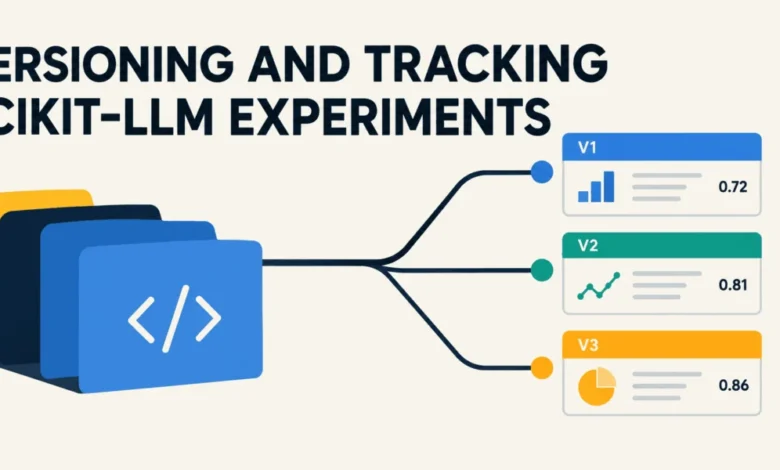
In the initial prototyping phase, the developer defines a baseline pipeline using a lightweight model, such as the orca-mini-3k variant. This initial run is encapsulated within an MLflow context manager. By logging parameters such as the llm_backend and the llm_model_file, the pipeline ensures that if an application performance issue arises later, the exact configuration used during the baseline testing can be reconstructed.
The second stage, the upgrade cycle, occurs when the developer replaces the lightweight model with a more powerful, higher-parameter alternative, such as the falcon-q4_0. The transition is documented within a distinct MLflow run. This stage is pivotal; it demonstrates the model-swapping capabilities of Scikit-LLM, where the underlying architecture of the pipeline remains unchanged while the intelligence engine is swapped out. This modularity is a hallmark of professional machine learning engineering, allowing teams to A/B test model performances systematically.
Finally, the auditing phase involves the aggregation of these runs into a comprehensive data frame. By analyzing the status column, engineers can identify successful runs while weeding out failed attempts caused by memory overflows, API timeouts, or configuration errors. This historical view is essential for regulatory compliance, particularly in sectors like finance or healthcare, where the provenance of a model’s decision-making process must be documented.
Technical Implications and Data Integrity
The use of cloudpickle as a serialization format is a technical necessity when dealing with modern, complex Python objects like Scikit-LLM classifiers. Unlike standard pickle, cloudpickle can serialize lambdas, functions, and classes that are frequently defined in deep learning workflows, ensuring that the entire pipeline—including the preprocessing steps and the model instance—is fully portable.
From a data-driven perspective, the ability to search runs based on performance metrics—such as accuracy, F1-score, or latency—transforms the registry from a mere storage locker into a decision-support system. By sorting runs by metrics.accuracy DESC, for instance, an engineer can programmatically identify the optimal version for promotion to production. This automated selection process minimizes human error and ensures that only the best-performing models reach the deployment phase.
Broader Industry Implications
The integration of these tools signals a maturation of the LLM sector. As organizations move beyond the "proof-of-concept" phase, the focus has shifted toward reliability and maintainability. The ability to register a model in a formal repository, complete with version numbering (e.g., Version 1, Version 2), mirrors the practices found in traditional software engineering (CI/CD). This creates a predictable pipeline where the deployment of a new model is as reliable as pushing a new version of an application codebase.
Moreover, the capacity to manage local, quantized models via MLflow has significant implications for data privacy. Organizations that are wary of sending sensitive data to external AI providers can now build, version, and deploy internal, secure LLM pipelines that reside entirely within their own infrastructure. This "sovereign AI" approach is becoming increasingly attractive for industries that handle PII (Personally Identifiable Information) and other sensitive data.
Conclusion: The Future of LLM Governance
The combination of Scikit-LLM and MLflow provides a necessary framework for the next generation of AI-driven applications. By enforcing strict versioning and providing tools for systematic comparison, this approach mitigates the inherent risks of working with black-box models. As the landscape of language models continues to evolve, the ability to rapidly swap, test, and register new architectures while maintaining a transparent history of previous iterations will distinguish successful AI implementations from failed experiments.
The transition from manual, ad-hoc development to a formal MLOps lifecycle is not merely a preference; it is a prerequisite for scaling LLM integration. By adopting these practices, engineering teams can ensure that their models are not just functional, but also robust, reproducible, and ready to meet the rigorous demands of production environments. As we look toward the future, the integration of these tools will undoubtedly remain a cornerstone of the AI developer’s toolkit, fostering a more transparent and reliable ecosystem for large language models.
Related posts: