The rapid evolution of modern web browsers has fundamentally shifted the traditional development paradigm of relying heavily on external packages for standard functionalities. For years, the standard approach to application development involved installing numerous specialized dependencies to handle everyday operations such as internationalization, data formatting, asynchronous requests, and user interface primitives. However, a significant gap between what developers traditionally required a library for and what the native web platform can handle natively has continued to narrow. Industry analyses indicate that a typical mid-sized JavaScript application currently maintains between 60KB and 90KB of compressed dependencies—ranging from 180KB to 270KB uncompressed—that modern web browsers can now natively support without external assistance.
Background and Evolution of the Web Platform
Historically, web developers turned to third-party ecosystems to compensate for inconsistent browser implementations and missing APIs. Libraries addressing tasks like date manipulation, deep object cloning, modal trapping, and number formatting became foundational to the npm ecosystem. However, organizations frequently overlook the rapid pace at which modern web engines—such as Chrome, Edge, Firefox, and Safari—release and standardize core platform features. While engineering teams routinely audit their package manifests for security vulnerabilities, they rarely evaluate whether existing libraries have become redundant due to native platform enhancements.
To address the challenge of tracking multi-browser compatibility, the WebDX Community Group introduced the concept of Baseline. This initiative provides a clear, standardized classification system that communicates the safety and availability of web platform features across all major browser engines. A feature generally progresses through distinct phases: it is initially introduced in a limited capacity, reaches "Newly Available" status once supported by all major browsers, and eventually attains "Widely Available" status after a standard incubation window of 30 months. This framework enables development teams to systematically evaluate native platform capabilities against the specific demographic profiles of their application user bases.
A Systematic Decision Framework for Dependency Audits

Transitioning away from established external packages requires a disciplined, structured approach to avoid inadvertently disrupting application performance or user experience. Industry experts recommend a three-part decision framework before deprecating any dependency. First, engineering teams must evaluate whether a native platform feature is Baseline-safe for their specific audience rather than relying solely on abstract global standards. B2B enterprise dashboards utilized primarily on modern, up-to-date desktop browsers present a different support profile compared to public-facing web properties catering to a long tail of legacy mobile devices.
Second, developers must analyze the tangible cost of any proposed code swap. In certain scenarios, adopting a native feature that lacks comprehensive support requires integrating a polyfill. If that polyfill exceeds the weight of the original dependency, the overall bundle size increases unless managed through conditional loading strategies. Third, engineering teams must verify whether native platform features fully encompass their specific functional requirements. While native alternatives often mirror basic functionalities, specialized libraries frequently provide advanced capabilities—such as HTTP request interceptors, automatic retries, or complex fallback mechanisms—that necessitate careful custom implementation.
Cluster Analysis: Internationalization and Localization Wins
The internationalization sector represents one of the most immediate opportunities for bundle reduction. Historically, developers relied on multiple specialized libraries to manage relative time formats, number structures, currency conversions, and text lists. Today, the native Intl namespace provides comprehensive solutions that are widely supported across major browser engines.
For instance, libraries designed to convert timestamps into relative string representations, such as "3 hours ago" or "yesterday," can be seamlessly replaced by Intl.RelativeTimeFormat. Similarly, Intl.NumberFormat handles complex numerical representations, including compact notations and localized currency formatting, while Intl.ListFormat natively manages grammatical conjunctions and punctuation rules. Collectively, deprecating legacy internationalization packages can eliminate approximately 14KB of gzipped code from an application bundle, yielding immediate performance dividends with minimal engineering overhead.
Evaluating HTTP Clients and Native Alternatives

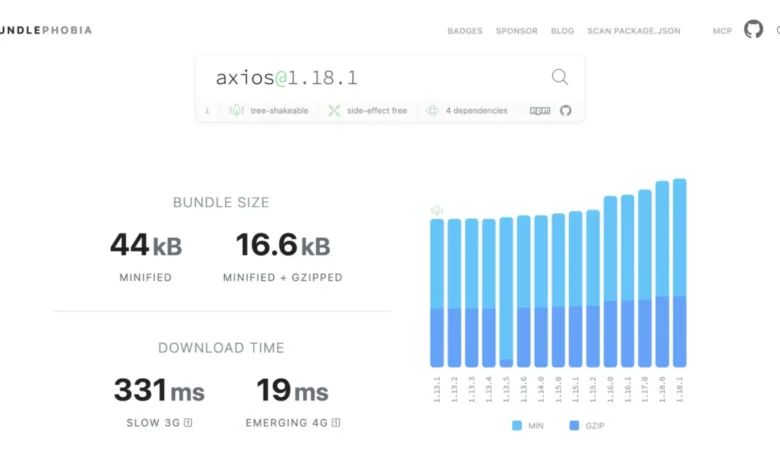
Network communication layer dependencies, such as popular HTTP libraries often exceeding 17KB in gzipped weight, warrant a more nuanced evaluation. For standard operations, the native fetch API combined with AbortController and AbortSignal.timeout() provides a robust mechanism for managing network requests and timeouts natively.
Nevertheless, enterprise applications frequently depend on advanced features inherent to dedicated HTTP clients, including global request interceptors, automatic retry logic, and centralized response transformations. Organizations must carefully review their actual codebase utilization before executing a complete migration. For applications primarily executing standard GET and POST operations, transitioning to a lightweight native fetch wrapper can successfully reduce bundle weight while preserving core functionality.
Modern User Interface Primitives and Native Accessibility
User interface development has similarly benefited from native platform evolution, particularly through the introduction of the <dialog> element, the Popover API, and CSS anchor positioning. Historically, developers incorporated multiple heavyweight libraries to manage modal dialogs, focus trapping, body scroll locking, and tooltip positioning.
The native <dialog> element, when invoked via showModal(), automatically manages focus trapping, background inertness, escape-key dismissal, and top-layer rendering to prevent z-index conflicts. Furthermore, background scrolling can be effectively restricted using modern CSS pseudo-classes such as body:has(dialog:modal). Combined with the Popover API and emerging CSS anchor positioning capabilities, these native features allow development teams to eliminate up to 24KB of gzipped UI dependency code while simultaneously improving accessibility compliance and out-of-the-box keyboard navigation.
Lodash Utilities and Native Data Structures

Utility libraries like Lodash have historically contributed significantly to application bundle bloat, even when imported selectively. Recent ECMAScript standards have directly integrated several of the most frequently utilized utility functions into the core JavaScript language.
The introduction of Object.groupBy and Map.groupBy allows developers to reorganize collections natively without external helper functions. Similarly, structuredClone provides a robust, native mechanism for performing deep object copies, correctly handling dates, maps, sets, and circular references for plain data structures. Furthermore, native Set objects now support comprehensive mathematical operations including intersection, union, difference, and subset evaluations. Eliminating redundant utility functions can readily reduce application bundles by 8KB or more.
Future Outlook: Emerging Standards and Strategic Timing
While native platform capabilities continue to expand, strategic timing remains critical for successful dependency audits. A prominent example involves the Temporal API, designed to replace the legacy JavaScript Date object with immutable structures and improved time zone management. Although Temporal represents a significant architectural advancement and has advanced through official language specifications, it has not yet achieved universal Baseline status across all stable browser releases. Adopting Temporal prematurely requires incorporating substantial polyfills that can significantly outweigh the footprint of lightweight legacy date libraries. Consequently, engineering organizations are advised to monitor platform adoption metrics and defer migration until native support matures.
Implementing a Quarterly Audit Process
To maintain optimized application performance, organizations should establish a repeatable quarterly audit workflow. This process involves listing production dependencies via package management tools, quantifying actual bundle impacts using source map explorers and bundle analyzers, and evaluating potential native replacements against current Baseline data. By systematically phasing out redundant libraries and leveraging progressive enhancement strategies for newly available platform features, development teams can consistently reduce JavaScript overhead, improve application load times, and deliver superior digital experiences to end users.