The modern digital advertising ecosystem relies heavily on attribution models, performance metrics, and statistical benchmarks provided directly by platform operators. Among these tools, ad platform lift studies—specifically those deployed by major digital players like Google, YouTube, Meta, and TikTok—have become the gold standard for measuring advertising efficacy. Brand Lift, Search Lift, and Conversion Lift studies promise to solve the eternal marketing conundrum: determining causality versus mere correlation in consumer behavior. However, a rigorous examination of official interpretation guidelines reveals a systemic divergence between how platforms define statistical certainty and how corporate buyers must evaluate financial risk.
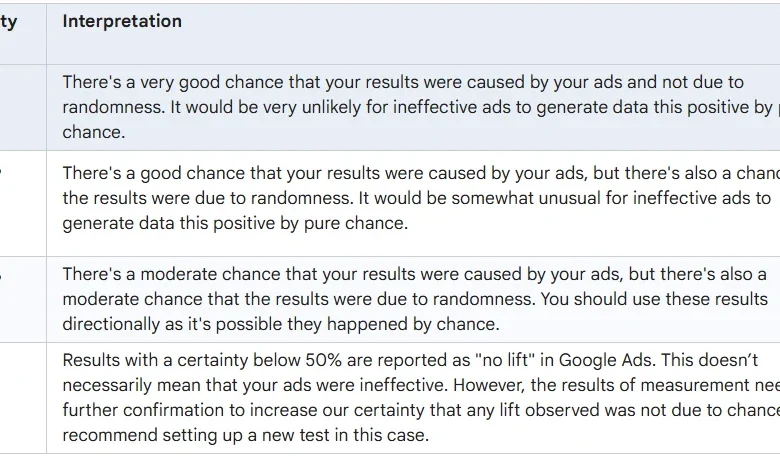
At the core of the friction is the way tech platforms categorize statistical outcomes. According to official documentation issued for Google and YouTube lift studies, results are binned into distinct tiers of certainty. A certainty score of 90% or higher is categorized as a "very good chance" of success. Scores ranging from 70% to 90% are termed a "good chance," while the 50% to 70% bracket is labeled a "moderate chance." Anything below 50% translates to "no lift." Furthermore, platform guidance explicitly indicates that studies achieving a score of 50% or higher can provide "valuable, directional insights," encouraging advertisers within the 50% to 70% range to utilize these ambiguous outcomes to guide strategy.
This terminology introduces a critical vulnerability for corporate marketing budgets. To a Chief Financial Officer (CFO) or Chief Marketing Officer (CMO), deploying capital requires high degrees of empirical reliability, particularly when allocating multi-million-dollar budgets. Yet, platform guidance leans heavily on qualitative, comforting descriptors such as "directional results" and "moderate chances." When translated into practical business terms, these phrases suggest that an ad campaign probably did not fail completely, leaving the door open for the platform to recommend further spending to see if results improve.
To understand the mechanics of this discrepancy, it is necessary to examine the divergent incentives of the two primary parties involved in digital advertising transactions. The platform functions as the seller of ad inventory. If a lift study produces weak, ambiguous evidence suggesting that an ad campaign might have worked, the platform incurs minimal downside. From the platform’s commercial perspective, exploring marginal data points or utilizing low-certainty insights keeps capital flowing into ad auctions.
Conversely, the corporate advertiser owns the marketing budget and carries the ultimate fiduciary responsibility. The marketer’s primary question is not whether the data contains interesting academic anomalies, but whether the empirical evidence is robust enough to justify risking another substantial tranche of corporate capital—such as a subsequent $5 million allocation—on the assumption that the initial spend generated a genuine return. Because platforms do not share in the financial losses of an underperforming campaign, the structural risk is entirely asymmetric.
The limitations of platform-defined certainty become starkly apparent when subjected to a replication risk framework. Drawing on methodologies inspired by biostatistician Steven Goodman’s work on statistical reliability, analysts can calculate the probability of successfully reproducing a reported lift under identical operational conditions.
For instance, consider a scenario where a YouTube Brand Lift Study reports a positive lift of three percentage points in consumer consideration, accompanied by a 70% certainty score—a metric that the platform classifies as a "good chance" of success. When this estimate is evaluated through a Bayesian replication model, the underlying mathematical reality shifts dramatically.
Under these conditions, the probability that an equivalent repeat campaign will yield any positive lift—even a negligible 0.01 points—sinks to approximately 65%. More critically, the probability that a replicated campaign will achieve the enterprise-grade threshold of 90% certainty drops to a meager 30%. Consequently, the "Replication Risk"—defined as the probability that a repeated campaign will fail to meet the rigorous standards required to justify continued spending—rises to 70%. In practical terms, an advertiser relying on a platform-certified "good chance" outcome faces a steep uphill battle where the odds of validating the investment a second time are remarkably low.
To mitigate this exposure, seasoned marketing analytics professionals frequently establish a stricter internal floor for decision-making. While platform operators normalize 70% certainty as an actionable insight, enterprise decision-makers often require a minimum of 90% to 95% certainty before advising executive leadership to reinvest capital. Even at a 90% certainty threshold, replication models indicate that the risk of failing to reproduce the result remains near 50%, underscoring the inherent volatility of digital media measurement.
The broader implications of relying on weak statistical evidence extend beyond mere budgetary waste. According to econometric research on Type S (sign) and Type M (magnitude) errors, weak statistical evidence often compounds risk in two distinct ways: the initial effect size is frequently overstated, and the underlying trend is unlikely to survive subsequent measurement. When advertisers build strategies on directional insights rather than high-confidence data, they expose their organizations to systemic overstatements of campaign efficacy.
This dynamic is not unique to a single search and video giant. Across the broader digital advertising landscape, major publishers including Meta and TikTok utilize similar reporting architectures. Agency partners, whose compensation models are frequently tied to the total volume of media spend under management, also face structural incentives to interpret ambiguous data optimistically.
Industry analysts emphasize that corporate governance requires marketing leaders to decouple their risk tolerance from the self-serving definitions provided by vendors. As digital ad spend continues to scale globally, the mandate for financial transparency dictates that enterprises must establish independent, rigorous analytical frameworks to evaluate performance. Relying on platform-sanctioned terminology like "directional" or "moderate" effectively outsources corporate risk tolerance to entities whose commercial interests lie in maximizing transaction volume rather than ensuring capital efficiency.
Related posts: