Beyond the Click: Why Modern Marketing Metrics Are Failing the C-Suite

In the contemporary corporate landscape, the eternal friction between the Chief Marketing Officer (CMO) and the Chief Financial Officer (CFO) often boils down to a fundamental misalignment in language and measurement. While marketing teams traditionally prioritize visibility, traffic, and top-of-funnel activity, financial leadership demands proof of sustainable, incremental business value. A recent strategic consulting engagement with a multinational corporation operating across 75 countries brought this longstanding operational divide into sharp focus, exposing a widespread industry reliance on vanity metrics that obscure true profitability.
The case study centers on an encounter with a regional marketing sub-team during a strategic overhaul aimed at positioning the enterprise for next-generation success. When pressed on the key performance indicators (KPIs) driving their digital campaigns, the team proudly pointed to "Cost Per Session" (CPS) as their primary measure of triumph. For a veteran analytics expert with decades of experience advising Fortune 500 companies, authoring multiple bestselling analytics texts, and helping pioneer foundational measurement tools, the metric was entirely novel—and deeply troubling.
Main Facts and Chronology
The discovery of the Cost Per Session metric triggered a broader investigation into how global enterprises evaluate marketing expenditure. Over a multi-month strategic consulting engagement, the analytics team mapped out the corporate reporting lifecycle, tracking how data flows from initial marketing activity all the way through to bottom-line profitability.
The chronological breakdown of the evaluation revealed a three-tier reporting structure currently utilized by modern enterprises:
- The Activity View: Initial reporting focuses heavily on platform-specific engagement, such as Google Advantage+ impressions, clicks, and session volumes.
- The Outcomes View: More advanced teams incorporate macro and micro-conversions, tracking orders, revenue generation, and conversion rates.
- The Accountability View: The most rigorous tier integrates financial inputs—specifically Campaign Costs and Cost of Goods Sold (COGS)—to evaluate true financial returns.
When applied to the enterprise’s actual campaign data, the chronological progression of these metrics fundamentally altered the assessment of campaign efficacy.
Supporting Data and Financial Analysis
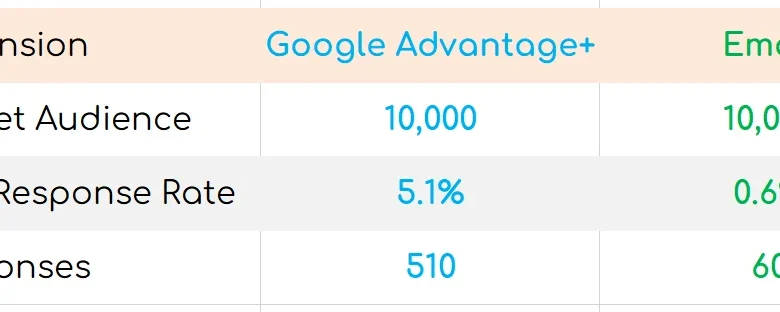
A granular review of the company’s digital advertising performance highlights the inherent dangers of relying solely on top-of-funnel metrics. The enterprise compared two primary acquisition channels: AI-driven paid campaigns (Google Advantage+) and direct email marketing.
In the initial Activity and Outcomes assessment, Google Advantage+ appeared to be an overwhelming success. The platform generated 173 orders and $17,000 in revenue, compared to a modest 14 orders and roughly $1,400 in revenue from email marketing. Based on gross revenue alone, digital advertising seemed to be the undisputed growth engine.
However, introducing financial accountability shifted the narrative entirely. By factoring in campaign costs ($7,000 for Google Advantage+) and Cost of Goods Sold, analysts calculated the Profit on Ad Spend (POAS) and Profit on Investment (POI).
The results revealed a startling dichotomy:
- Google Advantage+ generated $17,000 in revenue against $7,000 in campaign costs, yielding a negative Profit on Investment. For every $1 funneled into the AI-powered ad platform, the campaign returned approximately $0.70 in net profit.
- Conversely, email marketing, despite its lower overall revenue footprint, delivered a profit return of $5.70 for every $1 spent, operating with exceptionally high efficiency.
This stark discrepancy proves that high gross revenue can easily mask negative unit economics, transforming a marketing department into a vehicle for platform enrichment rather than corporate value creation.
Official Responses and Industry Implications
The implications of these findings extend far beyond a single corporate restructuring. Industry analysts and financial officers have long cautioned that traditional digital marketing metrics—such as Cost Per Session, Impressions, and basic Return on Ad Spend (ROAS)—fail to account for true incremental lift.
When presented with these findings, internal paid media teams often exhibit defensive postures, arguing that top-of-funnel traffic is essential for long-term brand equity and scale. Yet, financial stakeholders increasingly argue that scale without profitability is an unsustainable business model.
To bridge this gap, financial governance experts recommend a standardized hierarchy of accountability metrics:
- Priority 1 (POI – Profit on Investment): Subtracts both campaign costs and COGS from revenue, dividing by total spend to determine net profit return.
- Priority 2 (POAS – Profit on Ad Spend): Evaluates profit relative directly to advertising expenditure.
- Priority 3 (ROI – Return on Investment): Measures revenue minus ad spend relative to cost.
- Priority 4 (ROAS – Return on Ad Spend): The least rigorous standard, which frequently inflates marketing performance by ignoring actual ad costs and production expenses.
Strategic Remediation and the Shift to AI Search
Faced with negative profitability from major digital acquisition channels, strategic consultants recommend a decisive, multi-step remediation plan. Rather than maintaining status-quo spending, organizations are advised to immediately pause underperforming programmatic campaigns to reset baseline profitability. This temporary cessation often triggers alarms regarding traffic drops, but it forces marketing and agency teams to re-evaluate audience intent, creative relevance, and algorithmic configuration.
Furthermore, the urgency to abandon superficial metrics like Cost Per Session is amplified by the rapid evolution of search technology. As search engines transition toward AI-driven discovery models—such as conversational search interfaces and generative overviews—platform guidance increasingly emphasizes engagement quality over raw click volume. Recent documentation released by major search providers explicitly warns brands against optimizing solely for clicks or session volume, noting that AI-driven discovery yields smaller cohorts of highly qualified users who exhibit deeper site engagement and higher conversion intent.
To align with this shift, organizations struggling to eliminate Cost Per Session entirely are advised to transition toward measuring "Cost Per Non-Bounced Session," filtering out unproductive traffic that inflates apparent success while draining resources.
Broader Economic Impact
Ultimately, the transition from activity-based reporting to accountability-driven measurement represents a necessary maturation for modern marketing organizations. As corporate budgets face heightened scrutiny from CFOs navigating economic uncertainty, marketing strategies must prove their resilience against strict financial auditing.
By prioritizing outcomes over activity, and accountability over outcomes, enterprises can insulate their marketing investments against algorithmic disruption and economic headwinds. Aligning marketing execution with genuine financial profitability not only secures the long-term career viability of marketing leadership but also ensures that every corporate dollar spent directly contributes to sustainable enterprise value.