The Shift Toward Agent-Ready Architecture: How WordPress Is Adapting to the Rise of AI


The foundational design of WordPress has long revolved around the human visitor. For more than two decades, developers have built websites under the strict assumption that a browser is the epicenter of user engagement. Humans look around pages, fill out interactive forms, click on graphical buttons, and manually register for accounts. Consequently, developers construct themes, plugins, and databases around visual interactions that occur directly on a computer or mobile screen.
However, the rapid acceleration of artificial intelligence is fundamentally rewriting these core design assumptions. Modern AI agents do not necessarily need to view a graphical user interface, open a browser, or navigate the wp-admin dashboard to extract value or complete digital tasks. Instead, these autonomous software programs can directly fetch data, call underlying application programming interfaces (APIs), execute specific functions, and fulfill multi-step tasks in milliseconds.
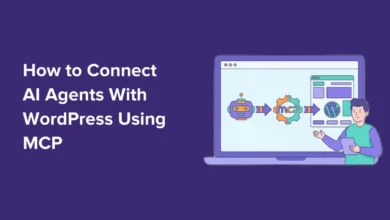
To keep pace with this technological evolution, the WordPress ecosystem is actively modernizing its underlying infrastructure. Emerging tools such as the WordPress Abilities API and the Model Context Protocol (MCP) Adapter are providing software with direct, programmatic pathways to discover and utilize site features. As these automated interactions become a standard part of the web landscape, developers and digital agencies face a new mandate: they must plan for a dual-audience web, designing systems that seamlessly accommodate both human users and AI-driven software agents. This paradigm shift alters long-held engineering practices regarding APIs, permissions, authentication protocols, performance monitoring, and system error management.
Understanding the Divergence: Human-First Versus Agent-Ready Systems
Human visitors possess a distinct cognitive flexibility that software agents fundamentally lack. When a person lands on a cluttered webpage or encounters a broken link, they intuitively scan navigation menus, interpret visual cues, reread prompts, or click alternative buttons until they achieve their desired goal.
AI agents, by contrast, require a much more rigid and predictable environment. They depend on clearly defined operational routes, structured inputs, standardized authentication methods, and machine-readable responses that can be reliably interpreted without visual context. This operational divide forces a reevaluation of traditional WordPress architecture:
- Where humans rely on visual navigation menus and clickable buttons, AI agents require discoverable capabilities exposed through code.
- Where humans complete physical text fields in a visual form, agents interact with structured inputs and RESTful APIs.
- Where humans manually submit login credentials on a visual screen, agents require secure, programmatic authentication mechanisms.
- Where humans interpret visual feedback, error messages, and animations, agents require structured data responses and machine-readable error codes.
- Where human sessions are measured in pageviews and dwell time, agent interactions are defined by discrete API calls and backend tool executions.
It is also critical to distinguish AI agents from traditional web crawlers and indexers. While standard crawlers primarily retrieve, read, or index static information for search engines, autonomous AI agents go a significant step further by taking active steps on behalf of a user. An agent might interrogate inventory databases, retrieve sensitive account records, generate and save content drafts, submit financial transactions, or trigger complex backend workflows. Once software is empowered to alter state rather than merely read content, website architecture must account for granular permissions, robust authentication, comprehensive failure states, and the real-world consequences of every executed action.
Moving Beyond Pages: Designing for Functional Capabilities
Traditional web design methodologies are anchored in the concept of the user journey. A visitor arrives at a landing page, clicks through sequential menus, fills out a form, and ultimately reaches a confirmation screen.
An AI agent, however, frequently bypasses this linear path entirely. Because it does not require a visual interface to understand underlying functionalities, it can interact directly with backend functions. Whether that function involves searching complex documentation, checking real-time ecommerce inventory, submitting an automated quote request, or generating a draft blog post, the interaction occurs at the code level.
Rather than forcing an AI agent to clumsily mimic the physical steps a human takes on a screen, modern web developers are increasingly exposing these actions in formats that software can natively understand and execute. The WordPress Abilities API exemplifies this evolution. Instead of forcing an external tool to scrape HTML or parse a web page, developers can directly define a specific action, specify the required data payloads, outline the expected outputs, and establish precise user permissions.
This capability-driven approach forces developers to ask a new set of strategic questions during the initial planning phase of a web project: What can this specific website safely allow human users and automated machines to execute independently?
The Heightened Importance of Authentication and Granular Permissions

When an AI agent is granted the ability to execute functional tasks within a WordPress environment, the primary security question shifts fundamentally. The inquiry is no longer simply "Can the software connect to the site?" but rather "What is this agent explicitly authorized to do?"
This distinction carries immense weight in the broader context of enterprise cybersecurity. According to CyberArk’s 2025 Identity Security Landscape report, a striking 68 percent of organizations currently lack adequate identity security controls specifically tailored for artificial intelligence integrations. While establishing an initial connection for an AI agent is technically straightforward, maintaining strict boundaries to limit that access to a specific task requires meticulous planning.
Security experts emphasize that an agent’s access should remain strictly tied to its immediate operational scope. For instance, an automated tool designed exclusively to search through site documentation has no operational justification for editing published posts. Similarly, a tool tasked with drafting content does not require permission to publish those drafts live. When dealing with high-stakes actions—such as modifying user accounts, deleting database content, or handling payment gateways—the security bar must be raised exponentially.
The WordPress Abilities API assists developers in enforcing these boundaries by allowing them to embed distinct permission checks directly into each capability, alongside rigorously defined inputs and outputs. This granular control is vastly superior to the risky practice of handing an external service full administrator credentials and blindly trusting it to self-regulate.
Fundamental security hygiene remains paramount in the age of AI integration. Any data transmitted by an agent must be rigorously sanitized and validated before WordPress executes the request. Furthermore, sensitive credentials must never be exposed within prompt strings, front-end client code, or unencrypted server logs. When an automated workflow reaches a junction where it is about to execute an irreversible or financially significant action, the architecture should be designed to automatically pause and require explicit human sign-off.
Performance Demands Driven by Machine Consumers
Human visitors naturally browse at an organic, measured pace. They load a single page, read the text, contemplate their next move, click a link, and wait for the subsequent response. AI agents, conversely, operate at machine speed. They are entirely capable of issuing dozens or even hundreds of rapid-fire requests within a span of seconds as they gather context, invoke various backend tools, compare analytical results, and execute multi-step operational tasks.
Because machine-driven workflows can place a substantially heavier load on a WordPress server than a single human browsing the site, optimization becomes critical. Developers must actively trim redundant database operations by combining multiple API requests into single endpoints, caching read-only responses, enforcing strict rate limits, and offloading heavy computational jobs into asynchronous background queues. Implementing sensible timeouts also ensures that a runaway automated workflow cannot monopolize server resources and degrade performance for human visitors.
Timeouts present a unique architectural challenge in agent-driven environments. If a server timeout occurs, the underlying request may have actually succeeded on the backend, even though the AI agent never received a formal confirmation message. If the agent automatically re-issues the identical request, the consequences can range from benign (in the case of a simple data lookup) to catastrophic (in the case of a duplicated financial transaction or inventory order). Consequently, modern agent architectures require idempotency mechanisms—ways for an agent to safely check whether a job has already been processed before attempting a retry.
Ensuring Predictable Responses and Workflow Observability
For an AI agent to function reliably, it requires absolute predictability from the systems it interacts with. If a server response is ambiguous or vague, the agent is left to guess whether its task is still processing, failed entirely, or completed successfully without transmitting a confirmation.
In long, multi-step automated workflows, unclear responses compound rapidly. If a single intermediate step returns an ambiguous result, the agent may erroneously repeat the action, skip a critical step, or proceed prematurely before the foundational task has finished. While repeating a documentation search is harmless, repeating an order placement or a content deletion can cause severe data corruption.
Modern enterprise platforms utilize specialized tracking methods to mitigate this risk. For example, the Kinsta API incorporates operation IDs for long-running hosting tasks. Instead of forcing an API connection to remain open and wait for a lengthy process to finish, the server immediately returns a unique operation ID that software can query periodically to check the exact status of the background job.
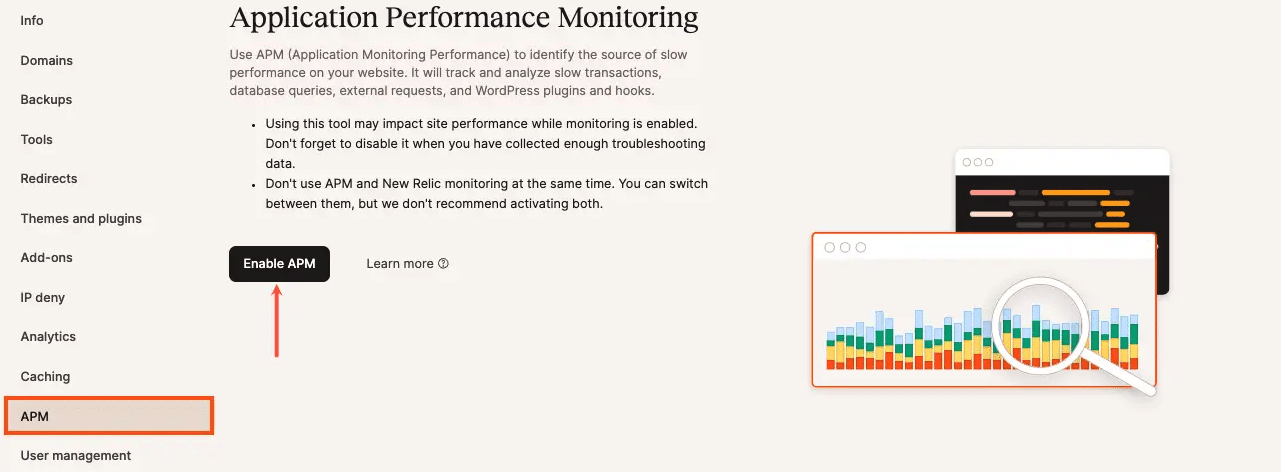
Simultaneously, comprehensive observability is vital for debugging when automated workflows inevitably encounter errors. A standard, generic error message is rarely sufficient to diagnose complex software failures. Developers need granular visibility into which specific API request stalled, whether WordPress successfully communicated with an external microservice, how the database responded, and whether an agent accidentally transmitted duplicate requests. Specialized monitoring tools, such as Kinsta APM (Application Performance Monitoring) and detailed server error logs, allow technical teams to trace this activity meticulously within isolated staging environments before changes ever hit production servers.
Expanding Machine Interfaces to the Hosting Layer
The transition toward agent-ready infrastructure does not stop at the application layer of WordPress; it extends directly into the underlying hosting environment. Modern web operations increasingly demand machine-facing interfaces at both the site level and the infrastructure level.
At the WordPress application level, tools like the Abilities API and the MCP Adapter expose site content and programmatic functions to external software. At the hosting level, advanced APIs expose operational infrastructure tasks that traditionally required a human system administrator to manually click through a graphical dashboard.
The Kinsta API, for instance, grants developers comprehensive programmatic access to vital hosting operations, including retrieving environment details, managing DNS domains, purging server caches, and handling automated backups. This capability bridges the gap between the WordPress application and broader business automation tools, allowing external systems to programmatically verify server health before deploying updates or triggering automated administrative workflows.
Furthermore, innovations such as Kinsta’s MCP server—built directly on top of its API—allow AI clients to utilize specific hosting functions as native tools. An AI assistant can inspect staging environments, clear server caches, clone WordPress installations, or pull plugin telemetry data without requiring a human operator to log into the MyKinsta dashboard for every routine maintenance step. Security best practices dictate that these integrations follow the principle of least privilege: an agent granted access to clear a server cache should be strictly restricted from performing broader account-level modifications.
Incorporating Agent-Readiness into Agency Architecture Reviews
Digital agencies and web development firms are rapidly realizing that agent-readiness must become a standard criterion in architectural reviews. While an enterprise client may not demand immediate AI agent integration for every new WordPress build, engineering teams must proactively avoid architectural decisions that lock these capabilities out or make future integration prohibitively expensive.
During the planning stages of a major web build, technical leads should evaluate several forward-looking criteria:
- Can core business logic be easily exposed via clean API endpoints, or is it trapped inside monolithic, hard-coded templates?
- Are user permissions and authentication protocols robust enough to support automated software agents alongside human users?
- Is the hosting infrastructure capable of absorbing sudden bursts of high-speed, machine-driven API traffic without impacting human user experience?
- Do error-handling mechanisms provide structured, predictable responses that external software can programmatically parse and recover from?
Case studies across the managed hosting landscape continually demonstrate the immense value of programmatic infrastructure. For example, agencies managing hundreds of enterprise WordPress sites frequently rely on advanced APIs to automate repetitive deployment and maintenance tasks that would otherwise require hundreds of hours of manual oversight. While these automations may not always be powered by conversational AI, they prove the undeniable utility of infrastructure built for software-to-software communication.
As client demands evolve, workflows that begin as simple internal automation scripts can easily be scaled to connect with advanced AI assistants, Model Context Protocol clients, or enterprise resource planning (ERP) systems. By ensuring that underlying functions possess clean interfaces and sensible security permissions, agencies future-proof their web builds against rapid technological shifts.
Conclusion: Building for People and the Software Acting for Them
WordPress remains fundamentally rooted in serving human users. Graphical pages, intuitive forms, interactive navigation menus, and polished user experiences will always remain the cornerstone of the web. What has permanently changed, however, is the realization that human eyes and browser clicks are no longer the exclusive mechanisms through which digital interactions occur.
As artificial intelligence agents assume a greater role in executing everyday digital tasks, the underlying plumbing of the web becomes vastly more important. Developers must maintain rigorous control over what external software can access, how much privilege it holds, how resilient server performance remains under automated pressure, and where technical teams can investigate when workflows fail.
Web development teams do not need to radically rebuild every existing WordPress site around autonomous AI agents today. However, they must permanently abandon the outdated assumption that every future interaction with a website will begin with a human opening a web browser. By leveraging advanced managed hosting platforms, robust APIs, and modern architectural standards, developers can build digital ecosystems that effortlessly serve both human visitors and the sophisticated software acting on their behalf.