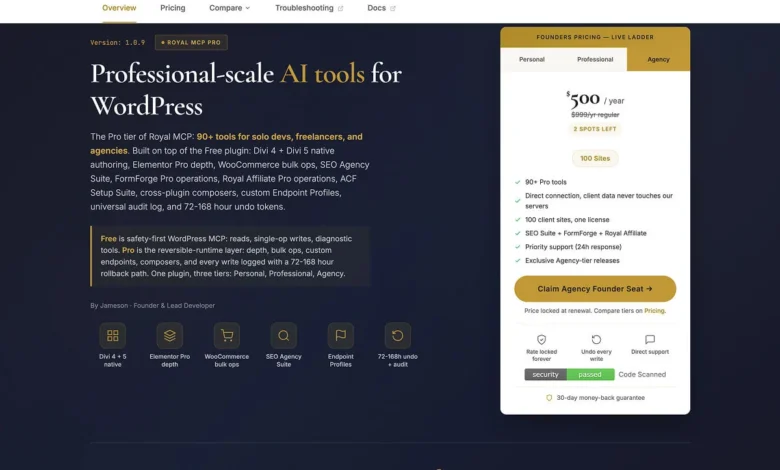
The integration of artificial intelligence into web development has largely focused on content generation, but a new class of tooling is shifting the paradigm toward autonomous site operations. Royal MCP Pro has emerged as a significant development in this space, acting as a self-hosted Model Context Protocol (MCP) server that grants AI clients—such as Claude, ChatGPT, Gemini, and Perplexity—direct, structured access to WordPress environments. By facilitating more than 300 distinct tools, the software allows for sophisticated, agent-driven management of websites, ranging from WooCommerce bulk operations to complex SEO workflows.
Background and the Rise of MCP in WordPress
The Model Context Protocol (MCP) was introduced to standardize how AI models interact with local and remote systems. Prior to its widespread adoption, connecting an AI agent to a website often required bespoke API integrations, custom middleware, or third-party connectors that frequently introduced security vulnerabilities or data privacy concerns.
Royal MCP Pro addresses these challenges by enabling direct communication between an AI client and the WordPress installation via OAuth 2.0 with Proof Key for Code Exchange (PKCE). This authentication flow eliminates the need for middle-tier proxies, ensuring that site data is not processed or stored by intermediary infrastructure. This architecture is particularly relevant for digital agencies managing high-stakes client sites, where data sovereignty and security compliance are paramount.
The release of Royal MCP Pro follows a surge in interest surrounding the open-source version of the plugin, which has surpassed 10,000 active installations on WordPress.org. The Pro iteration marks a transition toward professional-grade features designed for high-volume, multi-site management, focusing specifically on risk mitigation and workflow automation.
Core Functionality and Tool Orchestration
At its core, Royal MCP Pro functions as a bridge, translating natural language requests from an AI model into specific, executable functions within the WordPress core, Elementor, Divi, and various e-commerce ecosystems. With a library exceeding 300 tools, the plugin covers a vast spectrum of administrative tasks.
A key differentiator for the Pro version is the introduction of "composers"—macro-like functions that execute multi-step processes through a single AI request. The seo_optimize_for_launch composer, introduced in version 1.0.8, exemplifies this capability. Previously, a comprehensive SEO launch required five or more manual tool calls: auditing the post, configuring meta tags, verifying schema markup, setting up 301 redirects, notifying IndexNow, updating Google Search Console, and clearing the site cache.

By chaining these operations into a single atomic transaction, the plugin significantly reduces the likelihood of "hallucinations" or logical errors that can occur when an AI attempts to sequence complex, multi-stage tasks independently. If any step within the chain fails, the system executes a full rollback, ensuring the site remains in a known, stable state.
Addressing the Risks of Autonomous Writes
The primary barrier to adopting AI-driven site management is the potential for irreversible errors. Granting an AI the ability to execute bulk updates—such as modifying the pricing structure for 500 WooCommerce products—carries inherent risks. Royal MCP Pro mitigates this through a robust "Undo Token" system and comprehensive logging.
This feature allows for the reversal of actions performed by the AI, providing a safety net for users. The system logs every interaction and tool invocation, allowing administrators to review the AI’s history and revert changes as needed. Industry analysts suggest that this focus on "reversibility" is the most critical development in the AI agent space, as it transforms the relationship between user and agent from one of "trust" to one of "oversight." By providing a three-day window for reversal, the plugin accommodates both immediate error detection and delayed discovery, such as when a client reports an issue after a weekend.
Market Positioning and Founding Member Pricing
Royal Plugins has initiated a tiered "Founding Member" pricing model to coincide with the Pro version’s release. This strategy serves two purposes: it incentivizes early adoption and provides the developer with feedback from power users managing large fleets of sites.
The pricing structure is categorized as follows:
- Individual/Small Agency Tier: Designed for single-site owners or small businesses with limited infrastructure.
- Agency Tier: Tailored for operations managing up to 100 sites, providing a cost-effective solution for scaling automated workflows.
Data suggests that for agencies managing large portfolios, the return on investment (ROI) is realized through the reduction of manual labor hours. Tasks that previously required significant developer time—such as mass-updating metadata across a network of sites—can now be executed by a prompt, monitored by the plugin’s logging and rollback systems. The seats for the Founding Member rate are capped, creating a time-sensitive window that forces organizations to evaluate their current operational efficiency against the costs of manual site maintenance.
Implications for the WordPress Ecosystem
The introduction of tools like Royal MCP Pro signals a broader shift in how web administrators will interact with their CMS in the coming years. As AI models become more capable of logical reasoning and task execution, the "admin dashboard" as a UI-heavy interface may eventually transition toward a "command-line-plus-agent" model.

The security model employed by Royal MCP Pro—which avoids third-party telemetry and keeps data strictly between the AI client and the local server—sets a benchmark for future plugins in this space. Agencies currently experimenting with AI are advised to maintain strict access control profiles, ensuring that AI agents are granted only the minimum permissions necessary to perform their assigned tasks.
Furthermore, the emphasis on logging and rollback functionality is a necessary evolution. As the industry moves away from "AI-as-a-content-generator" to "AI-as-an-operator," the ability to audit and reverse machine-led changes will become the standard requirement for enterprise-level adoption. The reliance on OAuth 2.0 with PKCE also aligns with modern security standards, reflecting a maturing market that is no longer satisfied with "experimental" integrations.
Looking Ahead
The trajectory for Royal MCP Pro and similar MCP servers suggests that the next phase of WordPress development will be defined by orchestration. The capacity for an AI to navigate the intricacies of different page builders like Elementor and Divi, combined with the ability to manage complex e-commerce data, effectively turns a website into an API-accessible application.
While the current market remains in an early-adopter phase, the move toward standardized protocols like MCP means that these tools will likely become interoperable with a wider range of AI interfaces. For web developers and agency owners, the challenge will not be the technology itself, but rather the implementation of rigorous oversight protocols. As agencies begin to hand off routine, high-volume tasks to AI, the emphasis must remain on the systems that monitor these agents, ensuring that while the speed of site management increases, the integrity of the underlying data remains intact.
For those currently testing the free version on WordPress.org, the transition to the Pro version represents a shift from experimentation to production-grade operational efficiency. As the Founding Member pricing window closes, the industry will watch closely to see how many agencies adopt these tools as a standard component of their maintenance workflows, potentially setting the stage for a new standard in automated site management.