PressMeGPT Bridges Critical Gap in AI-Driven Web Development to WordPress Migration

The rapid evolution of artificial intelligence in web design has introduced a new paradigm for website creation, allowing users to quickly generate visually appealing frontends through platforms like Lovable, Bolt.new, or Base44, or even via intuitive tools used by clients directly. However, a significant challenge has emerged in integrating these AI-generated designs into robust content management systems (CMS) like WordPress, which are essential for long-term site management, blogging, plugin integration, and scalability. Historically, the transition from an AI-built or standalone static site to a native WordPress theme has necessitated a laborious, manual reconstruction, consuming valuable time and resources. This arduous process, often involving rebuilding a site section by section in WordPress, has created a substantial workflow inefficiency.
The Evolving Landscape of Web Design and the "Rebuild" Dilemma
For years, web development has moved from bespoke coding to template-driven designs, then to intuitive drag-and-drop page builders, and now, increasingly, to AI-powered generators. These AI builders offer unprecedented speed and accessibility, democratizing web design by enabling individuals and small businesses, often without technical expertise, to produce professional-looking websites in minutes. This wave of innovation has been celebrated for its ability to lower barriers to entry and accelerate initial project phases.
However, the speed of creation has often been juxtaposed with limitations in functionality and long-term management. Many AI-generated sites, while aesthetically pleasing, often reside on proprietary platforms, leading to vendor lock-in. They frequently lack integrated CMS capabilities, making it difficult to publish blog posts, manage user roles, optimize for search engines (SEO), or extend functionality with third-party plugins. This deficiency becomes apparent when a project matures beyond a simple brochure site, demanding dynamic content, e-commerce features, or advanced marketing integrations.
WordPress, commanding over 43% of all websites on the internet, remains the de facto standard for a feature-rich, scalable, and open-source CMS. Its vast ecosystem of themes, plugins, and developer support makes it the preferred platform for businesses seeking control, flexibility, and longevity for their digital presence. The disconnect between the ease of AI-driven frontend generation and the necessity for a powerful backend has thus forced a critical decision point: either compromise on long-term functionality or embark on a costly and time-consuming manual rebuild within the WordPress environment. This "rebuild dilemma" has represented a significant friction point for agencies, freelancers, and businesses attempting to leverage the best of both worlds.

PressMeGPT: A Bridge for Seamless Migration
Emerging as a pivotal solution to this persistent workflow bottleneck, PressMeGPT is specifically engineered to bridge the gap between rapidly generated frontends and the comprehensive capabilities of WordPress. This innovative platform is designed to take an existing website, an AI-generated project, or even a simple text prompt, and intelligently convert it into a production-ready WordPress theme or Elementor template. The core promise of PressMeGPT lies in its ability to deliver a substantial portion of a finished design—reportedly around 80%—in mere minutes, thereby shifting the focus of development from laborious reconstruction to efficient refinement. This paradigm shift allows developers and designers to invest their expertise in crucial branding, customization, and optimization, rather than repetitive foundational work.
The significance of PressMeGPT extends beyond mere conversion; it empowers users with full ownership of their generated themes, allowing for hosting on any preferred platform without proprietary restrictions. This stands in stark contrast to many AI builders that retain control over the hosting environment or restrict export options, ensuring true autonomy for the website owner.
Versatile Input and Robust Output Capabilities
The core strength of PressMeGPT lies in its highly flexible conversion process and the diverse range of inputs it can accommodate. Users can initiate a conversion from:
- Existing Website URLs: By simply providing a URL, PressMeGPT analyzes the structure and aesthetics of an live site, regardless of its original platform (e.g., Lovable, Bolt.new, Base44, or any other static site builder), and translates it into a WordPress-compatible format. This feature is particularly valuable for migrations from proprietary systems or for clients presenting existing non-WordPress sites.
- HTML Code: For developers or designers working with raw HTML, PressMeGPT can ingest the code directly, transforming it into a functional WordPress theme. This offers a pathway for integrating custom-coded frontends with the WordPress backend.
- Text Prompts: Leveraging the power of natural language processing, users can describe their desired website design, layout, and content elements through plain text prompts. The AI then interprets these instructions to generate a preliminary WordPress theme, acting as a powerful starting point for new projects.
Beyond these immediate capabilities, PressMeGPT has outlined an ambitious roadmap, with upcoming integrations for popular design tools like Canva and Figma. These integrations promise to further streamline the workflow for designers, allowing them to directly import their design files and convert them into functional WordPress assets, thereby closing the loop between design conception and CMS implementation.

Regardless of the input method, each generation cycle yields three distinct design variations, providing users with options and creative flexibility. The output is consistently a native WordPress theme or an Elementor template, ready for further customization using the user’s preferred builder—be it Elementor, the Gutenberg block editor, or other compatible tools. This approach distinguishes PressMeGPT from earlier generations of "prompt-only" AI website builders, which primarily focused on generating new sites from scratch. While useful for nascent projects, PressMeGPT’s ability to convert existing sites marks a significant leap forward, making it an indispensable tool for site migrations and the modernization of legacy web properties.
Integrating with Established Workflows: Elementor and the Block Editor
A key consideration for any new web development tool is its compatibility and integration with existing, widely adopted workflows. PressMeGPT strategically positions itself not as a replacement for established page builders but as an upstream accelerator. It handles the initial heavy lifting of theme generation, creating a robust foundation that can then be seamlessly handed off to popular builders like Elementor or the native Gutenberg block editor for detailed customization.
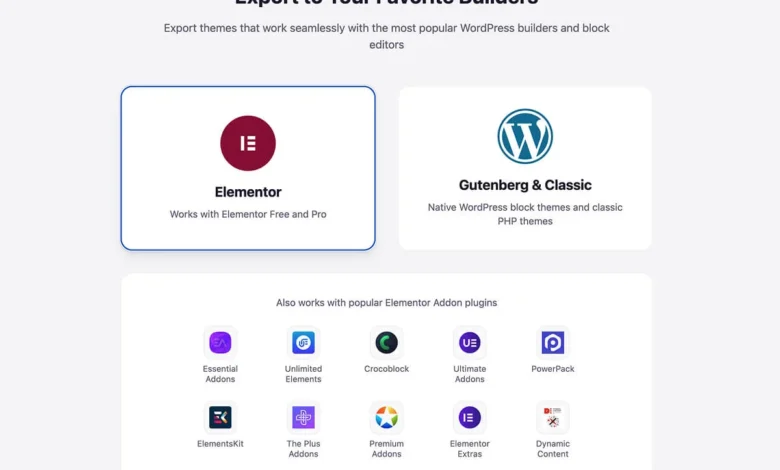
For the vast community of web professionals already standardized on Elementor, PressMeGPT offers a particularly compelling value proposition. The platform’s ability to export Elementor templates means that generated designs can be directly imported into a familiar Elementor environment, allowing teams to leverage their existing expertise and resources. Crucially, these templates are compatible with Elementor’s free version, eliminating the need for a Pro license to utilize the output, though the Elementor export feature is typically available from the Freelance plan upwards, with the entry-level Creator plan focusing on Gutenberg and classic theme exports. Furthermore, PressMeGPT-generated themes are designed to work harmoniously with popular Elementor add-ons, such as Essential Addons, Unlimited Elements, and Kadence Blocks, ensuring continuity and flexibility in design choices.
This integration philosophy underscores PressMeGPT’s commitment to augmenting, rather than disrupting, established development practices. By providing a solid, pre-built framework, it allows designers and developers to focus their creative energy on the final 20% of a project—the unique branding, interactive elements, and bespoke functionalities that truly differentiate a website—rather than spending hours on repetitive structural assembly.
The Practical Conversion Workflow

The operational workflow within PressMeGPT is streamlined into three distinct steps, designed for efficiency and clarity:
- Input: Users begin by providing their source material, whether it’s a website URL, raw HTML, or a descriptive text prompt outlining the desired design. This initial input serves as the blueprint for the AI’s generation process.
- Generate: Upon receiving the input, PressMeGPT’s AI engine processes the information and generates three distinct design variations. This iterative approach allows users to select the most suitable starting point, fostering creative exploration without significant time investment.
- Refine and Export: Once a preferred design variation is chosen, users can initiate the refinement process within PressMeGPT (if available for minor tweaks) or directly export the output as a native WordPress block theme or an Elementor template. This output is then ready for further customization within the WordPress Full Site Editor or Elementor.
A particularly noteworthy aspect of PressMeGPT’s output is its commitment to generating proper block themes. Unlike many AI tools that might only produce individual blocks or sections, PressMeGPT aims to create comprehensive block themes complete with real header and footer template parts. These are fully editable within the native WordPress Full Site Editor, offering a truly integrated and future-proof solution. This adherence to modern WordPress standards is critical for ensuring long-term compatibility, optimal performance, and ease of management. The company’s FAQ further emphasizes that these themes follow contemporary block theme standards, operate without requiring additional plugins or ongoing subscriptions, and contribute to faster site speeds, fewer conflicts, and enhanced security—a significant advantage given that third-party plugins are frequently identified as a primary source of security vulnerabilities in WordPress installations.
Strategic Advantages for Key User Segments
PressMeGPT presents compelling advantages for various segments of the web development community:
- Agencies: For web development and design agencies managing multiple client projects, the ability to generate 80% of a website’s design in minutes represents a monumental time-saving opportunity. This efficiency compounds across a client roster, significantly reducing project timelines and operational costs. The Elementor export capability is particularly beneficial, enabling junior team members to handle refinement tasks without needing deep coding knowledge, thereby optimizing resource allocation and project scalability.
- Freelancers: Independent web professionals often juggle numerous projects and tight deadlines. PressMeGPT empowers freelancers to bypass the tedious initial build phases, allowing them to allocate more time to delivering bespoke functionalities and custom solutions—the very services clients are willing to pay a premium for. This not only enhances productivity but also elevates the perceived value of their work, positioning them as strategic partners rather than mere executors. It integrates seamlessly with the growing array of AI tools for WordPress development, further streamlining the freelance workflow.
- Bloggers and Content Creators: For individuals focused on content creation, the technical complexities of website development can be a significant barrier. PressMeGPT offers a straightforward pathway to establishing a professional online presence. By simply describing their vision, content creators can acquire a functional, visually appealing theme without delving into theme development or incurring the expense of a custom build. This democratization of web design empowers them to launch and manage their platforms with greater autonomy and efficiency.
The 80% Solution: Understanding the Remaining 20%
While PressMeGPT’s claim of delivering approximately 80% of a design in minutes is a powerful testament to its efficiency, it is crucial for users to approach this with a clear understanding of what the remaining 20% entails. This final portion of the development process—the polish, the brand integration, the nuanced details, and the unique user experience elements—remains firmly within the human domain. It is in this crucial 20% that a website truly comes alive, reflecting the client’s unique identity and meeting specific functional requirements. Users must anticipate dedicating time to:

- Branding and Aesthetics: Fine-tuning colors, typography, imagery, and overall visual identity to align perfectly with a brand’s guidelines.
- Content Integration and Optimization: Populating the site with actual content, ensuring proper formatting, and optimizing for readability and SEO.
- Accessibility and User Experience (UX): Adjusting layouts, navigation, and interactive elements to ensure an inclusive and intuitive user experience for all visitors.
- Performance Optimization: While PressMeGPT aims for clean code, further performance tuning (e.g., image optimization, caching setup) is often necessary for peak speed.
- Specific Features and Integrations: Implementing unique functionalities, third-party integrations (e.g., CRM, email marketing), or custom code snippets that go beyond the generated structure.
Moreover, while a Theme Checker feature is anticipated for higher-tier plans, current users should proactively review their generated themes against accessibility guidelines and Core Web Vitals to ensure optimal performance and compliance. A practical detail worth noting from the PressMeGPT knowledge base is that exported themes typically reference images and videos via their remote paths. Localizing this media into WordPress is a separate step that consumes credits and is not included in the free plan. This aspect requires careful planning to avoid unexpected costs or workflow interruptions during initial projects.
Pricing, Credits, and Theme Ownership
PressMeGPT operates on a credit-based system, a common model for AI-powered services. The cost structure is transparent: generating a new theme typically consumes 3 credits and produces three design variations. Each AI-driven modification or refinement incurs at least 1 credit, while converting an existing website costs between 2 to 3 credits. PressMeGPT estimates that a fully customized theme might require 7 to 10 credits in total, reflecting the iterative nature of design refinement.
For those eager to explore the platform, a free plan is available, offering 5 credits per month, sufficient for testing a single theme. However, it’s important to note that themes generated under the free plan are public, media migration is excluded, and exports are limited to classic WordPress themes, rather than the more advanced block themes or Elementor templates.
Paid plans offer increased capacity and features, billed annually:
- Creator Plan: Starting at $69 per year, this plan typically includes 120 credits annually, equating to roughly one completed site per month.
- Freelance Plan: This tier usually includes more credits and unlocks advanced features like Elementor template export.
- Agency Plan: Priced at $399 per year, this plan offers a substantial 1,800 credits annually, supporting the development of approximately 15 sites per month, catering to high-volume users.
Monthly and one-time billing options are also available, providing flexibility, and all paid plans are backed by a 30-day money-back guarantee. A significant advantage of PressMeGPT is the explicit theme ownership model: once a theme is exported, it belongs entirely to the user. There are no recurring per-site fees, ongoing subscriptions for the theme itself, or mandatory plugins required for its functionality, ensuring a truly future-proof and independent web asset.

Broader Implications for the Web Development Ecosystem
PressMeGPT’s emergence signifies a maturation in the AI-driven web development landscape. It acknowledges the strengths of rapid AI generation while simultaneously addressing the enduring need for a robust, flexible, and owner-controlled CMS like WordPress. This tool has the potential to:
- Democratize Advanced Web Development: By lowering the technical barrier to entry for creating complex WordPress sites, it empowers a wider array of individuals and small businesses to establish a professional online presence.
- Enhance Developer Productivity: For seasoned professionals, it shifts the focus from repetitive foundational tasks to higher-value creative and strategic work, potentially increasing output and profitability.
- Streamline Migrations: It provides a much-needed automated solution for migrating sites off proprietary platforms or converting static sites into dynamic WordPress environments, a common challenge in the digital realm.
- Foster Innovation within WordPress: By facilitating the creation of native block themes and Elementor templates from diverse inputs, PressMeGPT contributes to the continued growth and adaptability of the WordPress ecosystem, encouraging experimentation with AI tools without sacrificing WordPress’s core benefits.
In an era where digital presence is paramount for every entity, tools like PressMeGPT are not merely conveniences but strategic assets. They represent a significant step towards a future where the initial design and foundational build of a website are largely automated, freeing human creativity and expertise for the critical aspects of brand differentiation, user experience optimization, and ongoing content strategy.
Conclusion: A Strategic Tool for Modern Web Development
For agencies, freelancers, and businesses grappling with the complexities of converting AI-generated or existing websites into a manageable, scalable WordPress platform, PressMeGPT offers a compelling and timely solution. It directly addresses a genuine workflow inefficiency that has long plagued the industry, providing a clean, efficient path from initial design to production-ready WordPress assets.
The free plan, with its 5 monthly credits, offers an accessible entry point for evaluating PressMeGPT’s capabilities on a real project. This hands-on experience will be crucial for prospective users to assess the quality of the output and its integration into their specific workflows. As the digital landscape continues to evolve, PressMeGPT positions itself as a vital component in the modern web development toolkit, poised to reshape how websites are conceptualized, built, and managed in the age of artificial intelligence.