WordPress Community Platforms: A Comprehensive Analysis of BuddyPress, BuddyBoss, and PeepSo in 2026

The landscape for building robust online communities on the WordPress platform has undergone a profound transformation, moving far beyond the once-singular choice that dominated the market. For years, the path was clear: install BuddyPress, integrate bbPress for forums, and select a compatible theme. This era of straightforward deployment has given way to a more complex, yet feature-rich, ecosystem where site owners must navigate a field of specialized solutions. As of 2026, the discussion around establishing a sophisticated WordPress community invariably converges on three primary contenders: BuddyPress, BuddyBoss, and PeepSo. Each offers a distinct approach, catering to varying technical proficiencies, budget constraints, and desired levels of integration and functionality.
The Evolution of WordPress Community Building: A Chronological Shift
The journey of community building on WordPress began in earnest with BuddyPress, first released in 2009. As an open-source project maintained by the WordPress community, it quickly became the de facto standard, enabling features like member profiles, activity streams, and groups. Its appeal lay in its flexibility and the freedom it offered developers to customize every aspect. However, as the demands of online communities grew – encompassing rich media, real-time communication, deeper integrations with learning management systems (LMS), and native mobile experiences – BuddyPress’s volunteer-led development pace began to show its limitations. Basic features that became standard on modern social platforms often required third-party add-ons, leading to a fragmented user experience and potential compatibility challenges.
This evolving market demand spurred the emergence of commercial solutions designed to offer more integrated, polished, and actively developed platforms. A significant turning point arrived in 2019 when BuddyBoss, which initially operated as a theme and add-on provider for BuddyPress, decided to fork the BuddyPress and bbPress codebases. This pivotal move resulted in the creation of the BuddyBoss Platform, a standalone product that no longer required BuddyPress or bbPress to be installed alongside it. This strategic divergence marked BuddyBoss’s commitment to an independent development roadmap, focusing on a unified user experience and deep integrations. Concurrently, PeepSo entered the market with an entirely different philosophy, building its community solution from the ground up, independent of the BuddyPress codebase. This architectural independence allowed PeepSo to design a modern, streamlined system without inheriting legacy structures, offering a powerful WordPress plugin alongside optional white-label mobile apps and a fully managed Power Suite.
Today, site owners are faced with a strategic decision, weighing the benefits of an open-source, highly customizable foundation against the allure of comprehensive, actively supported commercial offerings. This analysis provides a balanced examination of all three platforms, evaluating their core strengths, cost structures in 2026, and how their marketing narratives align with their real-world capabilities. By understanding these distinctions, prospective community builders can make an informed choice that best suits their project’s technical requirements, financial parameters, and operational preferences.
Understanding the Core Offerings: A Feature-Driven Comparison
While all three platforms fundamentally provide the building blocks for an online community – activity feeds, member profiles, groups, private messaging, and notifications – their implementation, integration depth, and bundled features vary significantly. This table summarizes key aspects and 2026 pricing, highlighting the differing value propositions.
| Criteria | BuddyPress | BuddyBoss | PeepSo |
|---|---|---|---|
| Free Version | Yes | Yes | Yes |
| Premium Pricing (2026) | N/A (Relies on paid add-ons) | Starting at $299/yr (renews $399/yr) | Starting at $249/yr (renews $249/yr) |
| Native Media | Requires third-party add-on | Native, included (photos, videos, docs) | Photos plugin in Community Bundle |
| Native Forums | Requires bbPress (separate plugin) | Native (forked from bbPress, deeply integrated) | Third-party wpForo integration available |
| Real-time Chat | Basic messaging only | Modern private messaging | Native real-time chat |
| LMS Integration Depth | Requires bridge plugins (fragmented) | Deep (LearnDash, Tutor LMS, LifterLMS, MemberPress) | Integrates with LearnDash, Tutor LMS |
| Native Gamification | Requires third-party plugin | GamiPress on Plus plan | Integrates with GamiPress |
| Native Moderation | Basic; requires plugin for more | Comprehensive (block, report, suspend) | Native moderation tools |
| Mobile App | No native options | $79/mo Lite or $179/mo Full | Bespoke white-label app (separate/Power Suite) |
| Theme | Any BuddyPress-compatible theme | Premium BuddyBoss Theme included in paid plans | Any WordPress theme; modern Block theme included |
| Hosting | Bring your own | Bring your own | Bring your own or bundled into Power Suite |
| Support | Community forums | Premium email support | Premium email support |
(Sources: WordPress.org plugin directory (BuddyPress, June 2026); buddyboss.com/pricing (June 2026); peepso.com/pricing (June 2026).)
BuddyPress: The Open-Source Foundation
BuddyPress remains a viable choice, particularly for developers and organizations prioritizing complete control and open-source principles. With over 100,000 active installations, it provides a solid, free, and vendor-agnostic foundation. Its strength lies in its modularity; every component is optional, allowing for highly customized builds. For those with the technical expertise to piece together a specific feature set, BuddyPress offers unparalleled flexibility, free from vendor lock-in. It serves as an excellent base for projects where a development team can actively manage and customize the plugin stack.
However, BuddyPress’s primary challenge is its development velocity. Being volunteer-led, major releases are infrequent, and core features can lag behind modern social platforms. Functionalities like native media uploads, rich link previews, and advanced follower relationships still necessitate third-party plugins. The administrative and front-end interfaces, while functional, often appear dated compared to commercial alternatives. This can translate into a less polished user experience and increased reliance on potentially unmaintained third-party add-ons. BuddyPress is thus ideal for projects with dedicated technical resources and a precise, focused use case, but less suited for non-technical operators seeking a quick, polished, and comprehensive solution.

BuddyBoss: The Integrated Powerhouse for Learning Communities
BuddyBoss distinguishes itself through its out-of-the-box polish, unified administrative experience, and modern front-end design. Its profound integrations with leading LMS platforms like LearnDash, Tutor LMS, LifterLMS, and MemberPress are a significant differentiator. For educational platforms or membership sites built around courses, BuddyBoss provides the most cohesive and least painful experience, seamlessly blending community features with curriculum delivery within a single UI. This integrated approach minimizes friction for users and streamlines management for administrators.
Another core strength of BuddyBoss is its dedicated mobile app offering. For communities where mobile engagement and push notifications are critical for retention—such as fitness programs, cohort-based courses, or high-engagement membership sites—a branded native app is a powerful asset. BuddyBoss has heavily invested in this area, offering separate yearly subscriptions for its App Lite and App Full editions, enabling a truly mobile-first strategy.
However, the comprehensive nature and premium experience of BuddyBoss come with a higher cost of ownership. The Pro plan, which bundles the BuddyBoss Theme with Platform Pro, starts at $299 per year (renewing at $399). The recommended Plus plan, adding gamification and engagement tools, is $349 per year (renewing at $599). Should a project require the mobile app, the cost escalates significantly, with the App Lite Edition priced at $948 per year and the App Full Edition at $2,148 per year. A full BuddyBoss build with the Plus plan and the App Full Edition could easily exceed $2,497 annually, excluding hosting and any LMS licenses. This cost structure positions BuddyBoss for agency-built projects, well-funded organizations, and operators whose business model heavily relies on a premium, integrated mobile experience. While BuddyBoss aims for compatibility with many BuddyPress add-ons, its six years of independent development mean that real-world compatibility can be limited, leading to a degree of vendor lock-in, especially given its reliance on the BuddyBoss Theme.
PeepSo: Modern Architecture and Managed Solutions
PeepSo stands out due to its architectural independence, having been built from scratch with its own data model, activity stream, profiles, and messaging system. This clean slate approach avoids the legacy constraints and database structures inherited by BuddyPress-based solutions, allowing PeepSo to develop a modern, performant plugin. This independence also means PeepSo is not beholden to the slow development cycles of BuddyPress or the need to maintain compatibility with an aging third-party plugin ecosystem.
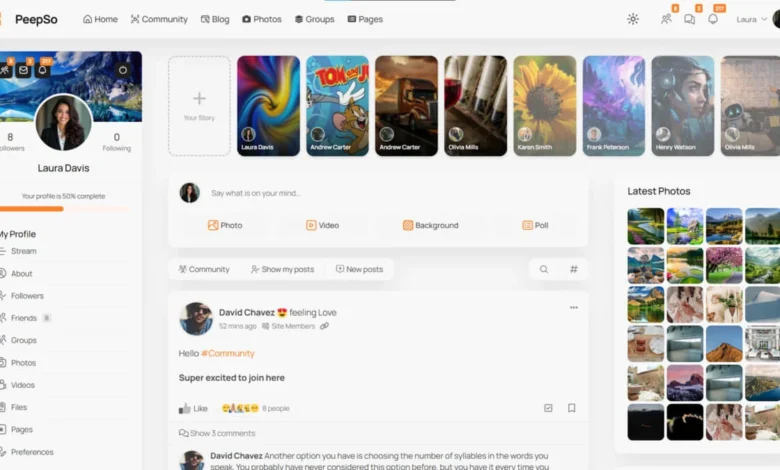
PeepSo is distributed directly from peepso.com, offering a fully-featured free core plugin for basic community functionality, with paid tiers unlocking its full suite of capabilities. The Community Bundle is priced at $124.50 for the first year, renewing at $249 annually, while the Ultimate Bundle, covering all features, is $249.50 in year one and $499 per year thereafter. PeepSo’s native real-time chat is particularly well-engineered, a feature often lauded even by competitors. The platform also includes a Photos plugin in its Community Bundle and offers a unique Stories plugin (in the Ultimate Bundle) for Instagram-style expiring posts, a content format not natively offered by BuddyBoss or BuddyPress.
For organizations seeking a truly hands-off approach, PeepSo offers its Power Suite, a fully managed package that includes the plugin, a bespoke white-label mobile app (iOS and Android), premium hosting, updates, and maintenance. Priced at $7,000+ per year, the Power Suite aims to provide enterprise-grade reliability and a single vendor relationship, significantly simplifying the technical layer for clients. For those preferring more flexibility, the bespoke white-label mobile app can also be subscribed to separately from the plugin license.
PeepSo’s primary area of distinction lies in its smaller, more centrally maintained third-party ecosystem. While this means fewer niche integrations might be available compared to BuddyPress, it translates into greater reliability, fewer compatibility issues, and more consistent updates across the core and its official add-ons. This makes PeepSo an excellent fit for publishers, content businesses, and creator-led sites looking to add a robust, reliable community layer to an existing audience, especially where budget is a significant constraint at comparable feature tiers.
Beyond Features: The Real Differentiators
While feature checklists are helpful, the true distinction between these platforms often lies in their underlying philosophies and the long-term implications for site owners.
1. Ecosystem Reliability vs. Breadth:
BuddyPress boasts the largest ecosystem of third-party add-ons, a result of over fifteen years of development. However, this breadth comes with a significant caveat: a considerable portion of these add-ons are lightly maintained or effectively abandoned, posing risks related to compatibility, security, and long-term functionality. For hobby projects, this might be acceptable, but for businesses relying on their community for engagement and revenue, such instability can be detrimental. BuddyBoss sits in the middle, with a smaller ecosystem than BuddyPress due to its fork, but its first-party feature set reduces the need for external plugins. PeepSo, while having the smallest add-on universe, offers the most reliable one. Its extensions are centrally maintained by the vendor, ensuring better compatibility and consistent updates. This trade-off between a vast, potentially unreliable ecosystem and a smaller, tightly controlled one is a critical consideration for long-term project viability.

2. The Real Cost of Ownership (3-Year Horizon):
Sticker prices can be misleading. A three-year total cost of ownership provides a clearer picture, factoring in initial promotional rates and subsequent renewal costs.
| Year 1 | Year 2 | Year 3 | 3-Year Total | |
|---|---|---|---|---|
| BuddyPress + premium add-ons + theme | $200–500 | $200–500 | $200–500 | $600–1,500 |
| BuddyBoss Pro (Theme + Platform Pro) | $299 | $399 | $399 | $1,097 |
| BuddyBoss Plus (Pro + engagement) | $349 | $599 | $599 | $1,547 |
| BuddyBoss Plus + App Full Edition | $2,497 | $2,747 | $2,747 | $7,991 |
| PeepSo Community Bundle | $124.50 | $249 | $249 | $622.50 |
| PeepSo Ultimate Bundle | $249.50 | $499 | $499 | $1,247.50 |
(Note: Hosting is generally not included except for PeepSo Power Suite. BuddyBoss also offers a "Done For You Bundle" at $4,999 in Year 1, including implementation services. PeepSo’s standalone bespoke app subscription is priced separately.)
This analysis reveals that PeepSo generally offers a more affordable path at comparable feature tiers. The PeepSo Community Bundle comes in below BuddyBoss Pro, and PeepSo Ultimate is roughly comparable to BuddyBoss Plus but often includes more features. The PeepSo Power Suite, while a significant investment, often lands below an equivalent BuddyBoss stack when factoring in the App and managed hosting. For projects with tight budget constraints, PeepSo’s pricing structure presents a compelling advantage. BuddyPress, while free at its core, typically accrues costs through essential premium add-ons and themes, placing it in a similar range to PeepSo’s entry-level bundles.
3. Vendor Relationships and Management Overhead:
The number of vendors a site owner interacts with significantly impacts operational overhead. BuddyPress requires juggling multiple vendors for themes, forums, media, and gamification, leading to numerous renewal cycles and support inquiries. BuddyBoss consolidates this to two or three vendors (Platform, Theme, and potentially the App), but hosting remains a separate responsibility. PeepSo’s Power Suite dramatically simplifies this by offering a single vendor relationship for the plugin, app, hosting, updates, and maintenance. For those prioritizing simplicity and minimal technical management, this unified approach is a strong draw. The standard PeepSo plugin, without the Power Suite, still offers a more consolidated vendor experience than BuddyPress, with core and add-ons from a single source.
4. Development Pace and Feature Velocity:
BuddyPress operates at the slowest pace, driven by its volunteer model. This ensures stability and openness but often means delayed adoption of modern features. BuddyBoss, with a paid product team, moves the fastest, delivering aggressive feature releases throughout the year. This rapid development, however, reinforces lock-in to its ecosystem and theme. PeepSo maintains a steady and predictable release schedule, driven by a focused paid team, with updates typically arriving every few weeks. Its unified product structure makes updates and support more straightforward than the fragmented BuddyPress model.
Verdict: Matching the Plugin to Your Project’s DNA
The ultimate decision hinges on the specific nature and strategic objectives of your community project.
-
Choose BuddyPress if you possess significant technical expertise or have a dedicated development team. It’s the ideal choice for projects demanding granular control, extensive customization, and a foundational open-source architecture free from vendor lock-in. However, be prepared for the time and effort required to assemble and maintain the various components, and to navigate a diverse ecosystem of add-ons with varying levels of support.
-
Opt for BuddyBoss if your project centers around a course platform requiring deep LMS integration (LearnDash, Tutor LMS, LifterLMS, MemberPress) or if a branded native mobile app is a non-negotiable component of your engagement strategy. BuddyBoss delivers a polished, opinionated, and integrated experience, ideal for high-engagement membership sites and educational ventures with a healthy budget to support its premium pricing and subscription model.
-
Select PeepSo if you are a publisher, content business, or creator-led site seeking to add a robust, modern community layer to an existing audience. Its standalone architecture, focused product development, and reliable ecosystem offer a compelling package. PeepSo is particularly attractive for those where total annual spend is a significant constraint, as it often provides a more affordable option at comparable feature tiers. For organizations desiring a completely managed solution, including the plugin, app, and hosting under a single vendor, the PeepSo Power Suite stands as a unique offering, delivering enterprise-grade reliability and peace of mind without the burden of managing the WordPress stack independently.
In essence, the choice between BuddyPress, BuddyBoss, and PeepSo is not merely a feature comparison but a strategic alignment with your project’s resources, long-term vision, and tolerance for complexity. The open-source user embraces ownership, the BuddyBoss user prioritizes polish and deep integration, and the PeepSo user values product cohesion and focused development. Each represents a valid answer to different strategic questions, underscoring the richness and specialization now available in the WordPress community platform market.