PressMeGPT Revolutionizes WordPress Theme Generation and Website Migration with AI-Powered Conversion Technology

The digital landscape has witnessed an explosion of innovative tools designed to accelerate website creation, from intuitive AI-powered builders like Lovable, Bolt.new, and Base44 to versatile design platforms where clients might craft their own initial visions. While these platforms excel at rapid prototyping and front-end aesthetics, a critical challenge emerges when these beautifully designed interfaces need to transition to a robust, scalable content management system (CMS) like WordPress. Historically, the journey from an AI-generated frontend or a client-designed static site to a fully functional WordPress theme capable of publishing blog posts, supporting plugins, and offering comprehensive site management has been arduous, often necessitating a complete manual rebuild. This laborious process, which frequently involves recreating layouts section by section, has long been a significant bottleneck for agencies, freelancers, and individual content creators alike.
The Evolving Web Design Landscape and a Persistent Challenge
The past few years have seen a dramatic surge in the adoption of AI-driven website builders. These platforms promise and often deliver a website in minutes, democratizing web presence for individuals and small businesses without requiring deep coding knowledge or design expertise. However, this convenience often comes with inherent limitations. Many AI builders are proprietary, locking users into specific ecosystems with restricted functionality, limited SEO capabilities, and a lack of true ownership over the underlying code. Clients frequently arrive with visually appealing sites from these platforms, only to discover the inability to easily add a blog, integrate e-commerce functionalities, manage user roles, or leverage the vast plugin ecosystem that WordPress offers. This scenario creates a significant "rebuild dilemma," where the initial time savings from AI generation are quickly eroded by the subsequent manual effort required to migrate to a more feature-rich, open-source platform.
The problem isn’t exclusive to AI-generated sites. Even traditional web development workflows often involve designers creating mockups in tools like Figma or Canva, which then require developers to translate these static designs into dynamic, editable WordPress themes. This translation, much like migrating from a basic AI builder, has traditionally been a labor-intensive, time-consuming process, acting as a chasm between design intent and functional implementation. The market has been crying out for a solution that bridges this gap, providing a clean, efficient path from diverse design origins to a production-ready WordPress environment.
PressMeGPT: A Bridge to Robust WordPress Integration
It is precisely this critical gap that PressMeGPT has been engineered to fill. Positioned as a transformative tool in the web development arena, PressMeGPT offers an innovative solution to convert existing websites, AI-generated projects, or even simple plain text prompts into fully functional, production-ready WordPress themes or Elementor templates. The core promise of PressMeGPT is to drastically cut down the time and effort traditionally associated with website migration and theme creation, delivering approximately 80% of a finished design in mere minutes. This allows developers, designers, and agencies to dedicate their valuable time to refinement, customization, and strategic enhancements rather than the painstaking task of reconstruction.

The significance of PressMeGPT lies not just in its ability to generate themes, but in its commitment to user ownership and platform independence. Unlike many AI website builders that host your site on their servers, PressMeGPT provides users with actual theme files that they own. These themes can be hosted anywhere, offering unparalleled flexibility and control, a crucial factor for businesses concerned about long-term scalability and vendor lock-in.
Versatile Inputs, Powerful Outputs
The versatility of PressMeGPT is a key differentiator, accommodating a wide spectrum of starting points for theme generation. Users can initiate a conversion from:
- Existing Websites: By simply providing a URL, PressMeGPT can analyze the structure and design of an already live website, regardless of its original platform, and translate it into a WordPress theme. This is invaluable for clients seeking to move away from proprietary builders or outdated systems.
- AI-Generated Projects: For those who have experimented with AI tools to create initial front-end designs, PressMeGPT offers a direct pathway to integrate these designs into the WordPress ecosystem, unlocking CMS capabilities.
- HTML/CSS Code: Developers with existing static HTML/CSS templates can leverage PressMeGPT to convert these into dynamic WordPress themes, significantly reducing manual coding efforts.
- Plain Text Prompts: Emulating the capabilities of generative AI, users can describe their desired website design in natural language, and PressMeGPT will generate a theme based on these instructions. This empowers individuals without design or development skills to conceptualize and realize a WordPress site rapidly.
Looking ahead, PressMeGPT has ambitious plans to further expand its input capabilities. Integrations with popular design tools like Canva and Figma are on the roadmap for all plans. This forthcoming feature will allow designers to directly import their design files, streamlining the transition from visual mockups to functional WordPress themes and further cementing PressMeGPT’s role as a comprehensive bridge between design and development.
Regardless of the input method, PressMeGPT’s generation process is designed for efficiency and choice. Each generation produces three distinct design variations, offering users options to select the most suitable foundation. The output is either a native WordPress theme, fully compatible with the Gutenberg block editor, or an Elementor template. This dual output caters to a broad user base, from those embracing WordPress’s native block-based editing experience to the vast community of Elementor users who prefer its drag-and-drop interface. This approach distinguishes PressMeGPT from many prompt-only AI website builders of the past, making it an indispensable tool for site migrations rather than just starting from scratch.
Addressing the "Rebuild" Dilemma
The fundamental problem PressMeGPT addresses stems from a core mismatch between modern site design and long-term site management. While AI builders and various platforms excel at quickly producing aesthetically pleasing frontends, they often leave users either without a proper CMS or tethered to a proprietary platform. This platform lock-in frequently translates into limited scalability, poor search engine optimization (SEO) capabilities out of the box, and a lack of control over the site’s future.

The moment a small business, a growing blog, or an e-commerce venture decides to expand—whether by adding new blog posts, managing customer accounts, or integrating specific functionalities via plugins—WordPress invariably becomes the logical and often necessary destination. Until now, this transition typically involved a laborious manual recreation of the site’s layout within WordPress, section by section, a process that is both costly and time-consuming. This "rebuild dilemma" has been a significant friction point in the industry, forcing businesses to choose between rapid deployment and long-term flexibility.
Even in traditional development, the assembly of layouts using page builders like Elementor or the native block editor can consume countless hours. Furthermore, the common experience of purchasing a premium WordPress theme from marketplaces like ThemeForest often reveals that the impressive demo site rarely translates seamlessly once a user’s actual content is introduced, leading to further manual adjustments and design compromises. PressMeGPT aims to alleviate this burden by providing a generated draft that closely resembles the initial design vision, allowing developers and content creators to focus their efforts on the crucial 20% of refinement and personalization that truly makes a site unique and functional, rather than spending hours on repetitive structural work.
Seamless Integration with Existing Workflows
A critical aspect of PressMeGPT’s design philosophy is its ability to integrate seamlessly with existing web development workflows, rather than seeking to replace established tools. While it can certainly be used to generate initial page or post layouts, its primary strength lies "upstream" of the chosen page builder. PressMeGPT handles the complex initial theme generation, providing a solid foundation that can then be handed off to Elementor, the Gutenberg block editor, or other preferred builders for detailed customization.
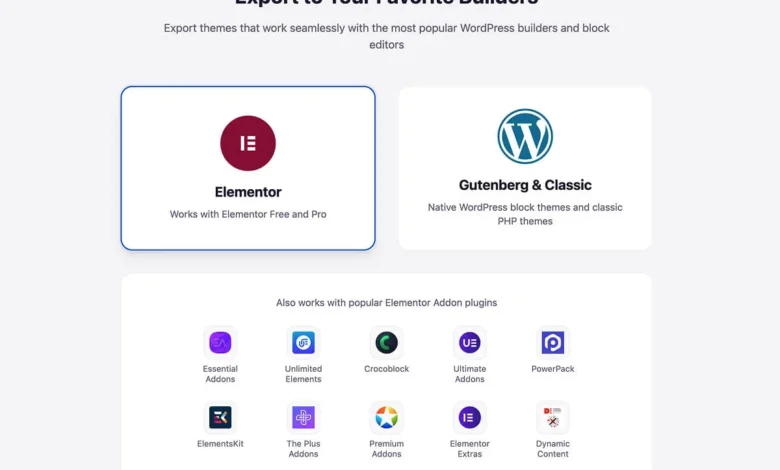
For the vast community of web professionals already standardized on Elementor, PressMeGPT’s Elementor template export capability is particularly valuable. It means the generated design work drops directly into a familiar and efficient workflow. Crucially, these templates are compatible with Elementor’s free version, eliminating the need for a Pro license to utilize the generated output. This significantly lowers the barrier to entry for many users. It’s important to note, however, that Elementor export functionality begins with the Freelance plan, while the entry-level Creator plan focuses on Gutenberg and classic theme exports. Furthermore, PressMeGPT ensures compatibility with popular Elementor add-ons such as Essential Addons, Unlimited Elements, and Kadence Blocks, preserving the rich ecosystem of customization options users have come to rely on.
This approach underscores a core principle: ownership. PressMeGPT doesn’t just create a page hosted on a third-party platform; it generates a legitimate, downloadable WordPress theme. Users retain full ownership of these files, enabling them to install them on an unlimited number of sites and switch hosting providers at will. This autonomy is paramount for both individual site owners and agencies managing multiple client projects, ensuring long-term flexibility and control over digital assets.
The Power of True Ownership and Modern Standards

The architectural design of PressMeGPT’s output is a significant advantage. When generating a WordPress theme, the tool focuses on producing proper block themes. This means the output includes real header and footer template parts, fully editable within WordPress’s native Full Site Editor. This is a crucial distinction from many AI tools that merely generate individual blocks or sections, leaving users to manually construct the overarching site structure, including headers, footers, and global elements. By providing a comprehensive block theme, PressMeGPT delivers a ready-to-customize framework that aligns with modern WordPress development practices.
The company’s FAQ further reinforces its commitment to quality by promising themes that adhere to contemporary block theme standards and function efficiently without requiring any additional plugins or ongoing subscriptions. This is a vital consideration for website performance, security, and long-term maintainability. Themes that rely on minimal external dependencies are generally faster, less prone to conflicts, and present fewer security vulnerabilities – a common concern with numerous third-party plugins. This emphasis on clean, native WordPress integration positions PressMeGPT as a forward-thinking solution for durable and high-performing websites.
A Detailed Look at the Conversion Process
The operational workflow within PressMeGPT is streamlined into three primary steps, designed for user-friendliness and efficiency:
- Input Submission: Users begin by providing their chosen input – a website URL, an existing HTML/CSS code snippet, a plain text prompt describing the desired design, or soon, a design file from Canva or Figma. This initial input serves as the foundational brief for the AI engine.
- Theme Generation and Variation: Once the input is processed, PressMeGPT’s AI engine goes to work, generating not one, but three distinct design variations of the WordPress theme or Elementor template. This offers users immediate choices and a starting point closest to their vision, reducing the need for extensive initial modifications.
- Refinement and Export: With the generated variations presented, users can then select their preferred design and proceed to refine it. This refinement stage is where the "human touch" comes in, allowing for specific branding, content integration, and stylistic adjustments. Once satisfied, the user can export the theme or template, ready for installation on any WordPress site.
The commitment to generating proper block themes, complete with editable header and footer template parts within the Full Site Editor, is a detail that cannot be overstated. It ensures that the generated output is not just a collection of design elements but a structurally sound and fully integrated WordPress theme. This approach significantly enhances the utility and longevity of the themes produced, aligning with the future direction of WordPress development.
Strategic Advantage for Web Professionals
PressMeGPT presents a compelling case for adoption across various segments of the web development industry:

- Agencies: For web development agencies managing multiple client projects, the ability to generate 80% of a website build in minutes offers a profound competitive advantage. The time savings, compounded across a client roster, can dramatically improve project timelines, increase output capacity, and enhance profitability. Furthermore, if an agency primarily utilizes Elementor, the seamless Elementor export allows junior team members to handle the refinement stages without needing advanced theme coding knowledge, optimizing resource allocation.
- Freelancers: Independent web professionals often juggle numerous projects, and repetitive tasks can quickly consume valuable time. PressMeGPT empowers freelancers to bypass the time-consuming initial setup and layout creation, allowing them to focus on the custom functionalities, unique integrations, and strategic elements that clients truly value and pay a premium for. This aligns with a growing trend of AI tools for WordPress development that augment, rather than replace, human expertise, enabling freelancers to take on more projects and deliver higher value.
- Bloggers and Content Creators: For individuals focused on content creation, the technical barriers of website development can be daunting. PressMeGPT simplifies this considerably. The ability to simply describe a desired site, receive a working theme, and then refine it without needing to learn theme development or invest in expensive custom builds is a monumental benefit. It democratizes the process of establishing a professional online presence, allowing content creators to launch faster and focus on what they do best: creating content.
Navigating the 80/20 Rule: Expectations and Refinement
While PressMeGPT promises to deliver approximately 80% of a design in minutes, it is crucial for users to approach this figure with a clear understanding of its implications. The remaining 20% represents the critical human element: the bespoke polish, the precise branding alignment, the unique content integration, and the subtle details that transform a functional draft into a distinctive and impactful website. This final stage of refinement remains entirely within the human developer’s purview. Setting realistic expectations from the outset is vital to a successful implementation of PressMeGPT. It is a powerful accelerator, not a magic wand that eliminates all human effort.
Furthermore, as with any nascent technology, certain practical considerations are important to note. While PressMeGPT is continuously evolving, a Theme Checker feature, designed to review themes against accessibility guidelines and Core Web Vitals, is slated for higher-tier plans. Until this feature ships, users are advised to manually check the initial generated themes for compliance before deploying them on live production sites. This due diligence ensures optimal performance and adherence to web standards.
Another practical detail, as outlined in the PressMeGPT knowledge base, concerns media handling. By default, exported themes reference images and videos by their remote paths from the original source. Localizing this media into the WordPress installation is a separate step, which consumes credits and is typically excluded from the free plan. While manageable, this is an important workflow consideration to be aware of during the first few projects to avoid unexpected hitches.
Subscription Model and Value Proposition
PressMeGPT operates on a credit-based system, a common model for AI-powered services. The cost in credits varies depending on the complexity of the task: generating a theme typically costs 3 credits and yields three design variations, while each AI modification or website conversion can cost between 1 to 3 credits. PressMeGPT estimates that a fully customized theme generally requires 7 to 10 credits in total.
To encourage exploration, PressMeGPT offers a free plan, providing 5 credits per month, sufficient for generating a test theme. However, users of the free plan should be aware of certain limitations: themes generated are public, media migration is excluded, and exports are limited to classic themes.

For more extensive usage, PressMeGPT offers tiered paid plans, billed annually with options for monthly or one-time payments, all backed by a 30-day money-back guarantee.
- Creator Plan: Starting at $69 per year, this plan typically includes 120 credits, allowing for approximately one completed site per month.
- Freelance Plan: This tier unlocks Elementor exports and offers a higher credit allowance, suitable for professionals managing a few clients monthly.
- Agency Plan: Priced at $399 per year, this plan provides a substantial 1,800 credits, enabling agencies to complete around 15 sites per month, catering to high-volume development needs.
A significant aspect of PressMeGPT’s value proposition is the principle of theme ownership. Once exported, the themes are entirely yours. There are no per-site fees, no recurring subscriptions tied to the generated theme itself, and no mandatory plugins required for the theme to function. This ensures that the generated assets are truly future-proof, providing long-term value and eliminating ongoing costs associated with proprietary platforms.
The Future of AI in WordPress Development
The introduction of tools like PressMeGPT marks a significant inflection point in the landscape of web development, particularly within the vast WordPress ecosystem. It addresses a real and persistent pain point for millions of website owners and developers globally. For those grappling with the complexities of migrating sites from various AI builders or proprietary platforms to a more flexible and powerful WordPress environment, PressMeGPT offers a highly targeted and efficient solution. Similarly, agencies and freelancers who regularly undertake site builds can find substantial operational efficiencies and cost savings, allowing them to scale their businesses and focus on higher-value client services.
The accessibility it offers to bloggers and content creators, enabling them to bring their visions to life without extensive technical knowledge or financial outlay for custom development, further democratizes website creation. By bridging the gap between rapid AI-driven design and the robust capabilities of WordPress, PressMeGPT is not just a tool for migration or theme generation; it represents a step towards a more integrated, efficient, and owner-centric future for web development. Testing PressMeGPT on a real-world project is the most effective way to gauge its efficacy and assess how its output aligns with specific project requirements, potentially reshaping workflows across the industry.