Pinterest Statistics Reveal a Powerful Visual Discovery Engine Driving Ecommerce in 2026

Pinterest is far more than a digital scrapbook; it’s a high-intent visual discovery engine with over half a billion users actively searching for inspiration, products, styles, and recipes each month. These users are not passively scrolling but are primed to take action on what they find, making Pinterest a significant revenue engine for brands. Its unique ability to drive unbranded searches and convert them into direct e-commerce sales positions it as a formidable platform, leaving traditional passive-scrolling feeds behind. As of 2026, a deep dive into Pinterest’s audience, ad performance, content trends, and e-commerce influence reveals its crucial standing in the digital marketing landscape.
Key Pinterest Statistics for Marketers in 2026
A snapshot of Pinterest’s current standing highlights its extensive reach, robust performance, and significant impact on consumer behavior.
- Global Reach: Pinterest boasts an impressive 619 million monthly active users (MAUs), offering a vast global audience that supports brand awareness, search visibility, and e-commerce success across diverse niches and at scale.
- Engagement Metrics: The platform’s average engagement rate typically hovers between 0.2% and 0.5%. While this may seem lower than other platforms, engagement on Pinterest is distinct, with Idea Pins notably driving the highest user interaction.
- Advertising Effectiveness: Brands leveraging Shopping ads on Pinterest are experiencing substantial returns, reporting a 15% higher Return on Ad Spend (ROAS) and 2.6 times greater conversion rates, underscoring the platform’s efficacy in moving consumers through the sales funnel.
Understanding the Pinterest User Base
The sheer size and active nature of Pinterest’s user base are fundamental to any successful marketing strategy. These figures illuminate the platform’s expansive reach, geographic distribution of its audience, and weekly user activity.
A Growing Global Footprint: 619 Million Monthly Active Users
In the fourth quarter of 2025, Pinterest reached a record high of 619 million global monthly active users. This represents a continuous expansion since the fourth quarter of 2021, solidifying its position as a major social media player. For marketers, this substantial user base is not just about numbers; it’s about the distinct user behavior. Pinners arrive on the platform with a clear purpose, making this audience highly valuable for targeted campaigns.
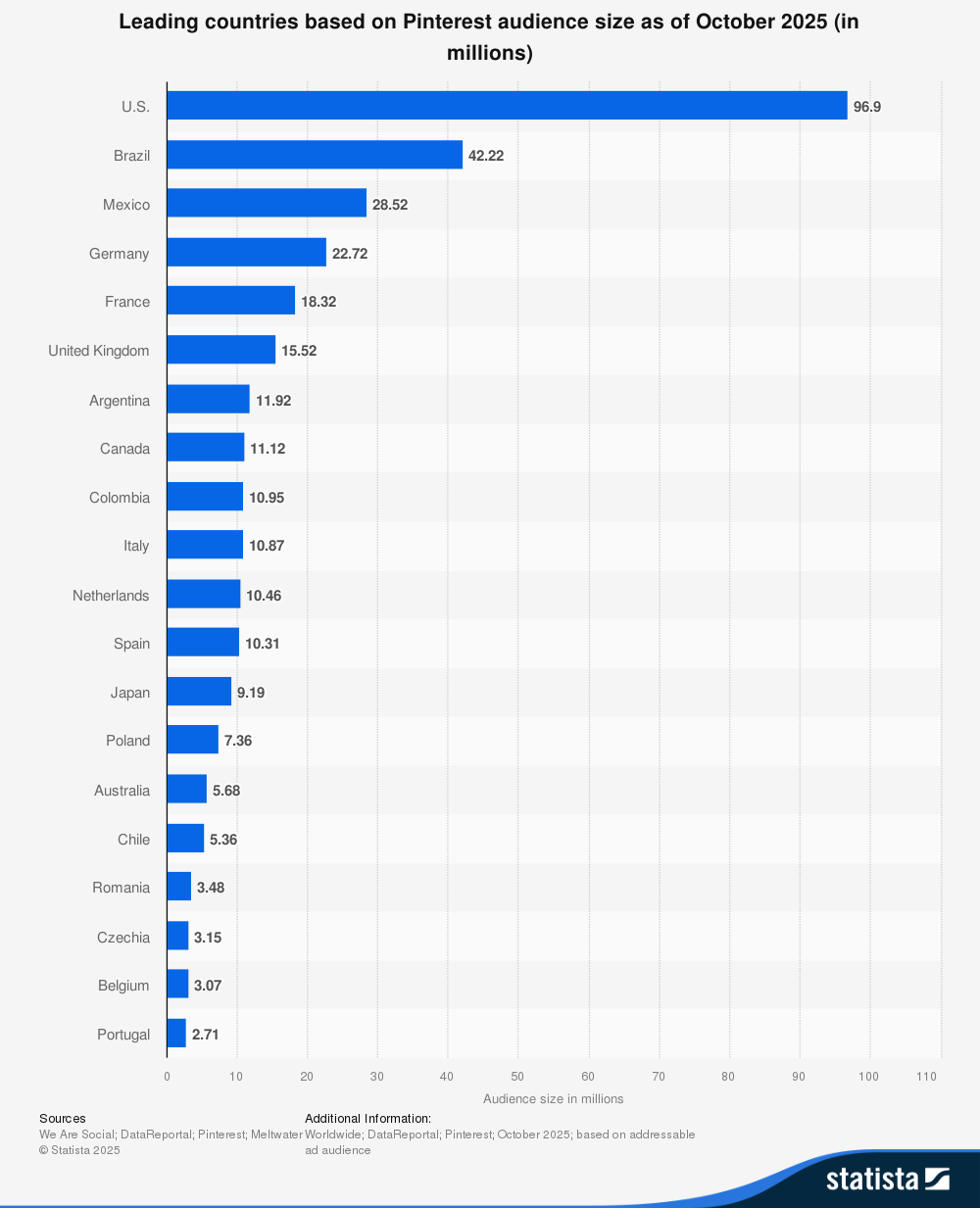
Dominance in the United States: Nearly 97 Million Users
As of October 2025, the United States remains Pinterest’s largest market, home to approximately 96.9 million users. For brands targeting American consumers, Pinterest presents a critical channel for reaching a significant demographic, particularly within specific product categories. Visualizations from Statista, such as graphs depicting the top countries by Pinterest users in 2025, consistently highlight the US’s leading position.
High-Intent Signals: Over 1.5 Billion Pins Saved Weekly
The act of saving a Pin is a powerful indicator of user intent. Internal Pinterest data reveals that users save over 1.5 billion Pins each week. This high volume of saves signifies users actively planning future purchases, projects, or decisions. For brands, this translates into an extended opportunity to influence potential buyers long after initial content publication.

Significant Social Media Presence: Nearly One-Third of Global Users
According to Sprout Social’s Q2 2025 Pulse Survey, approximately 31% of all social media users worldwide have a presence on Pinterest, ranking it as the ninth most popular platform. While it might not dominate public discourse like Instagram or TikTok, Pinterest’s strength lies in its niche audience. Pinners are generally more inclined towards planning and purchasing, leading to a higher conversion potential compared to many other networks.
Strongholds in English-Speaking Markets: US, Australia, and UK
Further reinforcing its appeal to key consumer markets, Sprout’s Q2 2025 Pulse Survey indicates that Pinterest reaches 33% of US consumers, 32% of Australian consumers, and 30% of UK consumers. These statistics underscore the platform’s importance for brands operating in English-speaking, high-spending markets, making it a compelling addition to any integrated channel strategy in these regions.
Pinterest Audience Demographics: A Detailed Look
Understanding the demographic makeup of Pinterest users is crucial for tailoring content and marketing efforts effectively. These statistics provide insights into gender distribution, age ranges, generational mix, and household income, ensuring brands connect with the right audience.
Female-Dominant User Base: Approximately 70% Women
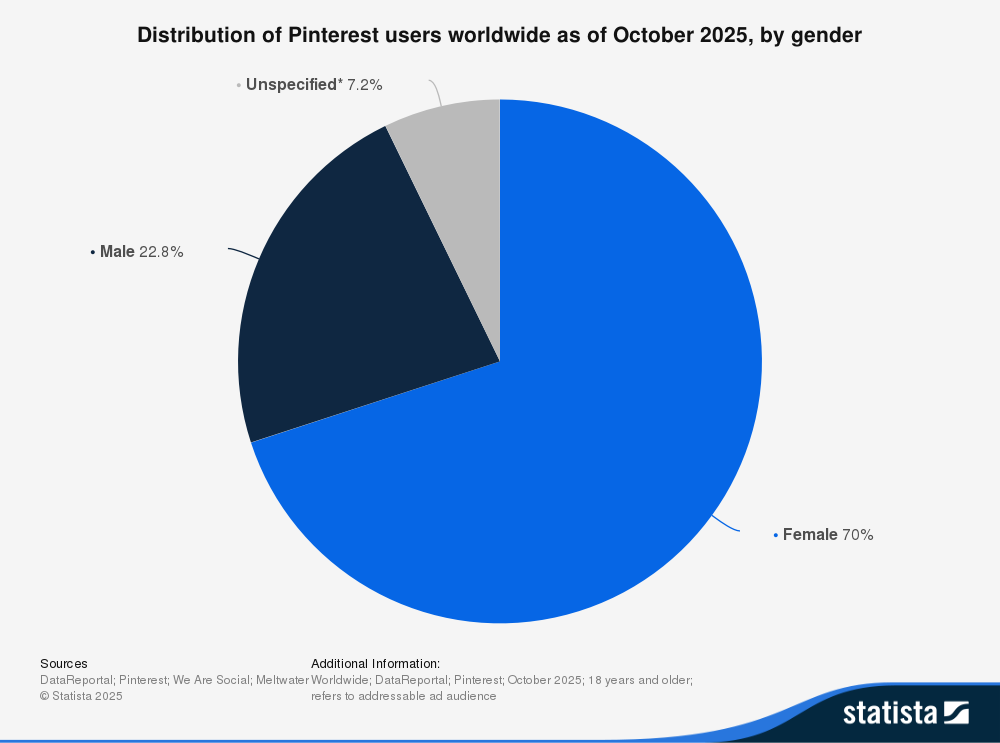
Pinterest exhibits a stronger female skew than most major social platforms, with women constituting roughly 70% of its user base. Men make up 22.8%, and 7.2% are unspecified. This demographic reality makes Pinterest particularly potent for brands in categories that historically resonate with female shoppers, though it does not exclude brands targeting a broader audience. Visual data, such as Statista’s pie charts illustrating Pinterest’s gender split in 2025, clearly depicts this trend.
Prime Demographic: Women Aged 25-34
Statista data identifies women aged 25 to 34 as Pinterest’s largest global audience segment. Within the US, the platform also shows strong reach among younger demographics, with 46% of individuals between 18 and 24 years old utilizing the platform. This indicates a significant opportunity for brands to engage with both established and emerging consumer groups.
Gen Z’s Growing Influence
Contrary to common perceptions of Pinterest as an older demographic platform, Gen Z is leading its adoption. Sprout’s Q2 2025 data reveals that 39% of Gen Z users are on Pinterest, followed by Millennials (32%), Baby Boomers (28%), and Gen X (26%). Pinterest’s internal data supports this, identifying Gen Z as the platform’s fastest-growing segment, primarily using it for product and brand discovery.
Future Usage Intent: Increased Engagement on the Horizon
Looking ahead to 2026, Sprout’s survey data suggests that 9% of consumers plan to increase their Pinterest usage. This figure rises to 13% among Gen Z and 11% among Millennials. This trend signals an opportune moment for brands to invest in the platform before it becomes more saturated, capitalizing on the growing engagement from younger, digitally native generations.
Reaching Affluent Households: Significant High-Income Reach
Pinterest demonstrates a remarkable ability to connect with high-income households. The platform reports reaching 40% of US households with an annual income exceeding $150,000. This statistic is a significant, often underestimated, asset for premium brands, financial services, travel companies, and luxury retailers seeking to engage with affluent consumers.
Pinterest Usage Patterns and Engagement Dynamics
Understanding how users interact with Pinterest is as critical as knowing their numbers. These statistics shed light on user expectations from brands, engagement frequency, and how users spend their time on the platform.
High Brand Content Interaction: 70% Weekly Engagement
Sprout’s 2026 Content Strategy Report indicates that approximately 70% of Pinterest users interact with brand content weekly, with this figure climbing to 78% among Gen Z. Pinterest stands out as a platform where users are less bothered by brand presence, second only to YouTube. Unlike other platforms where brands must carefully earn attention, on Pinterest, brand content is integral to the user experience, adding value when thoughtfully presented.
Preferred Content Formats: Static Images and Shoppable Pins
When engaging with brands, consumers on Pinterest most frequently interact with static images (38%) and Shoppable Pins (34%). Despite the rise of video content across social media, well-designed still imagery and product-focused Pins continue to resonate strongly with Pinterest users, particularly those with purchase intent.
User Preference for Entertaining Content
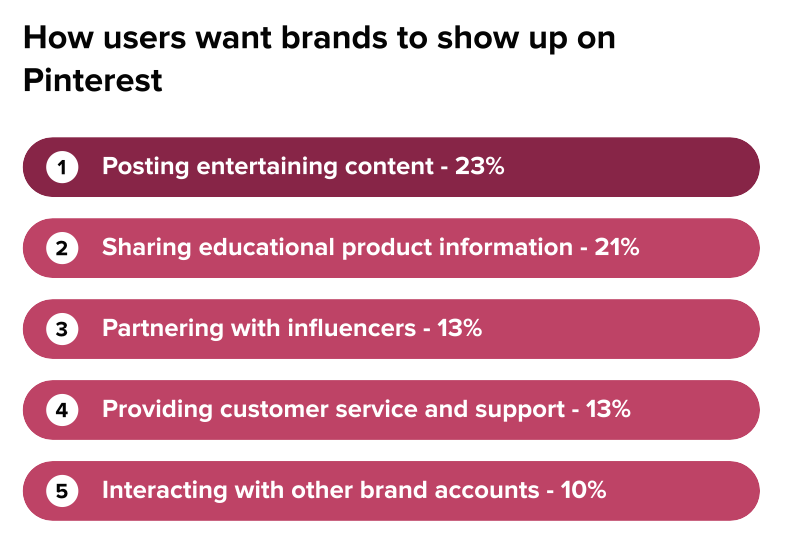
The majority of Pinterest users (23%) prioritize entertaining content from brands. This is closely followed by educational product information (21%), influencer partnerships, and customer service (both at 13%). A successful strategy on Pinterest often blends entertainment with education, creating "edutainment" content that informs users about products in an enjoyable, visual, and sometimes humorous manner.
Efficient Session Times: 10 Minutes Daily
DataReportal indicates that the average Pinterest user spends approximately 10 minutes per day on the platform. While this duration is shorter than on platforms like Instagram or TikTok, Pinterest sessions are characterized by higher user intent. This focused engagement allows brands to capitalize on users actively seeking inspiration and products, necessitating content that captures attention and drives immediate action.
Pinterest Advertising and Revenue Performance
Pinterest’s business model thrives on its ability to integrate organic and paid strategies. Advertising and revenue statistics reveal the platform’s strong performance for brands investing in paid promotion and its trajectory for future growth.
Driving Sales with Shopping Ads: Enhanced ROAS and Conversions
Pinterest itself highlights the synergistic effect of combining organic and paid strategies, stating it’s the optimal path to success. Brands integrating Shopping ads into their campaigns see a significant uplift: a 15% higher ROAS and a 2.6x increase in conversion rates compared to those who do not. Shopping ads directly place products in front of users actively searching for them, aligning perfectly with Pinterest’s user intent.
Accessible Advertising Costs: Lower ARPU and CPC
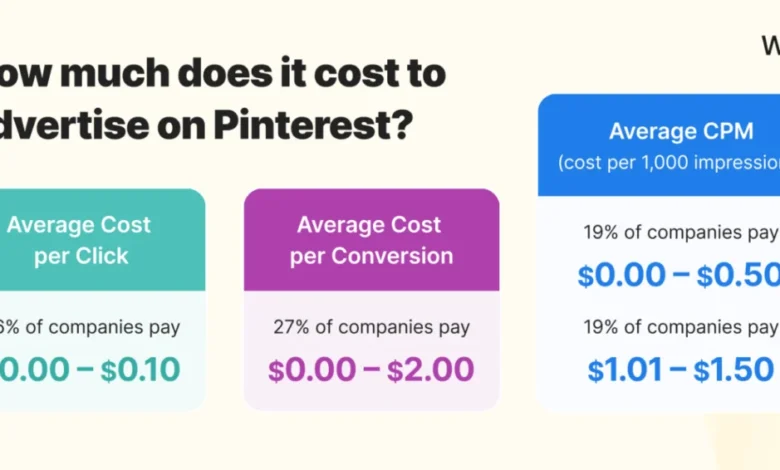
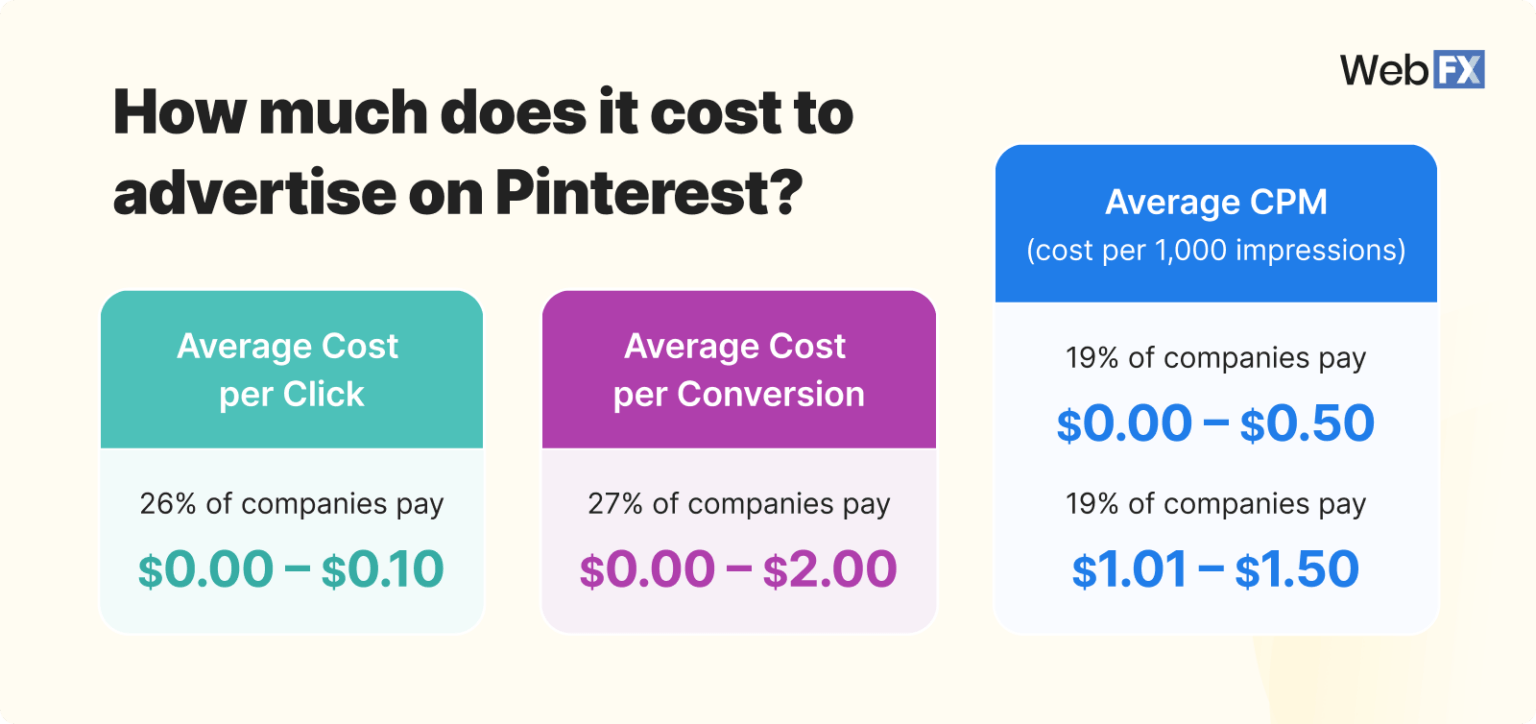
Pinterest’s average revenue per user (ARPU) stood at $2.16 in Q4 2025. This relatively lower ARPU compared to other platforms translates into a less competitive bidding environment, offering advertisers greater value. WebFX data further supports this, indicating that Pinterest advertising costs are cost-effective, with costs per conversion ranging from $0.00 to $2.00, and 26% of advertisers experiencing cost-per-click (CPC) between $0.00 and $0.10. This accessibility makes Pinterest an attractive channel for performance marketers, especially smaller brands venturing into e-commerce.
Consistent Revenue Growth: $4.2 Billion in 2025
Pinterest reported approximately $4.2 billion in revenue for 2025, marking a significant 16% year-over-year increase. This steady growth indicates increasing advertiser confidence and investment in the platform, signaling a potentially lucrative opportunity for brands to allocate budget before costs inevitably rise with increased competition.
Perceived Ad Relevance: Enhanced User Experience
A key differentiator for Pinterest is the user perception of ad relevance. Users report that ads on Pinterest feel more relevant than on other social platforms, primarily due to the platform’s intent-driven nature. Ads that align with user searches for ideas and products enhance the experience rather than disrupting it, allowing brands to achieve results without the creative fatigue often associated with other networks.
Pinterest Content and Engagement Trends
Content performance on Pinterest operates under unique dynamics, driven by visual discovery and user planning. These statistics reveal posting frequency, engagement types, and the platform’s significant contribution to web traffic.
Significant Web Traffic Generation: Over 1.3 Billion Monthly Visits
Semrush reports that Pinterest attracts over 1.3 billion monthly visits globally. Crucially, Pins frequently rank in Google search results, extending the reach of Pinterest content far beyond the platform itself and driving substantial organic traffic to brand websites.
The Power of Unbranded Search: 96% of Searches
A staggering 96% of all searches on Pinterest are unbranded. This statistic is a marketer’s goldmine, indicating that users arrive on the platform with an open mind, actively seeking ideas before committing to a specific brand. This presents a massive opportunity for brands to capture attention from consumers early in their decision-making process.
Engagement Rate Nuances: 0.2% to 0.5% Average
While the average engagement rate on Pinterest hovers between 0.2% and 0.5%, this metric requires context. Idea Pins consistently outperform other formats in driving engagement. Brands relying solely on Standard Pins may be missing out on significant interaction opportunities. Diversifying content formats is key to improving engagement rates.
Consistent Posting Strategy: 10 Posts Per Week
In 2025, brands published an average of 10 posts per week on Pinterest, a nearly 43% increase from 2024, according to Statista. This trend underscores the importance of consistent publishing for staying competitive. However, quality must be maintained; Pinterest rewards regularity, but only when the content earns its place in user feeds.
Pinterest Search and E-commerce Integration
Pinterest’s core strength lies in discovery and social commerce, making it exceptionally valuable for e-commerce and retail brands. The platform’s search functionality and shopping features are central to its appeal.
Top User Motivation: Product and Brand Discovery
Pinterest’s internal data confirms that the primary reason users engage with the platform is to discover new products and brands. This inherent shopping intent means users are not merely browsing but are actively seeking what brands have to offer, a distinct advantage over platforms where discovery is a secondary function.
Primary Discovery Network: 16% of Consumers
Sprout’s data reveals that approximately 16% of consumers use Pinterest as their primary social network for product discovery. Despite its size, this segment represents a highly purchase-ready audience, making it exceptionally lucrative for brands that actively participate on the platform.
Generational Preference for Discovery
Older generations show a strong preference for Pinterest as a product discovery channel. Baby Boomers lead at 26%, followed by Gen X at 20%, Gen Z at 12%, and Millennials at 10%. While Gen Z is the fastest-growing demographic, older shoppers exhibit clearer buying intent, making Pinterest a crucial discovery channel for brands targeting these segments.
Holiday Season Engagement: Lower for Direct Contact
During the holiday season, only 8% of social media users indicate Pinterest as their preferred channel for directly contacting brands, according to Sprout’s Q4 2025 Pulse Survey. This suggests Pinterest is primarily a discovery and planning tool, and brands should focus their customer service efforts on platforms like Instagram and Facebook, while prioritizing purchase inspiration on Pinterest.
Inspiration Driving Purchases: 80% of Weekly Pinners
A significant 80% of weekly Pinners find inspiration on Pinterest, whether for purchases, new products, or brands. This high level of inspiration directly translates into purchase decisions, making Pinterest an ideal platform for showcasing products through compelling Pins and informative guides to convert browsers into buyers.
High Purchase Conversion Rate: 85% of US Users
An impressive 85% of weekly US Pinterest users report having made a purchase based on a Pin they saw. This statistic is a powerful endorsement for brands aiming to drive sales through the platform. Creating curated boards featuring products can effectively inspire purchases and direct consumers to buy.
Conclusion: Pinterest as a Strategic E-commerce Channel
Pinterest uniquely combines a high-income user base, a prevalence of unbranded search, and powerful visual discovery capabilities, positioning it as a premier channel for e-commerce and brand awareness. To thrive on Pinterest, brands require not only exceptional content but also robust analytics, efficient scheduling, and reporting that directly links strategy to revenue. Platforms like Sprout Social offer integrated solutions for measuring performance, tracking ROI, and scheduling Pins, enabling businesses to effectively navigate and capitalize on the opportunities Pinterest presents. The platform’s ability to inspire and convert makes it an indispensable tool for modern marketing strategies.
Pinterest Statistics FAQs
Is Pinterest good for marketing?
Yes, Pinterest is highly effective for marketing due to its users’ inherent shopping intent. The platform’s primary draw is product and brand discovery, with 96% of searches being unbranded. Furthermore, 80% of weekly Pinners find inspiration for purchases, providing brands with a powerful avenue to convert interest into action.
What is the largest demographic on Pinterest?
The largest demographic on Pinterest is women aged 25 to 34. Overall, the platform skews female, with approximately 70% of users identifying as women, which explains the consistent success of categories like fashion, beauty, home decor, and lifestyle.
How many people use Pinterest in 2026?
As of 2026, Pinterest has 619 million monthly active users. This substantial user base solidifies its position as one of the world’s largest social platforms and a critical channel for marketers aiming to influence consumer purchasing decisions.