Navigating the Shift from Traditional Search to Answer Engines: A Strategic Forecast of Traffic and Revenue Volatility for 2026

The global digital landscape is currently undergoing a fundamental transformation as user behavior migrates from traditional keyword-based searching to resolution-oriented queries processed by generative artificial intelligence. This shift, characterized by the rise of Answer Engines (AEs) such as ChatGPT, Claude, DeepSeek, and Google’s AI-enhanced search modes, is projected to result in significant traffic and revenue fluctuations for digital enterprises. Industry analytical models suggest that businesses could face a reduction in organic and paid traffic ranging from 18% to 64% over the next calendar year. This transition marks the end of the "Librarian" era of search—where engines pointed users toward relevant resources—and the beginning of the "Research Assistant" era, where AI synthesizes information to provide direct answers, often eliminating the need for users to visit external websites.
The Evolution of Search: From Indexing to Synthesis
To understand the current crisis facing digital marketing, it is necessary to examine the chronological evolution of search technology. For over two decades, search engines functioned as digital librarians. When a user entered a query, the engine’s primary role was to identify and rank the most relevant "books" or web pages on the shelf. The business model for brands was straightforward: achieve high visibility within the "blue links" or pay for premium placement through search engine marketing (SEM).
The current era, however, is defined by the "Research Assistant" model. Instead of offering a list of sources, modern Answer Engines read, synthesize, and summarize information from across the web to deliver a singular, cohesive response. This evolution is driven by Large Language Models (LLMs) and Retrieval-Augmented Generation (RAG), which allow AI to understand context and intent with unprecedented accuracy. As these engines become "agentic"—capable of performing tasks like booking travel or purchasing products without human intervention—the traditional click-through model is increasingly threatened.

Chronology of the Answer Engine Transition
The transition from traditional Search Engine Optimization (SEO) to Answer Engine Optimization (AEO) has moved through several distinct phases:
- The Foundational Era (1998–2012): Search was primarily based on keyword matching and backlink authority. Google’s "10 blue links" dominated the user experience.
- The Semantic Shift (2013–2021): The introduction of the Knowledge Graph and updates like Hummingbird and BERT allowed engines to understand the relationships between entities and the nuances of natural language.
- The Generative Explosion (2022–2024): The launch of ChatGPT in late 2022 catalyzed a rapid shift. Google introduced Search Generative Experience (SGE), now AI Overviews, across 40 countries, while specialized engines like Perplexity and DeepSeek gained market share.
- The Agentic Future (2025 and Beyond): Search is moving toward "Agentic" functionality, where AI agents like Amazon’s Rufus or OpenAI’s ChatGPT Agents act on behalf of the user, further insulating the consumer from the brand’s original digital interface.
Analyzing the Impact: SEO and PPC Vulnerabilities
The impact of this shift is not uniform across all types of search queries. Analytical forecasting models categorize search intent into four primary segments, each facing varying degrees of risk.
Informational Queries: High Risk
Informational queries, such as "how to" guides or "what is" definitions, are at the highest risk of obsolescence. Because Answer Engines are designed to provide direct resolutions, users no longer need to click through to a blog or a news site to find an answer. For content publishers and top-of-funnel marketing strategies, this represents a near-total loss of traditional traffic.
Commercial Queries: High Risk
Commercial queries involve comparisons, such as "best laptop for graphic design." Answer Engines now generate custom, on-the-fly comparison tables and provide specific recommendations based on real-time data. This disrupts the affiliate marketing and review site ecosystems, as the AI becomes the ultimate arbiter of value.

Non-Brand Transactional Queries: Moderate Risk
Queries like "buy waterproof hiking shoes" are seeing a format shift. Instead of a list of organic category pages, AI provides a curated selection of products with summaries of why they fit the user’s specific criteria. While clicks still occur, the volume is lower, and the competition for the few AI-recommended slots is fierce.
Branded and Navigational Queries: Low Risk
Queries specifically mentioning a brand, such as "Kate Spade sale," remain relatively stable. Answer Engines recognize the user’s intent to reach a specific destination and typically facilitate that journey. This highlights a critical strategic pivot for 2026: the increasing importance of brand marketing over technical SEO.
Supporting Data: Quantifying Potential Revenue Loss
To illustrate the financial implications, industry analysts have developed forecasting models for "strong brand e-commerce" entities. Consider a hypothetical business receiving 5,000,000 annual visits from organic search with a Revenue Per Visit (RPV) of $2.50, totaling $12.5 million in annual organic revenue.
Based on current trends, the projected losses are as follows:

- Informational Traffic: A projected 80% loss in visits.
- Commercial Traffic: A projected 60% loss in visits.
- Non-Brand Transactional: A projected 35% loss in visits.
- Branded/Navigational: A projected 5% loss in visits.
In this scenario, the business would see an estimated total revenue loss of $4 million, or 32% of its organic search income. Similar patterns are observed in Pay-Per-Click (PPC) advertising. As AI Overviews take up more screen real estate, traditional text ads are pushed below the fold or replaced by AI-powered carousels. Analysts estimate that a company with $17.5 million in annual PPC revenue could face a loss of $4.6 million as ad formats transform and displacement by ad-free LLMs continues.
Institutional Reactions and Strategic Responses
The shift to AEO has prompted a variety of responses from Chief Marketing Officers (CMOs) and Chief Financial Officers (CFOs). In many boardrooms, the focus has shifted from "how to rank" to "how to be the cited source."
Marketing experts suggest that the "Marshall Project" for 2026 involves three critical steps:
- Loss Identification: Utilizing digital analytics to segment traffic by query type and quantifying the financial risk of AI displacement.
- Recovery Tactics: Optimizing content for "cite-ability" by AI models. This involves structured data, high-authority original research, and clear, answer-oriented prose.
- Growth Initiatives: Identifying new opportunities within the Agentic search world, such as ensuring products are compatible with AI shopping agents and capturing "zero-click" brand impressions.
Industry leaders emphasize that while the loss of traditional traffic is inevitable, the transition also offers a "once-in-a-generation" opportunity to gain market share from slower-moving competitors. "The goal is no longer just to be on the first page of Google," one analyst noted. "The goal is to be the answer that the AI provides."

Broader Implications and the Future of Digital Analytics
The rise of Answer Engines necessitates a complete overhaul of digital measurement frameworks. Traditional metrics like Click-Through Rate (CTR) and keyword rankings are becoming less relevant in a world where the AI provides the answer on the results page.
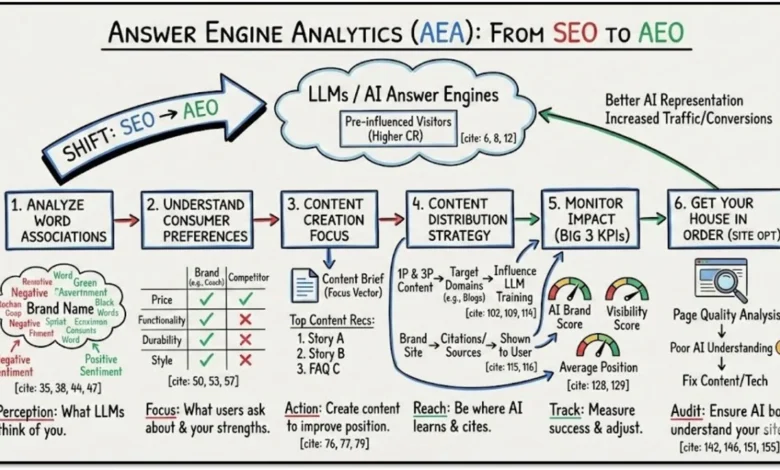
Emerging frameworks, referred to as Answer Engine Analytics (AEA), focus on different Key Performance Indicators (KPIs):
- Brand Mentions in AI Responses: How often a brand is included in a synthesized answer.
- Sentiment and Recommendation Accuracy: Whether the AI recommends the brand for specific high-intent queries.
- Share of Model (SoM): A metric measuring a brand’s visibility within the training data and outputs of major LLMs compared to its competitors.
The broader impact extends to the very structure of digital organizations. Companies are now hiring "AEO Specialists" and "AI Prompt Engineers" to ensure their data is digestible by LLMs. Furthermore, the reliance on brand marketing is reaching an all-time high. As AI engines prioritize authoritative and recognizable brands to avoid "hallucinations," a strong brand identity serves as a safeguard against algorithmic volatility.
Conclusion
The transition from keyword searching to resolution-based Answer Engines represents a structural shift in the internet’s economy. While the projected losses of 18% to 64% in traffic are daunting, they reflect a change in how humans interact with information rather than a decline in digital commerce itself. For businesses, the mandate for 2026 is clear: adapt to the "Research Assistant" paradigm by quantifying risks, restructuring content for AI synthesis, and doubling down on brand authority. Those who successfully navigate this evolution will not only recover their losses but will likely lead the next era of digital engagement. Carpe diem.
Related posts: