RapidCanvas Secures $29M Series B Funding to Democratize Enterprise-Grade AI Solutions

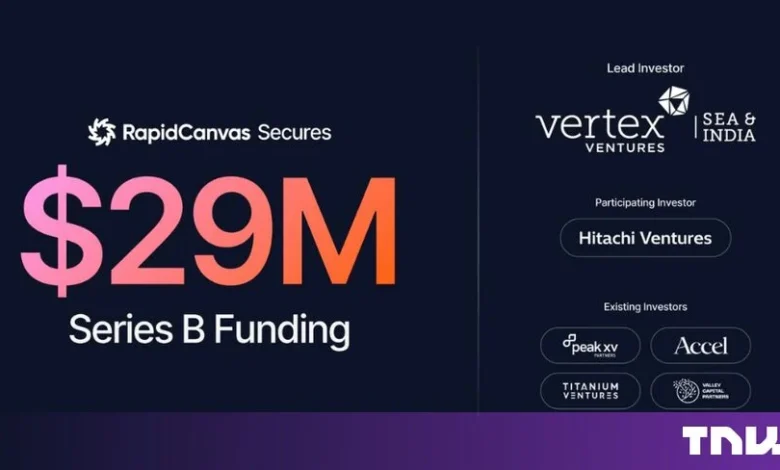
Austin-based RapidCanvas, a burgeoning leader in the enterprise artificial intelligence sector, has successfully closed a $29 million Series B funding round, marking a significant milestone in its mission to bridge the gap between complex AI capabilities and mid-market business operations. The round was spearheaded by Vertex Ventures SEA & India, with notable participation from Hitachi Ventures. This injection of capital brings the company’s total funding to $52.5 million, providing a substantial runway to accelerate its aggressive expansion strategy.
The financing event arrives just months after the company’s $16 million Series A round in December 2024, signaling strong investor confidence in the startup’s hybrid model of platform technology combined with expert human intervention. Existing investors—including Accel, Peak XV Partners, Valley Capital Partners, and Titanium Ventures—all participated in the latest round, underscoring a unified belief in the firm’s trajectory and its unique approach to the "AI agent" market.
A Hybrid Approach to AI Implementation
At the core of the RapidCanvas business model is a departure from traditional "self-service" AI platforms. While many competitors offer software-as-a-service (SaaS) tools that require companies to navigate complex implementation processes, RapidCanvas pairs its proprietary AI agent platform with a dedicated team of field engineers.
These engineers are embedded into the client’s workflow, functioning as a bridge between the technology and the business. They undergo a rigorous discovery phase to understand the specific operational nuances of the client, subsequently building and maintaining custom AI applications that integrate seamlessly with existing enterprise software, such as Customer Relationship Management (CRM) and Enterprise Resource Planning (ERP) systems. By automating complex, rule-based workflows, RapidCanvas claims to solve the "tech talent gap" that often prevents smaller organizations from leveraging the full power of artificial intelligence.
Chronology and Financial Trajectory
RapidCanvas has demonstrated a rapid pace of growth since its inception, consistently hitting milestones that differentiate it in a crowded AI startup ecosystem.
- Late 2024: The company secured $16 million in Series A funding, which served as the launchpad for its current enterprise-facing architecture.
- 2025 (Fiscal Year): RapidCanvas reported an eightfold increase in annual recurring revenue (ARR) over the preceding six quarters, a growth trajectory that caught the attention of major global venture capital firms.
- Early-to-Mid 2026: The startup expanded its client roster to over 75 enterprise customers, proving that its model of human-in-the-loop AI is scalable across diverse industries.
- October 2026: Closing of the $29 million Series B round, intended to catalyze international hiring and product development for its Enterprise Context Engine.
The Vision: Moving Beyond the Fortune 100
"AI can be the great equalizer, but so far its biggest wins have gone to the Fortune 100," says Rahul Pangam, co-founder and CEO of RapidCanvas. This sentiment captures the essence of the company’s mission. For much of the past three years, the deployment of sophisticated AI agents—systems capable of performing tasks like data analysis, supply chain optimization, and automated reporting—has been largely restricted to massive corporations with the capital to hire dedicated data science teams.
RapidCanvas aims to lower this barrier to entry. By providing the "field engineers" as part of the service, they effectively serve as an outsourced AI department for mid-market firms. This strategy addresses a common pain point: the existence of "AI fatigue," where companies purchase software licenses but fail to achieve meaningful ROI because they lack the internal expertise to configure the tools for their specific business logic.
Scaling Operations and Talent Acquisition
With the new $29 million, RapidCanvas has outlined a clear roadmap for capital allocation. A significant portion of the funds will be directed toward expanding sales and marketing teams, particularly in North America and Asia. The company intends to forge strategic partnerships with private equity firms and business advisory groups, which often serve as the primary technology consultants for small-to-medium-sized businesses (SMBs).
Furthermore, the company is intensifying its hiring efforts for AI engineers across three key hubs: the United States, Brazil, and India. This geographical diversity in its workforce is intended to provide "follow-the-sun" support and development, ensuring that client applications remain operational and optimized around the clock.
Technological Differentiation: The Enterprise Context Engine
One of the most critical aspects of the Series B funding is the planned investment into the company’s "Enterprise Context Engine." In the current AI landscape, a primary challenge for large language models (LLMs) is the lack of institutional context. An AI might be technically proficient at writing code or summarizing documents, but without an understanding of a company’s specific internal rules, definitions, and workflows, its outputs are often inaccurate or irrelevant.
The Enterprise Context Engine acts as a centralized repository for this institutional knowledge. By storing the specific business rules, compliance requirements, and operational definitions of a client, it ensures that every AI agent deployed by RapidCanvas operates with an "internal map" of the organization. This allows the AI to make decisions that are not just theoretically sound, but practically applicable to the specific client.
This specific focus places RapidCanvas in a burgeoning sub-sector of the AI market. Similar startups, such as Uvi, have also attracted venture backing (recently raising $7.5 million) for their focus on "company context," suggesting that the next wave of enterprise AI will be defined not by the power of the model itself, but by how well it can be "grounded" in the reality of a specific firm’s operations.
Market Context and Industry Implications
The investment in RapidCanvas occurs against a backdrop of massive capital inflow into enterprise-focused AI tools. The broader market trend, exemplified by companies like Dust—which recently raised $40 million—indicates that investors are pivoting away from "general purpose" AI and toward specialized, collaborative tools.
For many enterprises, the "multiplayer" nature of AI—where agents and human employees work in tandem—is becoming the industry standard. RapidCanvas’s model is particularly attractive to investors because it addresses the "last mile" problem of AI adoption. While general models like GPT-4 or Claude can handle general queries, they struggle with the proprietary, unstructured data locked within internal company silos. By focusing on the integration of these silos, RapidCanvas is positioning itself as a critical infrastructure layer rather than a mere utility.
Challenges and Future Outlook
Despite the successful funding round, the path forward for RapidCanvas is not without obstacles. The market for AI agents is becoming increasingly saturated, and the company will face stiff competition from incumbent software providers who are rapidly integrating "AI agents" into their existing suites. Microsoft, Salesforce, and SAP are all aggressively developing their own AI-native interfaces, which could potentially commoditize the services RapidCanvas offers.
However, RapidCanvas’s bet is that enterprise clients will prefer a platform-agnostic, white-glove service that can unify disparate systems rather than being locked into a single ecosystem vendor. The company’s ability to maintain its high growth rate while expanding its headcount in three different countries will be the ultimate test of its management capabilities.
As the company enters this new phase of growth, its focus on "Fortune 100-grade" solutions for the broader enterprise market will likely serve as a litmus test for whether a hybrid model—blending human expertise with automated agentic workflows—can truly democratize AI, or if it will remain a luxury service reserved for those who can afford the premium of human-in-the-loop engineering. With $52.5 million in the bank, RapidCanvas is well-positioned to find the answer.