WPBeginner Spotlight 28: WPVibe Hits 40,000 Sites, a New WPForms Dashboard, and Two WordPress Security Updates

September has proven to be a watershed month for the WordPress ecosystem, marked by an aggressive convergence of artificial intelligence capabilities and core platform security updates. As automated site orchestration transitions from experimental novelty to mainstream utility, prominent plugins are rapidly adopting standardized protocols to interact directly with conversational AI assistants like Claude, ChatGPT, and Cursor. This month’s developments highlight a structural shift in how administrators interact with their digital infrastructure, moving from traditional click-based dashboards to natural-language intent processing. Concurrently, maintainers across core WordPress and WooCommerce issued vital security and maintenance patches, underscoring the ongoing tension between rapid technological expansion and platform integrity.
The integration of artificial intelligence into content management systems accelerated dramatically through the broad implementation of the WordPress Abilities API. This standardization layer allows distinct plugins to expose their native functionalities—such as inventory management, backup creation, customer support logging, and fundraising campaigns—in a syntax easily parsed by external large language models. Rather than navigating deeply nested administrative menus, site owners can now execute complex database queries, generate multi-tier discount structures, or audit multi-site networks simply by issuing conversational prompts.
The Rise of Conversational Orchestration: WPVibe Reaches 40,000 Installs
Leading the charge in AI-driven site administration is WPVibe, a free Model Context Protocol (MCP) plugin that acts as a secure bridge between local WordPress installations and third-party AI assistants. On September 23, the plugin surpassed 40,000 active installations, achieving this milestone merely two weeks after crossing the 20,000-install threshold, while maintaining a flawless five-star rating on the official WordPress.org repository.
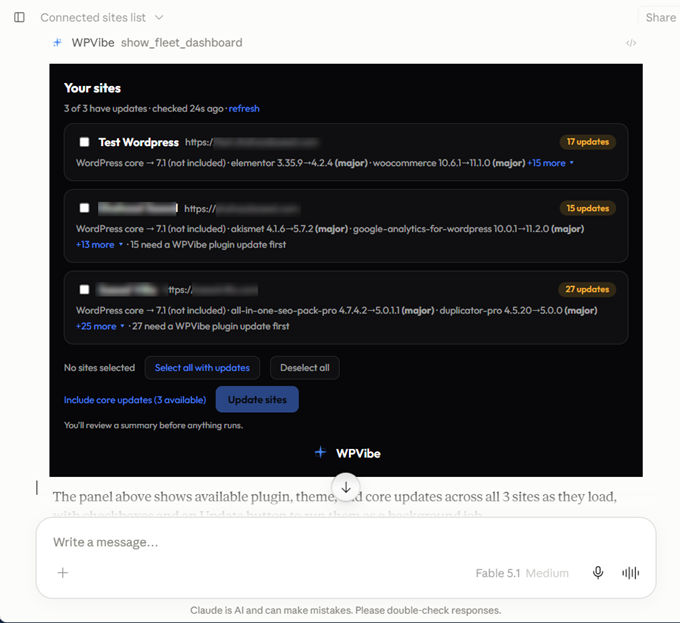
The rapid adoption trajectory correlates with the rollout of WPVibe’s Fleet Management feature, engineered specifically for agencies and portfolio managers overseeing multiple WordPress properties. Historically, managing updates across dozens of discrete websites required logging into individual admin panels or relying on expensive third-party SaaS platforms. Fleet Management redefines this workflow by allowing administrators to query an AI assistant regarding pending updates across an entire network and execute those updates within a single chat window.
Unlike legacy bulk-update tools, WPVibe incorporates a verification protocol. The system conducts automated health checks before and after patch deployment to ensure that core files, themes, and plugins initialize correctly without triggering fatal errors. Core WordPress updates are intentionally quarantined from automated execution unless explicitly authorized by the administrator, pausing the routine for manual approval. Furthermore, update operations run asynchronously in the background, allowing users to close their browser tabs while the system finalizes tasks. To democratize access, the Fleet Management architecture is integrated into all WPVibe tiers, including the free plan, with usage limitations restricted solely to daily AI action allocations rather than feature availability.
To streamline initial deployment, developers introduced a four-step diagnostic setup page within the wp-admin interface. This utility runs bi-directional connection tests both internally and externally. If server configurations, such as security plugins blocking application passwords, interfere with the connection, the interface provides plain-language remediation instructions.
Form Analytics and Multi-Site Visibility: The New WPForms Dashboard
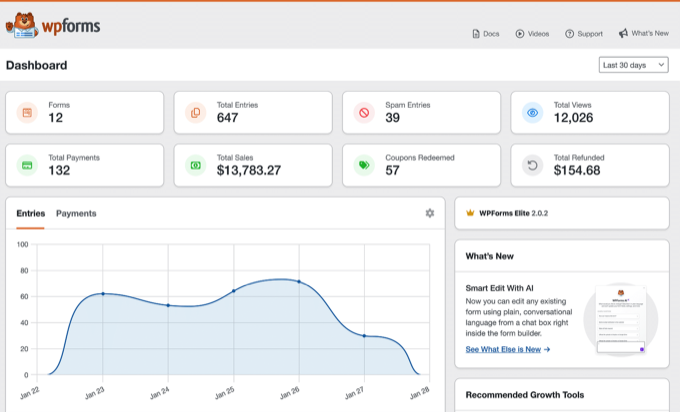
In the realm of lead generation and data collection, WPForms—installed on over 6 million active domains—unveiled a centralized dashboard on September 17 designed to eradicate the friction of reviewing fragmented form metrics. Prior to this update, administrators were forced to navigate into individual form editors to analyze submission rates, conversion percentages, and financial transactions.
The new dashboard aggregates performance indicators side-by-side upon landing in the WPForms administration menu. Designed for zero-configuration deployment, the interface surfaces comprehensive entry metrics, payment volumes, and impression counts for every active form on the site. This holistic overview enables site operators to instantly isolate conversion bottlenecks and identify high-performing assets without manual data aggregation. Complementing this release, the introduction of WPForms QR Codes allows physical businesses and event organizers to generate scannable graphic assets that route mobile users directly to targeted forms, bridging offline traffic with digital data collection pipelines.
Core Security Hardening and the Roadmap to WordPress 7.2
Platform security dominated administrative discussions throughout September, as core maintainers issued back-to-back maintenance and security releases to neutralize critical vulnerabilities. WordPress 7.1.1 arrived on September 17, delivering 17 core bug fixes, 19 block editor improvements, and 11 distinct security patches, including a vulnerability reported by Rafie Muhammad of Awesome Motive.
This was followed closely on September 22 by WordPress 7.1.2, a targeted emergency release addressing a critical vulnerability. Under specific server configurations and theme states, unauthenticated remote attackers could manipulate local file inclusion vectors to force WordPress into executing arbitrary local PHP files. Recognizing the widespread risk, the core security team backported the patch to legacy installations dating back to WordPress 4.7.
Concurrently, the core development team published the official roadmap for WordPress 7.2, slated for a stable release in early December 2026. The development cycle focuses on expanding Gutenberg performance optimizations, enhancing collaborative editing workflows, and refining permission structures for headless implementations. Notably, native AI functionality remains excluded from core architecture. Maintainers reaffirmed their official stance that artificial intelligence must demonstrate proven, long-term stability and universal user adoption before moving beyond community-contributed plugins like WPVibe.
Infrastructure and Data Sovereignty: Duplicator 5.0 and E-commerce Automation
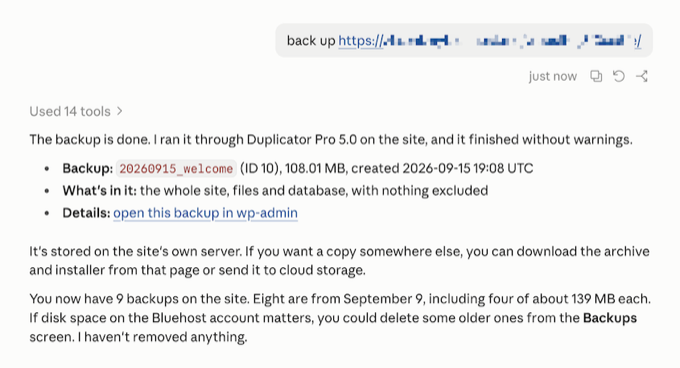
Data backup and migration infrastructure underwent a generational upgrade with the release of Duplicator 5.0 on September 22. Surpassing 1 million active installations, the plugin integrated the WordPress Abilities API to enable conversational backup management. AI assistants can now audit existing restore points, execute full site or database-only backups, and verify task completion prior to running risky update scripts.
In addition to AI integration, Duplicator 5.0 introduced AutoTune, an intelligent environment analyzer designed to prevent server timeout errors during heavy extraction phases. By dynamically adjusting PHP memory limits and execution windows based on real-time server telemetry, the plugin significantly reduces migration failure rates.
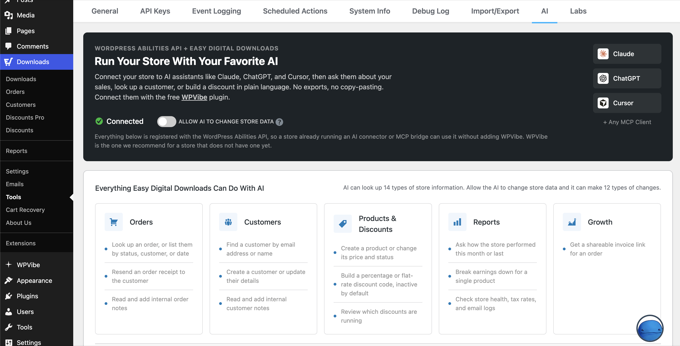
E-commerce operations experienced similar automation breakthroughs. Easy Digital Downloads (EDD) released version 3.7.1 on September 23, introducing 25 distinct AI abilities covering customer records, order histories, financial reporting, and discount code generation. Store administrators can now query Claude or ChatGPT for complex metrics—such as monthly net revenue, refund distributions, and average order values—or request the automated generation of draft products complete with pre-written descriptions. Crucially, write operations operate under strict permission boundaries, requiring human authorization before any promotional code or catalog modification goes live.
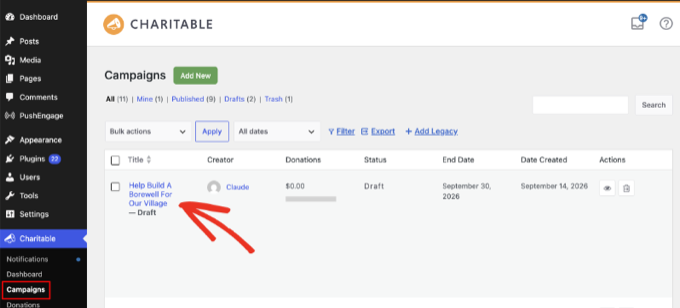
Simultaneously, the non-profit fundraising platform Charitable integrated write-support abilities, enabling AI assistants to draft complex campaign structures, log offline check donations, and manage donor profiles via natural language prompts. Charitable also addressed transactional friction by introducing Tiered Rates for Fee Relief. Instead of applying a flat processing fee recovery percentage across all transactions, administrators can establish dynamic fee bands scaled to the size of the donation, balancing donor goodwill with payment gateway cost recovery.
Enterprise Localization, Privacy Compliance, and Core Extensions
Global reach and legal compliance remained critical areas of focus as the open-source ecosystem expanded its localization and privacy tooling. The AI translation service Universally launched version 1.0.9 on September 17, introducing automatic browser-language redirects. The system detects a visitor’s preferred linguistic profile and routes them to the corresponding localized URL without requiring manual selection from a widget. To preserve user agency, manual language overrides are cached for 30 days. Furthermore, an integration with the community platform BuddyBoss extends real-time translation capabilities from static pages to dynamic member-generated posts and comments, removing language barriers in international forums.
In the domain of regulatory compliance, ConsentLayer released Cookie Inspector, a free developer utility designed to audit tracking scripts and consent banners. The Chrome extension analyzes active DOM elements to verify whether tracking cookies deploy prior to explicit user consent, providing immediate diagnostic feedback for GDPR and CCPA compliance audits.
Meanwhile, WooCommerce rolled out version 11.1, featuring native product variation galleries, streamlined order withdrawal workflows, and foundational architecture for upcoming block themes. Security teams patched subsequent vulnerabilities in versions 11.1.1 and 11.1.2 while initiating beta testing for WooCommerce 11.2, which promises enhanced barcode import matching and native delivery date scheduling.
Broader Industry Developments and Ecosystem Expansion
A wave of peripheral plugin updates reinforced the month’s momentum. QuickSnip introduced a comprehensive Loom importer, allowing users to migrate their video libraries seamlessly. PushEngage launched native browser extensions utilizing AI to draft push notifications directly from active web pages. OptinMonster introduced Campaign Teasers to convert dismissed popups into persistent edge tabs, while Smash Balloon expanded Feed Analytics Pro 2.0 to track interaction metrics across Airbnb reviews and Facebook event feeds. Sugar Calendar added native registration forms to capture attendee-specific metadata, and All in One SEO extended its TruSEO content scoring algorithm to category and tag archives.
At the organizational level, WordPress Executive Director Mary Hubbard assumed the presidency of the Open Website Alliance, solidifying cross-platform collaboration between WordPress, Drupal, Joomla, and TYPO3 to advocate for open-source web standards. Simultaneously, Automattic introduced Spacefast, a specialized hosting environment tailored for static outputs and agent-generated web applications.
As September draws to a close, the WordPress community stands at the precipice of a new operational paradigm. The fusion of natural language interfaces, robust automated safety nets, and rigorous security hardening ensures that site administration is becoming faster, safer, and remarkably more accessible to non-technical operators.
Related posts: