The Evolving Landscape of WordPress Community Platforms: A 2026 Analysis of BuddyPress, BuddyBoss, and PeepSo.

Building an online community on the WordPress platform has transformed from a straightforward choice into a complex strategic decision, reflecting the broader evolution of digital social spaces. What was once a singular path, largely defined by the installation of BuddyPress and its ecosystem of compatible themes and plugins like bbPress for forums, has fragmented into a vibrant, competitive market. Today, site administrators and developers considering a robust community layer on WordPress primarily weigh the offerings of three dominant players: BuddyPress, BuddyBoss, and PeepSo. This analysis delves into the nuances of each platform, examining their architecture, feature sets, cost implications for 2026, and their alignment with diverse project requirements, aiming to provide a clear understanding of which solution best fits specific needs, budgets, and operational preferences.
The Genesis of WordPress Communities: A Historical Perspective
The concept of integrating social networking functionalities directly into WordPress websites gained significant traction with the advent of BuddyPress. Launched in 2009, BuddyPress emerged as a pioneering open-source plugin, effectively democratizing the creation of niche online communities. Its modular design allowed for features such as user profiles, activity streams, private messaging, and groups, establishing it as the de facto standard for social integration on WordPress. For years, the recipe for a community-driven WordPress site was simple: BuddyPress as the foundation, often paired with bbPress for forum capabilities, and a compatible theme to unify the user experience. This era championed flexibility and community-driven development, allowing a vast ecosystem of third-party add-ons to flourish around the core plugin.
However, as the digital landscape evolved, so did user expectations. The rise of sophisticated social media platforms set new benchmarks for user experience, mobile accessibility, and real-time interaction. The volunteer-led development model of BuddyPress, while preserving its open-source ethos, struggled to keep pace with the rapid innovation seen in proprietary social platforms. This gradual shift in market demand opened the door for new entrants and alternative approaches, leading to the current competitive environment.
The Current Contenders: BuddyPress, BuddyBoss, and PeepSo
The conversation around building contemporary WordPress communities now invariably centers on three distinct solutions, each with a unique philosophy and trajectory:
- BuddyPress: The venerable open-source project, maintained by the WordPress community, continues to offer a free and highly customizable foundation.
- BuddyBoss: Originating as an ecosystem around BuddyPress, BuddyBoss underwent a significant strategic shift in 2019, forking the BuddyPress and bbPress codebases to create a standalone, proprietary platform focused on premium features and deep integrations, particularly for e-learning.
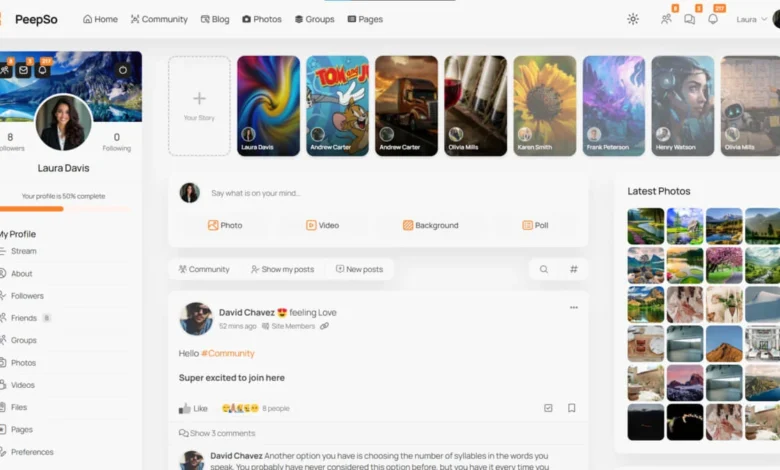
- PeepSo: Taking an entirely different approach, PeepSo was built from the ground up as an independent solution, emphasizing a unified architecture, modern user experience, and a streamlined approach to community building, including white-label mobile applications and managed hosting options.
Understanding the historical context and architectural divergence of these platforms is crucial for an informed decision, especially concerning the relationship between BuddyPress and BuddyBoss, which is often misunderstood.
Clarifying the BuddyPress and BuddyBoss Relationship
A common misconception in the WordPress community persists that BuddyBoss is merely an extension "built on top of BuddyPress." This ceased to be accurate following a pivotal decision by the BuddyBoss team in 2019. Recognizing the limitations and development pace of maintaining compatibility with an external, open-source project, BuddyBoss executed a strategic fork of both BuddyPress and bbPress. This resulted in the creation of the BuddyBoss Platform, a completely independent product.
Consequently, BuddyBoss no longer requires BuddyPress to function, and indeed, the two plugins cannot coexist on the same WordPress installation without conflict. Since the fork, BuddyBoss has maintained its own aggressive release schedule, allowing it to integrate features, refine its user interface, and develop its ecosystem without being constrained by BuddyPress’s development cycle or architectural assumptions. This independence is a critical factor influencing compatibility with third-party add-ons and the overall user experience offered by BuddyBoss today.
In-Depth Analysis: BuddyPress
Overview: BuddyPress remains a cornerstone for many WordPress communities due to its free, open-source nature and community-driven development. With over 100,000 active installations, it is a testament to the power of open collaboration. Its core strength lies in providing a flexible framework for developers who require granular control over their community features, enabling them to assemble a highly customized stack without vendor lock-in. Every component, from activity streams to user groups and private messaging, is optional, allowing for a lean installation tailored to specific needs. For those comfortable with coding and managing a multi-plugin environment, BuddyPress offers an unparalleled level of freedom. A full BuddyPress community website often involves integrating various third-party plugins for features beyond its core, such as media uploads or advanced gamification.
Where BuddyPress Falls Short: Despite its enduring appeal, BuddyPress faces significant challenges in the contemporary landscape. Its development, being volunteer-led, progresses at a slower pace compared to commercial alternatives. Major releases are infrequent, and core team discussions have openly addressed questions regarding its long-term sustainability and the ability to integrate modern social features. Basic functionalities that are standard on platforms today—such as native media uploads (photos, videos), rich link previews, and advanced follower relationships—often require additional, sometimes less actively maintained, third-party plugins. The administrative and front-end user experiences, while functional, can appear dated when compared to the polished interfaces of commercial solutions.
Ideal Use Case: BuddyPress is best suited for projects with dedicated technical resources (developers) who prioritize full control, open-source principles, and a highly customized feature set. It’s an excellent foundation for niche communities where specific functionalities need to be built from the ground up, and where the project timeline and budget allow for the assembly and maintenance of a diverse plugin stack. It is less ideal for non-technical users seeking an out-of-the-box, polished solution with rapid deployment capabilities.
In-Depth Analysis: BuddyBoss
Overview: BuddyBoss has positioned itself as a premium, polished solution designed for professional-grade community platforms, particularly those integrated with e-learning. Its unified administrative interface and modern front-end design provide a cohesive user experience from the outset. A key differentiator is its deep integration with leading Learning Management System (LMS) plugins such as LearnDash, Tutor LMS, LifterLMS, and MemberPress. This allows course content to be seamlessly embedded within the BuddyBoss community environment, creating a unified learning and social experience rather than disparate systems. This tight integration makes BuddyBoss a highly attractive option for educators, course creators, and membership site owners seeking to foster engaged learning communities.
Another significant feature is its companion mobile application. BuddyBoss has invested heavily in developing native iOS and Android apps, recognizing the critical role mobile plays in user engagement and retention. For communities where push notifications, offline access, and a branded mobile experience are crucial—such as fitness programs, cohort-based courses, or high-engagement membership sites—the BuddyBoss App provides a powerful tool for driving interaction.
Where BuddyBoss Falls Short: The primary drawback of BuddyBoss is its cost of ownership, which can escalate quickly. While offering a free version, its premium features are bundled into paid plans. For 2026, the Pro plan starts at $299 per year (launch pricing, renewing at $399), including the BuddyBoss Theme and Platform Pro. The recommended Plus plan, at $349 per year (launch pricing, renewing at $599), adds gamification and advanced engagement tools. Critically, the mobile app is a separate annual subscription, ranging from $948 per year for the Lite Edition to $2,148 per year for the Full Edition. This means a comprehensive BuddyBoss setup with the Plus plan and the App Full Edition could cost approximately $2,497 per year before factoring in hosting or any LMS licenses.
Furthermore, despite claims of compatibility with many BuddyPress add-ons, six years of independent development have inevitably narrowed real-world interoperability. The platform is designed around the BuddyBoss Theme, leading to a degree of vendor lock-in. Migrating a site heavily built on BuddyBoss to another solution can involve significant switching costs.

Ideal Use Case: BuddyBoss is the go-to choice for course platforms, agency-built community projects with substantial budgets, and organizations for whom a branded native mobile app is a core strategic requirement. It excels in delivering a cohesive, professional-grade learning and community environment out-of-the-box. It is less suitable for projects with tight budgets or those merely seeking a basic community layer on an existing content site without the need for deep LMS integration or mobile app functionalities.
In-Depth Analysis: PeepSo
Overview: PeepSo distinguishes itself through its independent architectural design. Unlike BuddyBoss, which originated from a fork of BuddyPress, PeepSo was developed entirely from scratch. This "clean slate" approach means it carries no legacy code, architectural assumptions, or database structures dating back to BuddyPress’s 2009 release. This independence allows PeepSo to innovate rapidly without the constraints of maintaining compatibility with an aging third-party plugin ecosystem or the slow drift of the BuddyPress core. The result is a highly performant and modern solution with its own data model, activity stream, user profiles, and messaging system.
PeepSo offers a robust free core plugin providing essential community functionalities, with premium tiers unlocking a comprehensive suite of features. For 2026, the Community Bundle starts at $124.50 for the first year (renewing at $249 per year), while the Ultimate Bundle, offering full feature parity, is priced at $249.50 in year one (renewing at $499 per year). PeepSo also provides a bespoke white-label mobile app option, where customers can customize the app’s branding (name, icon, splash image, logo, colors), with PeepSo managing the submission and deployment to the Apple App Store and Google Play Store. This app service can be subscribed to separately or bundled into their premium offerings.
A unique proposition from PeepSo is its Power Suite, a fully managed package that includes the plugin, mobile app, premium hosting, updates, and maintenance. This comprehensive solution caters to operators who prefer a single vendor for their entire technical stack, abstracting away the complexities of WordPress management.
Where PeepSo Falls Short: PeepSo’s primary limitation lies in its smaller third-party ecosystem compared to BuddyPress and, to a lesser extent, BuddyBoss. While this contributes to its architectural independence and focused product development, it means there are fewer extensions written by outside developers. Niche integrations, particularly specific WooCommerce membership bridges that exist for BuddyPress, might require custom development work on PeepSo. While this might be a concern for projects with highly specialized integration requirements, for most content-led sites seeking to add a community layer, this rarely poses a significant impediment.
Ideal Use Case: PeepSo is an excellent fit for publishers, content businesses, and creator-led sites looking to integrate a modern community layer into an existing audience. Its standalone architecture, focused product development, and smaller but centrally maintained ecosystem ensure reliability and predictable behavior. For projects where total annual expenditure is a significant constraint, PeepSo generally offers a more affordable option across comparable tiers. The PeepSo Power Suite is particularly appealing to enterprise clients or those who prioritize hands-off technical management, seeking enterprise-grade reliability and a single point of contact for their entire community platform.
Feature-by-Feature Comparison: The Differentiating Elements
While all three platforms provide foundational community features such as activity feeds, member profiles, groups, private messaging, and notifications, their implementations and native inclusions vary significantly. The real differentiators emerge when examining bundled functionalities versus those requiring third-party add-ons.
-
Native Media (Photos, Videos, Documents):
- BuddyBoss: Offers the strongest out-of-the-box support for native media uploads, including photos, videos, and document sharing directly within groups, profiles, and activity feeds. This is crucial for rich media-centric communities.
- PeepSo: Includes a dedicated Photos plugin within its Community Bundle, and an innovative Stories plugin (in the Ultimate Bundle) for Instagram-style expiring posts, a feature not natively offered by BuddyBoss or BuddyPress.
- BuddyPress: Lacks native media support beyond basic text and profile photos, necessitating third-party add-ons, which can lead to a fragmented and less actively maintained experience.
-
Native Forums:
- BuddyBoss: Integrates a forked version of bbPress directly into its platform, creating a deeply unified forum experience tied to groups, profiles, and the activity stream. This is ideal for communities where forums are central.
- BuddyPress: Relies on a separate bbPress plugin installation. While functional, the integration is less seamless, with discernible "seams" between the two plugins.
- PeepSo: Does not offer native forum support. However, a third-party wpForo integration from Wbcom Designs is available to bridge this gap, offering a workable, albeit less deeply integrated, solution.
-
Real-time Chat:
- PeepSo: Boasts a genuinely well-engineered, native real-time chat built into its core product. This provides a significant edge for communities where instant member-to-member communication is a critical value proposition.
- BuddyBoss: Offers modern private messaging that resembles contemporary social networks. While effective for asynchronous communication, it is not a true real-time chat in the same vein as PeepSo’s.
- BuddyPress: Provides basic, functional messaging, which, while adequate for member communication, lacks the modern feel and real-time capabilities of its commercial counterparts.
-
LMS Integration Depth:
- BuddyBoss: Excels here with deep integrations into LearnDash, Tutor LMS, LifterLMS, and MemberPress. It renders course content directly within the BuddyBoss UI, providing a unified learning and community experience. This is BuddyBoss’s strongest argument for course platforms.
- PeepSo: Integrates effectively with LearnDash and Tutor LMS, adopting a more conventional approach where the community functions alongside the course area rather than fully wrapping around it. This suits course creators seeking an adjacent community layer.
- BuddyPress: Requires bridge plugins for LMS integration, leading to a more fragmented experience. While technical teams can assemble this, it’s not an out-of-the-box cohesive solution.
-
Gamification, Moderation, and Mobile App:
- BuddyBoss: Bundles GamiPress (on Plus plan) for points, leaderboards, and achievements, includes comprehensive native moderation tools (block, report, suspend), and offers the separate BuddyBoss App for native iOS and Android.
- PeepSo: Features native moderation tools, integrates with GamiPress for gamification, and provides a bespoke white-label mobile app as a separate subscription or bundled in Power Suite.
- BuddyPress: Relies entirely on third-party plugins for gamification and advanced moderation, and offers no first-party mobile app options, requiring significant assembly work.
The consistent pattern is clear: BuddyBoss bundles the most features natively, justifying its premium price point. PeepSo offers a strong native feature set, particularly excelling in real-time chat, while BuddyPress remains the lightest by design, requiring users to assemble most advanced functionalities themselves. The choice largely depends on the project’s complexity, technical resources, and budget.
The Plugin Ecosystem: Quantity vs. Reliability
The perceived richness of a plugin ecosystem is often a key selling point, but its practical value can vary. Both BuddyPress and BuddyBoss frequently highlight their extensive third-party add-on universes. On paper, BuddyPress, with over fifteen years of development, indeed has the largest number of compatible extensions. However, in practice, a significant portion of these add-ons for both platforms are either lightly maintained, effectively abandoned, or tested only against older, end-of-life WordPress versions. This can lead to compatibility issues with core WordPress updates, security vulnerabilities that remain unpatched, and features that simply cease to function over time. For hobby projects, this might be an acceptable risk, but for businesses relying on their community for engagement and revenue, such instability can be detrimental.
PeepSo, by contrast, operates with a smaller, more controlled ecosystem. While this means fewer third-party extensions to choose from, the existing ones are typically more centrally maintained and developed by PeepSo or trusted partners. The core plugin itself is a unified codebase from a single vendor, simplifying updates and support. This trade-off between sheer quantity and assured reliability is a critical consideration. For sites requiring niche, highly specialized integrations, BuddyPress’s vast universe might be advantageous, assuming diligent vetting of add-ons. For businesses prioritizing long-term stability, predictable behavior, and streamlined support, PeepSo’s focused and centrally maintained ecosystem presents a strong asset.
The Real Cost of Ownership: Beyond Sticker Prices (2026 Projections)
Evaluating the true cost of ownership requires looking beyond initial sticker prices to account for promotional rates, renewal costs, and the need for additional plugins or services over several years. The 2026 pricing landscape illustrates significant differences:

-
BuddyPress + premium add-ons + community theme: While the plugin is free, a typical real-world setup often involves purchasing 2-3 premium add-ons (e.g., for media, advanced groups, gamification) and a dedicated community theme. This typically ranges from $200-$500 per year, leading to a 3-year total of $600-$1,500 (excluding hosting). This variability reflects the "assemble-it-yourself" nature of BuddyPress.
-
BuddyBoss Pro (Theme + Platform Pro): Priced at $299 for the first year (launch pricing) and renewing at $399 annually. The 3-year total is $1,097.
-
BuddyBoss Plus (Pro + engagement tools): Initially $349 (launch pricing), renewing at $599 per year. The 3-year total is $1,547.
-
BuddyBoss Plus + App Full Edition: This comprehensive package, including the mobile app, pushes the first-year cost to $2,497, renewing at $2,747 per year. The 3-year total reaches $7,991 (excluding hosting and LMS licenses). BuddyBoss also offers a "Done For You Bundle" at $4,999 in year one, packaging the theme, platform pro, App Full Edition, and implementation services.
-
PeepSo Community Bundle: Costs $124.50 for the first year (promotional), renewing at $249 per year. The 3-year total is $622.50.
-
PeepSo Ultimate Bundle: Priced at $249.50 for the first year (promotional), renewing at $499 per year. The 3-year total is $1,247.50.
-
PeepSo Power Suite: This fully managed package (plugin, app, premium hosting, updates, maintenance) starts at $7,000+ per year. While a higher annual outlay, it often comes in below the equivalent BuddyBoss-plus-App-plus-managed-hosting stack when comparable features and services are factored in, offering significant value for those seeking a hands-off, all-in-one solution.
This detailed cost breakdown reveals that PeepSo generally offers a more affordable entry point and a lower total cost of ownership across comparable feature tiers. For projects where budget constraints are a defining factor, PeepSo often presents a compelling value proposition. It’s crucial to remember that hosting costs are additional for BuddyPress and BuddyBoss, unless a managed solution like PeepSo Power Suite is chosen.
Strategic Differentiators: Beyond the Feature Checklist
Beyond raw features and pricing, the choice between these platforms often hinges on more strategic considerations:
-
Vendor Relationships and Management:
- BuddyPress: Entails the most vendor relationships, as the core plugin is free, but themes, forums, media support, and gamification often come from disparate third-party developers. This means managing multiple renewal cycles and support inquiries.
- BuddyBoss: Narrows this to 2-3 vendors. The Theme and Platform Pro are unified, and LMS integrations are built-in. However, the mobile app is a separate annual subscription, and hosting remains the user’s responsibility.
- PeepSo Power Suite: Consolidates everything into a single vendor relationship: plugin, app, hosting, updates, and maintenance. The standard PeepSo plugin with optional app and self-managed hosting falls closer to BuddyBoss in terms of vendor count but maintains a unified core.
-
Plugin Ecosystem Quality and Reliability:
- BuddyPress: Offers the largest number of third-party add-ons, a legacy of over 15 years. However, this breadth comes with the caveat that many add-ons are poorly maintained or abandoned, posing risks to security and long-term functionality.
- BuddyBoss: Sits in the middle. Its third-party add-on ecosystem has narrowed since the 2019 fork, but its more comprehensive first-party feature set reduces the frequent need for external plugins.
- PeepSo: Has the smallest, but arguably most reliable, add-on universe. Fewer abandoned plugins, a unified codebase, and centrally maintained integrations contribute to greater dependability and easier support.
-
Development Pace and Innovation:
- BuddyPress: The slowest-moving, being volunteer-led with infrequent major releases. This ensures stability but means modern community features arrive late, if at all.
- BuddyBoss: The fastest-moving, driven by a paid product team with aggressive feature releases throughout the year. This pace comes with increased lock-in to its ecosystem and a scaling renewal price as more components are added.
- PeepSo: Moves steadily and predictably, with regular releases (every few weeks) from its paid development team. Its focused product surface area and unified nature simplify updates and support compared to the multi-vendor BuddyPress model.
Verdict: Matching the Plugin to Your Project
The "best" community plugin for WordPress is not a universal truth but a contextual decision, driven by the specific needs, resources, and strategic goals of each project.
-
Choose BuddyPress if your project has dedicated technical expertise (a developer) capable of assembling, customizing, and maintaining a stack of disparate plugins. Its appeal lies in its free, open-source foundation, absolute vendor independence, and granular control over every component. It is the wrong choice for projects demanding out-of-the-box polish, rapid deployment by non-technical users, or a modern, integrated feature set without significant custom development.
-
Opt for BuddyBoss if you are building a course platform requiring deep integration with LMS plugins like LearnDash, Tutor LMS, or LifterLMS, or if a branded native mobile app is central to your engagement strategy. This choice requires a healthy project budget to accommodate the premium theme, platform, and app subscriptions. In return, you receive a highly polished, opinionated, and feature-rich experience that looks professional and ships quickly.
-
Select PeepSo if you are a publisher, content business, or creator-led site looking to add a modern, cohesive community layer to an existing audience. Its standalone architecture, focused product development, and reliable ecosystem work in its favor. For projects where total annual expenditure is a significant constraint, PeepSo generally offers a more affordable option across all comparable tiers.
-
Consider PeepSo Power Suite if you are an operator who desires a single vendor to manage the entire community infrastructure—plugin, branded mobile app, and premium managed hosting—in a single, enterprise-grade package. It is the ideal choice for those who prioritize hands-off technical management, predictable costs, and robust reliability without the overhead of self-managing a complex WordPress stack.
Ultimately, the decision transcends a simple feature checklist. It delves into which trade-offs you are willing to make, the level of technical involvement you desire, and the long-term strategic direction of your online community. The choice of platform reflects a fundamental preference: for openness and ownership (BuddyPress), for polish and deep integration (BuddyBoss), or for focus and product cohesion (PeepSo). Understanding these underlying philosophies will inevitably guide you to the solution that best answers your project’s unique questions.