The Evolution of AI Agents: From Informational Assistants to Autonomous Workflow Operators in Web Development


The landscape of artificial intelligence in software engineering and web administration is undergoing a fundamental structural transition. For years, enterprise adoption of artificial intelligence was characterized by assistive models—systems designed to answer queries, draft documentation, or generate troubleshooting heuristics. While these tools successfully reduced cognitive friction, they ultimately left the physical execution of tasks in the hands of human operators. Today, that paradigm is actively dissolving. Artificial intelligence is shifting from conversational advice to direct, capability-driven execution.
This transformation is reshaping how organizations interact with content management systems, cloud infrastructure, and enterprise platforms. Rather than utilizing software solely as a passive repository of knowledge, engineering teams are increasingly deploying AI agents capable of orchestrating complex, multi-step workflows. These systems can autonomously evaluate requirements, interact with connected development tools, execute routine protocols, and document their outcomes, all while operating underneath strict human governance frameworks.
The Implications of Outcome-Focused Workflows
Industry analysts project that this operational shift will accelerate rapidly over the coming years. According to enterprise research data published by Gartner, more than half of major commercial organizations are expected to transition away from purely assistive AI tools in favor of outcome-focused workflow platforms by 2028. This projection highlights a growing organizational appetite for software capable of assuming direct responsibility for procedural execution rather than merely supplying instructions for employees to carry out manually.
In web operations, this trend is acutely visible within the WordPress ecosystem. Historically, managing a large-scale WordPress deployment involved repetitive, manual interventions across distinct environments. A site administrator or DevOps engineer would routinely log into a dashboard, generate a staging environment, execute plugin upgrades, conduct preliminary quality assurance checks, push modifications to a production server, clear edge caches, and manually log the sequence of events in an internal ticketing system.
While these tasks are necessary to maintain security and performance, they consume valuable engineering hours. Modern AI agents, when integrated correctly with modern application programming interfaces, can reliably assume ownership of these repetitive mechanical procedures. This shift does not imply that artificial intelligence should possess unrestricted autonomy over live production environments. Instead, contemporary systems rely on supervised automation—a model where human operators define operational guardrails, permissions, and approval gates, while software handles the labor-intensive execution.
The Technological Foundation: APIs and Standardized Tooling
The feasibility of agent-driven web operations depends heavily on the availability of standardized programmatic interfaces. For artificial intelligence to interact effectively with a website or hosting infrastructure, it requires a secure mechanism to discover available actions, understand required inputs, and verify outputs.
Within the WordPress core architecture, frameworks like the Abilities API provide a standardized method for defining actions, parameters, and security boundaries across themes and plugins. Complementary technologies, such as the WordPress Model Context Protocol (MCP) Adapter, allow these defined capabilities to be securely exposed as external tools that autonomous agents can discover and invoke.

Concurrently, managed hosting providers have expanded their programmatic offerings to support advanced automation. Infrastructure platforms like Kinsta have integrated robust REST APIs that allow developers to manage server environments programmatically. These interfaces expose critical hosting operations—including the creation of staging sites, automated deployments from staging to production, cache invalidation, log retrieval, plugin updates, and analytics collection.
By combining AI reasoning engines with standardized APIs, development agencies and internal IT departments can construct sophisticated automation pipelines. In this operational model, the workflow shifts from a manual sequence of dashboard interactions to a structured architecture: Human operator, to AI agent, to API execution layer, resulting in verified actions subject to human review.
Practical Applications in Maintenance and Deployment
Evaluating the practical utility of agentic workflows requires examining the routine burdens shouldered by web management teams. Maintenance, deployments, performance troubleshooting, and administrative reporting are prime candidates for supervised automation.
Plugin and theme updates represent an immediate opportunity for efficiency gains. Maintaining a portfolio of dozens or hundreds of WordPress sites typically involves tedious verification cycles. An autonomous agent can programmatically scan for available patches, evaluate compatibility metrics, apply updates within a staging environment, execute automated visual regression testing, and report findings back to the engineering lead. If a test fails, the agent can automatically halt the sequence and initiate a rollback procedure.
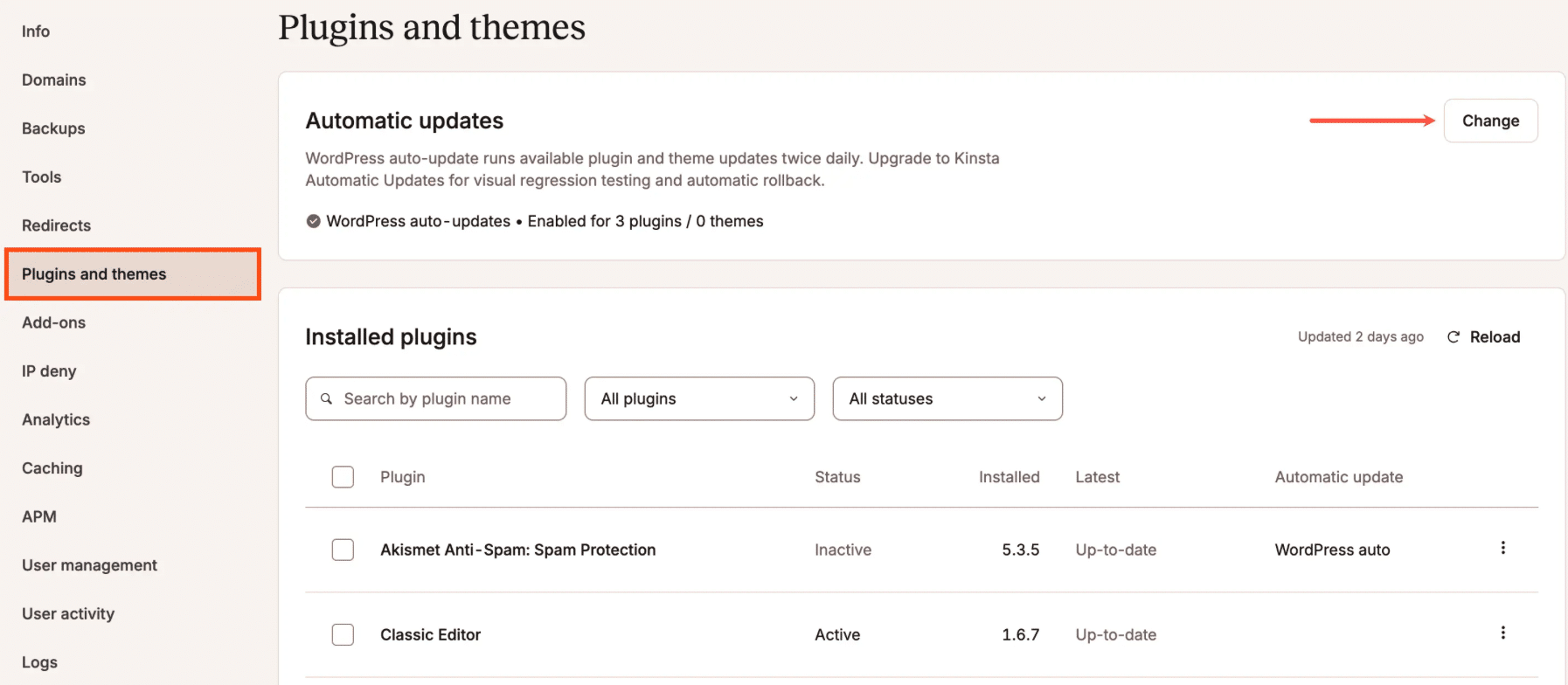
Certain aspects of this architecture are already standard practice in modern managed hosting. Automated update mechanisms can generate system backups, execute updates, compare pre- and post-update screenshots, and revert changes automatically if visual errors are detected. Integrating AI agents into these frameworks introduces a higher level of orchestration, allowing systems to coordinate updates across multiple client sites simultaneously while intelligently routing edge-case failures to human engineers.
Similarly, staging and deployment pipelines can be delegated to automated agents. An agent can spin up an isolated staging environment, apply approved code modifications, trigger automated integration tests, and prepare a deployment package for human sign-off. The developer retains ultimate control over the production environment, approving or rejecting the final deployment based on the agent’s synthesized reports.
Performance Troubleshooting and Observability
When a website experiences unexpected latency or runtime errors, diagnosing the root cause typically demands extensive manual investigation. Engineers must query server logs, analyze database performance metrics, inspect recent software updates, review traffic anomalies, and evaluate resource consumption.
Agentic systems can streamline this investigative phase by aggregating operational data automatically. Utilizing APIs capable of retrieving real-time server logs, traffic analytics, and Application Performance Monitoring (APM) metrics, an AI agent can synthesize disparate data points into a coherent diagnostic summary.
For instance, an agent integrated with server telemetry can identify traffic spikes, correlate them with specific HTTP response codes, isolate slow PHP processes or database queries via APM tools, and present a comprehensive root-cause analysis to the development team. In low-risk scenarios, the agent might even be authorized to execute predefined remediation protocols, such as clearing corrupted object caches or scaling server resources, before alerting human staff.
Governance, Security, and Guardrails
As artificial intelligence systems gain the ability to execute functional tasks, the necessity for robust security guardrails increases exponentially. While a generative AI model providing an inaccurate text response represents a minor inconvenience, an autonomous agent executing an unauthorized or erroneous database modification can precipitate catastrophic downtime and data loss.
Consequently, organizations implementing agent-driven workflows must enforce the principle of least privilege. An AI agent tasked with analyzing site analytics requires no administrative permissions to modify Domain Name System (DNS) records or manage user accounts. By strictly compartmentalizing access tokens and restricting agent capabilities to narrowly defined operational spheres, engineering teams can mitigate systemic risk.
Furthermore, high-stakes actions—such as production deployments, database restorations, security permission modifications, and infrastructure provisioning—must remain gated behind mandatory human approval checkpoints. Comprehensive audit trails are equally critical. When an automated agent executes tasks within an infrastructure ecosystem, teams must maintain complete visibility over the chronological sequence of events. Activity logs must accurately record which agent initiated an action, the precise timestamp of execution, the parameters utilized, and the resulting status.
Transforming the Agency Delivery Model
Beyond the technical architecture, agent-driven operations introduce significant structural changes to the business models of digital agencies and IT consultancies. Historically, agency revenue models and operational overhead have scaled linearly; managing twice as many client websites traditionally required a proportional increase in human labor dedicated to routine maintenance, security checks, and reporting.
Supervised automation decouples site volume from repetitive manual toil. By delegating administrative upkeep, patch management, and initial troubleshooting to AI agents, agency personnel can reallocate their time toward high-value strategic initiatives. Developers can focus on complex software architecture, custom feature development, and security hardening, while account managers can concentrate on client relations, business growth, and strategic consulting.
This evolution does not diminish the value of human expertise; rather, it elevates it. The core responsibility of technical teams transitions from executing operational tasks to designing, auditing, and refining the automated workflows that govern those tasks. As the web development industry adapts to this new operational framework, the organizations best positioned for success will be those that embrace supervised automation while preserving rigorous human oversight, ensuring that efficiency gains never compromise operational security or client trust.