The Death of the Button: Why the Future of Web Design is Intent-Driven and Interface-Free

The digital landscape is undergoing a profound structural evolution, moving away from an era defined by menus, multi-step forms, and endless point-and-click interactions toward experiences shaped entirely around human intent. For decades, software development and user experience (UX) design have been anchored to the paradigm of the Graphical User Interface (GUI). Pioneered by systems like the Xerox Star in the 1970s and popularized globally by the original Apple Macintosh, the foundational contract of computing relied heavily on visual navigation. If a user wanted to complete a routine task—such as booking travel accommodations, purchasing consumer goods, or researching a complex medical symptom—they were expected to manually traverse a labyrinth of digital interfaces. This traditional model required users to click through nested dropdown menus, adjust range sliders, fill out tedious multi-step forms, accept intrusive cookie consent pop-ups, and manage dozens of open browser tabs simply to cross-reference basic information. Consequently, digital consumers grew accustomed to spending more time actively managing software mechanics than actually achieving their real-world goals.
That foundational contract is now officially changing. Propelled by rapid advancements in artificial intelligence, machine learning, and large language models (LLMs), a new generation of web tools is pioneering a radical philosophy known as Intent-Driven Design. Rather than expecting human users to learn complex interface hierarchies and click through elaborate sales funnels, these modern platforms operate by capturing high-level human goals and silently executing the underlying computational labor in the background. This emerging design philosophy does not emerge in a vacuum; it builds directly upon long-standing Human-Computer Interaction (HCI) concepts, most notably Golden Krishna’s seminal thesis “The Best Interface Is No Interface” and Don Norman’s established principles of human-centered design. As the industry recalibrates, the ultimate goal of modern web architecture is no longer to construct prettier buttons or flashier micro-animations, but rather to eliminate the interface entirely wherever possible. For UX professionals, this shift demands a critical re-evaluation of their core responsibilities, moving away from designing static, visible screens and toward guiding transparent, intent-driven AI experiences.

The Friction of Legacy Workflows: Anatomy of the Ten-Click Process
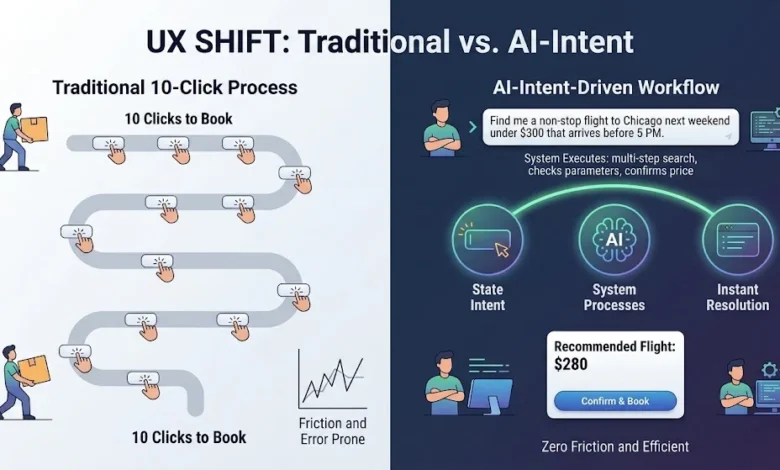
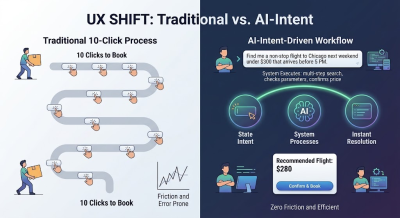
To fully comprehend the direction of contemporary web development, it is necessary to examine the friction that the digital community has accepted as standard operating procedure for decades. Consider the traditional workflow associated with purchasing a commercial airline ticket online. The user experience is intentionally hyper-interactive and fragmented. A consumer must first navigate to an airline aggregator or carrier website, locate and select departure and arrival input fields, manually input calendar dates via a pop-up widget, specify passenger counts, click search, sift through pages of sorted results, filter by layovers or baggage fees, select specific seats, input personal and passport identification details across multiple pages, enter payment information, pass multi-factor authentication checks, and finally receive a confirmation screen.
This sequence represents the textbook definition of the point-and-click UI paradigm. In this legacy architecture, the computer acts as a passive container of data, while the human user functions as the meticulous orchestrator—manually inputting parameters, interpreting raw outputs, and executing each micro-step along the path to a completed objective.
Intent-driven design flips this dynamic entirely. Instead of forcing individuals to navigate the mechanical steps required to discover an outcome, the interface simply asks a foundational question: What are you trying to accomplish? When a user expresses a clear, high-level goal—such as requesting a non-stop flight to Chicago for the upcoming weekend under a specified budget that arrives before a certain hour—the software parses this natural language intent, executes the complex multi-step search queries behind the scenes, cross-references inventory, and presents a single, actionable resolution. The traditional ten-click process thus dissolves into a unified intent outcome.
Real-World Implementations: Platforms Replacing Buttons With Intent
This transformation is not a theoretical forecast restricted to the distant future; it is actively reshaping accessibility and functionality across some of the most widely utilized digital platforms today.
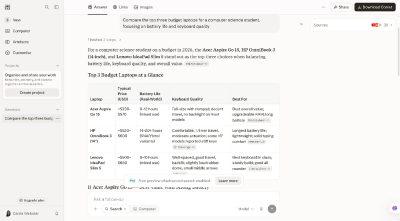
Leading this transition in the information retrieval sector is Perplexity AI, which challenges the traditional search engine model established by pioneers like Google. Conventional search engines were constructed as digital directories, rewarding keyword queries with a page of blue links and leaving the manual labor of opening multiple tabs, skimming lengthy articles, avoiding advertisements, and synthesizing answers to the user. Perplexity AI facilitates instant, intent-based searches that bypass the traditional tab-and-link paradigm by synthesizing contextualized answers directly onto a single screen.
In the realm of digital creation, tools such as Vercel v0 are redefining web design by eliminating the need for manual drag-and-drop mechanics. Historically, building a website or user interface required design professionals to utilize complex vector tools like Figma or visual editors to manually draw layout rectangles, input hexadecimal color codes, adjust padding variables, and write cascading style sheets (CSS). Generative platforms allow creators to articulate structural and functional goals through natural language prompts, instantly generating functional user interface components and code bases without requiring manual layout construction.
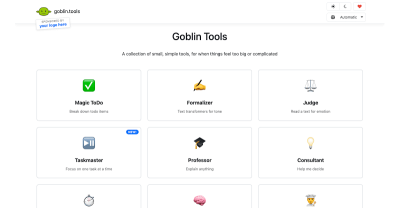
Similarly, productivity applications like Goblin.tools address the cognitive load associated with traditional task management software. Conventional productivity suites often demand that users manually construct task hierarchies, drag items across digital Kanban boards, and assign granular deadlines. Goblin.tools utilizes single-task artificial intelligence models to automatically break down overwhelming, complex real-world projects—such as planning a job interview or organizing a household move—into manageable, step-by-step checklists, requiring zero manual configuration or prior setup.
Core Pillars of Intent-Driven Web Architecture
The removal of traditional menus, sidebars, and static forms requires a complete overhaul of how web usability is measured and maintained. UX designers pioneering this space rely on three foundational pillars: high-level goal ingestion, generative user interfaces, and autonomous execution by background AI agents.
High-Level Goals and Contextual Awareness
Invisible interfaces do not always wait for explicit textual commands; instead, they leverage ambient computing and contextual metadata to anticipate user needs. Guided by established industry benchmarks such as Apple’s Human Interface Guidelines on Contextual and Ambient Design, modern digital systems read environmental inputs—including device status, geographical location, and historical interaction patterns—to trigger proactive utility. For instance, a transit application can automatically surface a digital boarding pass and platform change notification the moment a commuter arrives at a railway station, eliminating the need to search through an application hierarchy.
Generative User Interfaces (Generative UI)
In legacy web design, every visitor encounters an identical static layout. An e-commerce portal presents the identical navigation bar to a first-time browser seeking customer support as it does to a returning customer tracking an active delivery. As highlighted in analytical frameworks published by the Nielsen Norman Group regarding AI as a new UX paradigm, computing is shifting decisively from command-based interaction to outcome-specification.
This shift enables Generative UI, where interface layouts are rendered dynamically on the fly based on the immediate context of the user’s current objective. If an individual expresses a need to analyze complex financial forecasting data, the web application generates a custom calculator widget on demand, which subsequently recedes from view once the specific objective has been satisfied.
Autonomous Execution and Frictionless Reversibility
Traditional software design has long been obsessed with error prevention, frequently interrupting users with cautionary confirmation modals asking whether they are certain they wish to execute an action. Intent-driven interfaces adapt Jakob Nielsen’s foundational usability heuristics concerning user control and error recovery by shifting the safety net from rigid prevention to easy reversibility. Because autonomous agents frequently execute workflows on behalf of the user, modern products prioritize frictionless rollback mechanisms. Prominent undo functionalities, simple conversational revision prompts, and transparent audit logs replace intrusive warning dialogs.
Ethical Considerations, Risks, and the Black Box Challenge
While the removal of digital friction offers substantial efficiency gains, stripping away traditional visual controls introduces notable technical and ethical challenges. When software operates on inferred intent rather than direct point-and-click commands, designers must carefully navigate complex product design pitfalls.
The Illusion of Control and User Autonomy
When a digital platform begins making automated decisions on behalf of a user, the experience can easily transition from helpful to invasive or patronizing. Research from academic institutions such as the Stanford Human-Computer Interaction Group indicates that automation must maintain strict boundaries to prevent user alienation. Furthermore, ethical guidelines established by organizations like the Center for Humane Technology emphasize that product designers must actively guard against manipulative defaults and opaque automation loops. Designers are forced to maintain a delicate equilibrium: automating routine, repetitive execution while explicitly prompting human confirmation for high-stakes actions, such as financial transactions, public content publishing, or significant privacy modifications.
The Black Box Problem and Transparency
In a traditional user interface, encountering an unexpected result allows for straightforward troubleshooting—such as recognizing an incorrectly checked filter box or an erroneous date selection. Within intent-driven architectures, diagnostic troubleshooting becomes considerably more complex due to the inherent opacity of algorithmic processing. To mitigate this black box challenge, guidelines from initiatives like the Google PAIR (People + AI Research) Guidebook advocate for transparent feedback loops. Systems must explicitly articulate their current interpretation of a user prompt—such as displaying a clear text confirmation stating it is searching exclusively for non-stop flights under a specific price threshold—thereby allowing users to calibrate trust and correct misinterpretations instantly.
Implications for the Future of UX Design
As the digital industry continues its transition toward agent-driven computing, the core competencies required of UX professionals are undergoing a fundamental transformation. Rather than devoting professional hours to sketching static buttons, refining grid systems, and engineering rigid form validation sequences, modern designers must master the orchestration of dynamic, generative UI components that adapt fluidly to human intent.
By mastering emerging patterns such as ambient feedback mechanisms, inline conversational prompts, and transparent system status indicators, designers can ensure that screenless, agent-driven tools remain intuitive, ethical, and deeply aligned with human needs. For decades, the digital economy has measured success through engagement metrics centered on time spent in applications, overall click-through rates, and page views per session. Websites were intentionally engineered to maximize visual engagement and interaction volume.
The philosophy underlying Golden Krishna’s core assertions, combined with the broader principles of the Center for Humane Technology’s mindful design movement, reverses these legacy metrics entirely. The ultimate evaluation of a modern digital product is no longer determined by how visually captivating its interactive buttons happen to be, but rather by how effectively the software solves the underlying problem while immediately getting out of the user’s way. The digital ecosystem is entering a definitive era where web applications will be measured not by the complexity of their interfaces, but by their capability to render those interfaces entirely obsolete through seamless, invisible execution.