The comparison between Shopify and Pirate Ship frequently arises in discussions among online sellers, yet it’s crucial to understand that they are not direct rivals. Instead, they serve distinct, albeit complementary, functions within the ecommerce ecosystem. Shopify is a comprehensive platform designed to build and operate an online store, encompassing everything from storefront creation to payment processing. Pirate Ship, on the other hand, specializes in streamlining the purchase of shipping labels, offering significant cost savings for businesses selling physical products within the United States. For the majority of US-based sellers, the most effective strategy is not to choose one over the other, but rather to leverage Shopify for managing their online presence and Pirate Ship for optimizing their shipping expenses. This article will dissect the core functionalities of each platform, identify areas of overlap, and provide a clear framework for deciding which tool is best suited for different aspects of your shipping operations.
The notion that these two platforms are mutually exclusive is a misconception. Pirate Ship offers an official Shopify application, making a common and highly effective setup to utilize Shopify for the storefront and customer-facing aspects, while integrating Pirate Ship for the acquisition of shipping labels. This symbiotic relationship allows sellers to benefit from the robust features of a full ecommerce platform while simultaneously accessing deeply discounted shipping rates. We will compare them across several key dimensions, including their primary functions, cost structures, shipping rates, checkout experience, workflow efficiency, and customer support, to illuminate precisely where each platform excels and how they can best be integrated into a successful online business strategy.
A Quick Comparison: Shopify vs. Pirate Ship
| Feature | Shopify | Pirate Ship |
|---|---|---|
| What it is | Full ecommerce platform (store builder, checkout, payments, shipping) | Free shipping software for buying discounted USPS and UPS labels |
| Monthly Cost | $29 to $299 per month billed annually (Plus from $2,300) | $0 per month; you only pay for postage |
| Free Trial | 3-day free trial, then $1 per month for the first 3 months | Free to use, no credit card required |
| USPS Labels | Discounted rates through Shopify Shipping | USPS Commercial Pricing, including Priority Mail Cubic |
| UPS Labels | Discounted rates through Shopify Shipping | Deeply discounted UPS, including UPS Ground Saver |
| Other Carriers | DHL Express included; FedEx with your own account | USPS and UPS only |
| Live Rates at Checkout | Yes, carrier-calculated rates (Advanced and Plus, or add-on) | No, it works after the sale only |
| Batch Shipping | Basic; deeper features via apps | Yes, with no batch size limit |
| Storefront & Checkout | Yes, this is the core product | No |
| Integration | Pirate Ship connects as a Shopify app | Imports Shopify orders and syncs tracking back |
| Best For | Running your whole online business | Cutting your per-label shipping cost |
Understanding the Core Functions of Each Platform
To truly grasp the dynamic between Shopify and Pirate Ship, it’s essential to move beyond the idea of a direct competition. Think of Shopify as the entire retail establishment – the shop floor, the cash register, and the inventory management system. Pirate Ship, conversely, is the efficient postal service counter within that shop, focused solely on ensuring packages are sent out at the best possible price.
Shopify: The Ecommerce Powerhouse
Shopify’s strength lies in its comprehensive suite of tools designed for building and managing an online business from the ground up. It provides merchants with everything they need to establish an online presence, sell products, and manage customer interactions.
What Shopify Does Well:
- Storefront Creation: Shopify offers a user-friendly interface for designing and customizing professional-looking online stores. With a wide array of themes and drag-and-drop functionality, sellers can create visually appealing storefronts without extensive coding knowledge.
- Product Management: Sellers can easily upload product catalogs, manage inventory levels, categorize products, and set pricing.
- Payment Processing: Shopify integrates seamlessly with Shopify Payments, offering a secure and straightforward way to accept credit card payments, along with a multitude of other payment gateways.
- Checkout Experience: The platform provides a streamlined and secure checkout process for customers, which can be customized to enhance the user experience.
- Marketing and SEO Tools: Shopify includes built-in tools for search engine optimization (SEO), email marketing integrations, and discount code creation to help businesses attract and retain customers.
- Scalability: Shopify is designed to grow with a business, offering tiered plans and the Shopify Plus option for enterprise-level needs, supporting businesses from startups to major global brands.
Where Shopify Falls Short (in the context of shipping costs):
- Shipping Rate Discounts: While Shopify Shipping offers discounted rates, these are generally not as deeply discounted as those available through specialized shipping software like Pirate Ship, especially for USPS and UPS services. The savings are often more modest, and the platform may not always offer access to the most niche or cost-effective shipping services.
- Limited Carrier Options for Direct Integration: While Shopify supports USPS, UPS, and DHL Express, integrating with other carriers like FedEx often requires bringing your own account and setting up the integration separately.
Pirate Ship: The Shipping Cost Optimizer
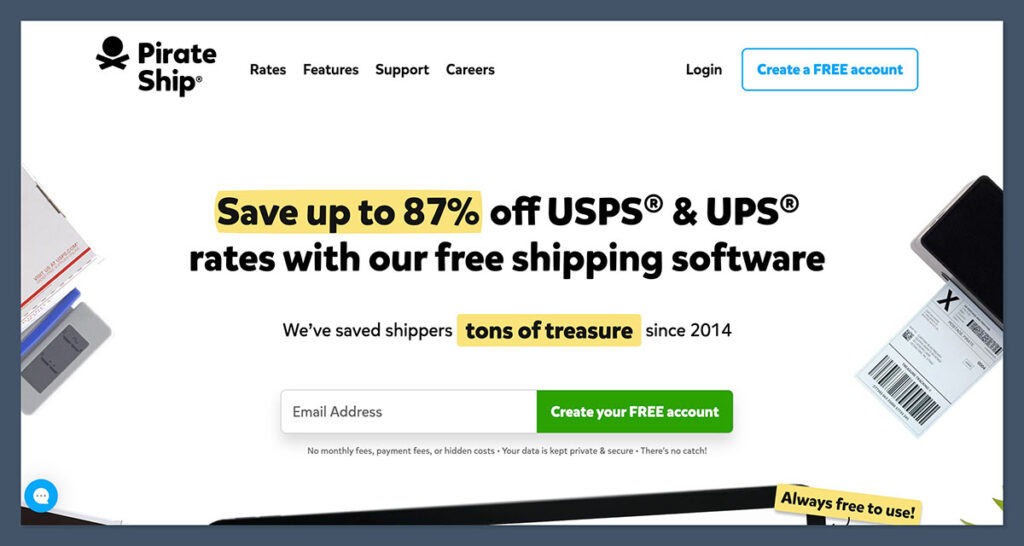
Pirate Ship’s singular focus is on providing the lowest possible shipping rates for its users. It achieves this by passing on USPS Commercial Pricing and offering significantly discounted UPS rates without any added markups or monthly fees.
What Pirate Ship Does Well:
- Unbeatable Shipping Rates: This is Pirate Ship’s core value proposition. It provides access to USPS Commercial Pricing, which is typically reserved for high-volume shippers, and deeply discounted UPS rates, including services like UPS Ground Saver. These rates often undercut those offered by other platforms, leading to substantial savings, especially for businesses with significant shipping volumes.
- Access to Niche Services: Pirate Ship makes it easy to access services that can be highly cost-effective for specific types of shipments, such as USPS Priority Mail Cubic (ideal for small, heavy packages) and UPS Ground Saver (for less time-sensitive shipments).
- Free Software: The platform is entirely free to use. There are no monthly subscription fees, no per-label markups, and no minimum volume requirements. The only cost incurred is the actual postage price.
- Batch Shipping Efficiency: Pirate Ship excels at handling bulk shipping. Sellers can import and process large numbers of orders simultaneously, print labels in batches without any size limitations, and streamline the fulfillment process.
- User-Friendly Interface: Despite its powerful features, Pirate Ship maintains a straightforward and intuitive interface, making it easy for sellers of all technical abilities to navigate and use.
Where Pirate Ship Falls Short:
- No Storefront or Checkout Functionality: Pirate Ship does not offer any features for building an online store, displaying products, or processing customer payments. Its sole purpose is to facilitate the purchase and printing of shipping labels.
- Limited Carrier Support: It exclusively supports USPS and UPS. Sellers who rely heavily on other carriers like FedEx, DHL, or regional carriers will need to use other solutions for those shipments.
- No Live Rates at Checkout: Pirate Ship operates post-sale. It cannot display real-time shipping costs to customers during the checkout process on an online store.
- Best for Building an Online Store: Shopify
The distinction here is not even a contest. Shopify is purpose-built for creating and managing online stores, a function Pirate Ship does not address at all. Shopify provides a complete ecommerce solution: a hosted storefront, customizable design themes, a product catalog management system, a secure checkout process, integrated payment processing, and essential marketing tools, all accessible from a unified administrative dashboard.

Shopify operates on a tiered pricing structure. The Basic plan starts at $39 per month (or $29 per month when billed annually). The Grow plan is priced at $105 per month ($79 annually), and the Advanced plan is $399 per month ($299 annually). For enterprise-level businesses, Shopify Plus begins at approximately $2,300 per month. New users typically benefit from a 3-day free trial, followed by an introductory offer of $1 per month for the initial three months before standard pricing takes effect. If a merchant utilizes Shopify Payments for transaction processing, credit card rates commence at 2.9% plus $0.30 per online transaction on the Basic plan, with these rates decreasing as one progresses to higher-tier plans.
In stark contrast, Pirate Ship offers no storefront capabilities, no product pages, and no checkout system. It is designed with the assumption that the seller already has a platform where orders are generated and simply needs an efficient way to ship those orders. Therefore, if the fundamental requirement is a digital space to list products and receive payments, Shopify is not merely the superior option; it is the only viable choice between the two.
The Verdict: Shopify is a comprehensive ecommerce platform, while Pirate Ship is solely a shipping label purchasing tool. For businesses requiring a platform to list products and process transactions, Shopify is the definitive solution.
- Best for Shipping Rates: Pirate Ship
This is where the comparison becomes particularly insightful, as it represents the primary area of overlap between the two platforms. Both Shopify and Pirate Ship offer discounted shipping labels for USPS and UPS, but the magnitude of these discounts differs significantly.
Pirate Ship’s raison d’être is to provide the cheapest possible postage. It grants users access to USPS Commercial Pricing, the same discounted tier utilized by high-volume shippers, and offers deeply discounted UPS rates. Crucially, Pirate Ship adds no markup to these rates; the price you pay is the carrier’s discounted price. Furthermore, it unlocks access to cost-saving services that might otherwise be overlooked, such as USPS Priority Mail Cubic, which is exceptionally economical for small, heavy packages, and UPS Ground Saver, a cost-effective option for non-urgent, lower-value shipments.
Shopify Shipping also provides discounted rates for USPS, UPS, and DHL Express, with these discounts improving as merchants upgrade to higher-tier plans. However, numerous comparative analyses by merchants consistently reveal that Pirate Ship offers lower per-label costs for both USPS and UPS shipments. The difference can amount to several dollars per package, depending on the weight and dimensions. The most substantial savings are typically observed with USPS Priority Mail Cubic and UPS Ground Saver, services that Pirate Ship prices very aggressively.
For sellers shipping a minimal number of orders, the convenience of purchasing labels directly within the Shopify interface might justify a slightly higher per-label cost. However, for businesses where shipping expenses represent a significant line item on their profit and loss statements, even a small per-package saving can accumulate into substantial cost reductions over time.
The Verdict: For USPS and UPS shipping specifically, Pirate Ship’s rates generally outperform Shopify’s native shipping labels, and it does so without any software fees. If minimizing shipping costs is a primary objective, Pirate Ship is the clear winner in this category.
- Best for Cost Structure: It Depends on Your Needs
At first glance, Pirate Ship appears to have an undeniable advantage due to its free software model, while Shopify operates on a subscription basis. However, this comparison is misleading because the two platforms offer fundamentally different services.
Pirate Ship’s software is genuinely free. There are no monthly fees, no hidden markups on postage, and no minimum usage requirements. The only expense incurred by the user is the actual cost of the postage. This makes it an easily integrable cost-saving tool for virtually any budget.
Shopify, conversely, charges for the infrastructure and services required to run an online business: website hosting, a secure checkout system, payment processing, data security, and a suite of tools for marketing and business management. Comparing a "free" label purchasing tool with a paid platform that provides the entire ecommerce ecosystem is an apples-to-oranges comparison. The subscription fee for Shopify represents the cost of establishing and operating a digital storefront, not merely the cost of printing shipping labels.
A more accurate perspective is to view Shopify as the investment in your online store and Pirate Ship as a method to reduce the operational costs associated with shipping from that store. If your sole requirement is to purchase shipping labels and you already operate your sales through another channel—such as an online marketplace, social media, or in-person sales—then Pirate Ship alone can fulfill your shipping needs at no software cost. However, if you need a dedicated online storefront, that is a Shopify expense that cannot be circumvented by opting for Pirate Ship, as the latter does not offer storefront capabilities.
The Verdict: Pirate Ship unequivocally wins on pure software cost due to its free model. However, if the requirement is for an online store, that is exclusively a Shopify function. The most strategic approach for many businesses is to combine the paid platform (Shopify) with the free shipping tool (Pirate Ship) rather than viewing them as mutually exclusive alternatives.
- Best for Checkout and Carrier Options: Shopify
The consideration of shipping extends beyond just the cost of the label; it also encompasses the customer’s experience at checkout and the range of carriers available to the seller.
Shopify natively handles the checkout process. On its higher-tier plans, it can display carrier-calculated rates directly to customers during checkout. This provides shoppers with precise, real-time shipping costs before they finalize their purchase. This transparency is critical, as a significant percentage of online shoppers expect to know shipping expenses upfront. Additionally, Shopify offers broader native carrier support, including USPS, UPS, and DHL Express. Sellers can also integrate their own FedEx accounts to offer FedEx shipping options.

Pirate Ship, however, has no integration with the customer-facing checkout process. It operates entirely behind the scenes, after an order has been placed and the seller needs to purchase and print a label. Furthermore, its carrier support is limited to USPS and UPS. If a business’s shipping strategy relies on carriers like FedEx, DHL, or various regional carriers, Pirate Ship cannot directly assist with those shipments.
The Verdict: For providing live shipping rates at the point of sale and offering a wider selection of carrier integrations, Shopify emerges as the stronger choice. Pirate Ship functions as a back-office tool for label acquisition, not as a frontend checkout solution.
- Best for the Shipping Workflow: Pirate Ship
Once an order is secured and the immediate task is to fulfill and dispatch it, Pirate Ship’s specialized focus begins to yield significant advantages. The platform was meticulously designed to streamline the process of transforming orders into shipping labels efficiently.
The workflow is remarkably clean: sellers can easily compare available USPS and UPS services side-by-side, select the most appropriate and cost-effective option, and print the label. Pirate Ship enables batch printing of large volumes of labels without any size constraints, allows for the creation and saving of package presets (automatically populating weight and dimensions), validates addresses to prevent errors, generates necessary customs forms for international shipments, facilitates the purchase of shipping insurance, prints return labels, and produces End of Day SCAN forms required by carriers. Labels can be printed on standard desktop printers or 4×6 thermal printers. Its detailed spending reports provide a breakdown of costs by service and shipping zone, which is invaluable for financial planning and cost analysis.
Shopify also offers label printing capabilities, and for businesses shipping a small number of orders daily, managing this within the same administrative interface can indeed be simpler. However, as shipping volume increases, the comprehensive features of Pirate Ship’s label workflow—particularly its advanced batch processing and rate comparison tools—surpass Shopify’s native functionalities. Often, achieving similar levels of efficiency with Shopify would necessitate the integration of third-party applications.
The Verdict: Pirate Ship excels in handling high shipping volumes, while Shopify offers greater simplicity for lower volumes. At the outset, printing labels directly within Shopify is often the more straightforward path. As order numbers grow, Pirate Ship’s specialized tools for batch processing and rate comparison significantly expedite the daily shipping routine and contribute to cost reduction.
- Best for Support and Getting Started: A Close Call
Both platforms are generally well-regarded for their customer support, making this aspect a matter of nuanced preference based on individual needs.
Shopify provides round-the-clock support through live chat, complemented by an extensive help center filled with comprehensive guides, tutorials, and courses. Higher-tier merchants often receive priority support channels. Given the breadth of Shopify’s offerings, there is a considerable amount to learn, and the initial setup of a full online store can require a significant time investment.
Pirate Ship is recognized for its prompt, friendly, and often humorously delivered (in pirate-themed language) live chat and email support. Because its product is highly specialized and focused, the onboarding process is exceptionally quick. Most users can generate their first shipping label within minutes of signing up, and no credit card information is required to begin.
The Verdict: Both platforms offer strong support systems. Shopify’s support must cover a vast array of features, while Pirate Ship’s support is rapid and highly focused. Neither platform’s support should present a significant barrier to adoption.
How to Choose Between Shopify and Pirate Ship
Given that these tools serve distinct purposes, the decision-making process is less about choosing a singular "winner" and more about aligning each platform’s capabilities with your specific business requirements.
Choose Shopify if:
- You need to establish an online presence and sell products directly to consumers.
- You require a comprehensive platform for website design, product management, and payment processing.
- You want to offer customers live shipping rate calculations at checkout.
- You need to integrate with a broad range of carriers beyond just USPS and UPS.
- You are building a brand and require a unified platform to manage your entire online business.
Choose Pirate Ship if:
- Your primary goal is to reduce the cost of shipping USPS and UPS labels.
- You already have a sales channel and only need to purchase and print shipping labels.
- You ship a high volume of packages and can benefit from significant per-label savings.
- You want a free, no-frills solution for acquiring discounted postage.
Use Both if:
- You operate an online store built on Shopify and want to maximize your shipping cost savings.
- You want to maintain Shopify’s integrated storefront and checkout experience while leveraging Pirate Ship’s superior rates for USPS and UPS shipments.
This combined approach is increasingly popular among established Shopify merchants. Pirate Ship offers a seamless integration as a Shopify app, allowing it to import unfulfilled orders directly. Sellers can then purchase labels through Pirate Ship at its discounted rates, after which the app automatically marks orders as fulfilled and syncs the tracking numbers back to Shopify. While this adds a single step to the workflow, the savings on USPS and UPS labels often quickly outweigh any minor inconvenience.
The Importance of Data and Merchant Feedback
The comparison presented here is informed by an analysis of each platform’s current pricing structures and feature sets as published on their official websites. The supported carriers and services offered by each are also key considerations. The functionality of Pirate Ship’s Shopify integration, which facilitates the seamless transfer of order and tracking information, has been thoroughly evaluated. Furthermore, this assessment draws upon recurring themes and patterns observed in merchant feedback across various review sites and online seller communities, providing a real-world perspective on user experiences. Pricing details were cross-referenced with official provider pages prior to publication, acknowledging that rates and plan structures are subject to regular updates. Rather than imposing a subjective score on tools that fulfill different functions, the evaluation emphasizes their intended purpose and the specific areas where their capabilities intersect.
Key Takeaways:
- Shopify is an ecommerce platform; Pirate Ship is a shipping label tool. They are not direct competitors.
- Pirate Ship generally offers lower shipping rates for USPS and UPS. This is its primary advantage.
- Shopify provides the storefront, checkout, and payment processing. This is its core function.
- A combined approach is highly effective. Many sellers use Shopify for their store and Pirate Ship for label purchasing.
- Pirate Ship is free software; Shopify is a paid subscription. The cost reflects the different services provided.
Shopify vs. Pirate Ship: Our Verdict
Declaring a single definitive winner would be inaccurate because Shopify and Pirate Ship are not vying for the same market segment. Shopify stands out as the premier choice if your fundamental need is a platform to sell online. It provides the essential tools—storefront, checkout, payment processing, and integrated shipping management—required to build and scale a successful online business. Pirate Ship, conversely, is the optimal solution if your primary objective is to secure the most economical shipping rates. It is free to use and consistently delivers lower prices on USPS and UPS labels compared to native platform offerings.
For a significant number of US-based sellers, the most advantageous strategy is not to choose between them, but to implement a combined solution: Shopify to power the online store and Pirate Ship to procure the shipping labels. This approach allows businesses to retain the robust storefront and customer experience offered by Shopify while simultaneously reducing per-order shipping costs by utilizing Pirate Ship’s discounted rates. The integration between the two platforms ensures that orders and tracking information remain synchronized, creating a streamlined and cost-effective operational flow. Ultimately, the right choice hinges on a clear understanding of whether your business requires a complete ecommerce solution, a specialized tool for cheaper postage, or the synergistic benefits of both.
Frequently Asked Questions
Is Pirate Ship truly free?
Yes. Pirate Ship does not charge any monthly fees, markups on postage, or minimum usage requirements for its software. The sole expense is the actual cost of the postage, which is provided at USPS Commercial Pricing and discounted UPS rates. The platform generates revenue from the carriers, not from its users.
Can I use Pirate Ship with Shopify?
Absolutely. Pirate Ship offers an official Shopify application that seamlessly integrates with your Shopify store. It imports your unfulfilled Shopify orders, enables you to purchase discounted USPS and UPS labels, and then automatically updates those orders as fulfilled, synchronizing tracking numbers back to Shopify.
Does Pirate Ship replace Shopify?
No. Pirate Ship does not provide any storefront functionality, checkout system, or product catalog management. Its sole purpose is to facilitate the purchase and printing of shipping labels. If you need a platform to conduct online sales, you will still require a solution like Shopify or another sales channel.
Is Pirate Ship cheaper than Shopify Shipping?
For USPS and UPS labels, Pirate Ship is typically more cost-effective. Merchant comparisons consistently show Pirate Ship offering lower per-label rates, with the most significant savings often seen on USPS Priority Mail Cubic and UPS Ground Saver services. For very low shipping volumes, the convenience of Shopify’s integrated shipping might offset minor cost differences.
Does Pirate Ship work outside the US?
While Pirate Ship facilitates shipments originating from US addresses, it does handle international shipments via USPS and UPS. This includes the generation of customs forms and offers a cost-effective international shipping option for qualifying packages. However, it does not support shipping originating from outside the United States.
Should a brand new store use Shopify Shipping or Pirate Ship?
For a brand-new store shipping only a few orders and prioritizing simplicity, purchasing labels directly through Shopify is the most straightforward initial approach. As shipping volume increases to a point where postage savings become significant, integrating Pirate Ship for USPS and UPS labels is one of the most effective methods for reducing costs.