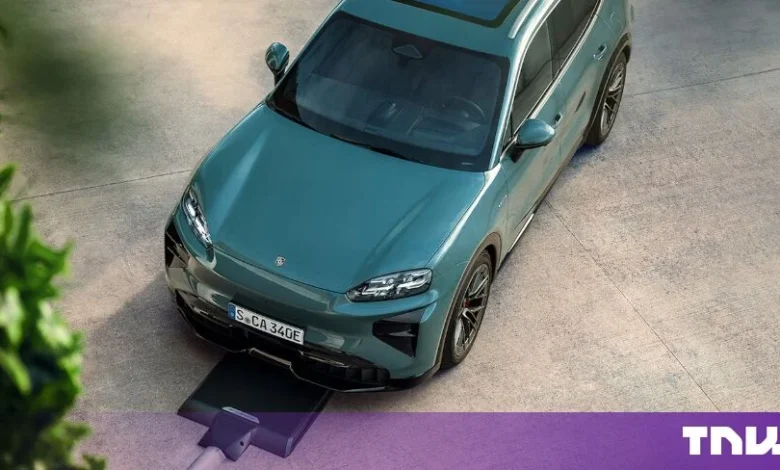
Porsche has officially opened order books for a sophisticated 11 kW wireless charging solution tailored for the Cayenne Electric, marking a significant milestone in automotive electrification. By introducing this technology, Porsche has become the first manufacturer to offer inductive charging hardware for a consumer vehicle in both Europe and North America. This innovation shifts the paradigm of electric vehicle (EV) maintenance, moving away from manual cable management toward a seamless, automated power transfer experience.
The system is priced at a premium, reflecting its advanced engineering and integration capabilities. In Germany, the comprehensive package—consisting of a ground-mounted transmitter pad and the vehicle-integrated receiver hardware—retails for a total of EUR 6,961.49. A breakdown of these costs reveals a floor pad priced at EUR 5,116.99 and car-side hardware at EUR 1,844.50. For customers who prefer a phased approach, Porsche offers a pre-installation kit for EUR 226.10, allowing for a future retrofit.
Technical Specifications and Engineering Precision
At the core of this system is an 11 kW power transfer capability, which delivers energy to the Cayenne Electric’s 113 kWh battery pack with remarkable efficiency. Porsche engineers have optimized the system to reach up to 90% efficiency. While this trails slightly behind the industry-standard 94% efficiency seen in direct-wired conductive charging, the trade-off in convenience is substantial.
Unlike conventional home charging, which relies on the vehicle’s onboard charger to convert alternating current (AC) to direct current (DC), the Porsche inductive system is designed to bypass the onboard charger entirely. The ground pad transfers energy to a liquid-cooled receiver unit mounted on the vehicle’s undercarriage, which then feeds DC power directly into the battery. This bypass mechanism not only reduces thermal stress on the onboard AC/DC converter but also simplifies the energy pathway.
The physical hardware is as robust as it is innovative. The transmitter pad weighs approximately 50 kilograms and is fully waterproof, designed to withstand the crushing weight of the vehicle itself. Safety remains a paramount concern for inductive systems; to mitigate risks, the system utilizes integrated radar sensors. If the sensors detect foreign objects—such as metallic debris, animals, or human presence—the power transfer is instantly interrupted to ensure safety. Furthermore, the system relies on the Cayenne’s sophisticated Park Assist technology to ensure the vehicle is precisely aligned over the pad, ensuring optimal coupling and efficiency.
Chronology and Market Deployment
The debut of this technology follows the start of series production for the Cayenne Electric, which commenced in February at Volkswagen’s manufacturing facility in Bratislava. By launching this system, Porsche is positioning itself as a technology leader, though the rollout is strategic and staged.
While European markets are the first to gain access, the absence of China from the current deployment list is notable. China represents the most mature market for inductive charging technology, with several domestic manufacturers already experimenting with high-power wireless solutions. Additionally, the Chinese market is seeing rapid adoption of alternative automation technologies, such as the robotic charging arms being pioneered by companies like Xiaomi. Porsche’s decision to prioritize Europe likely stems from a desire to address the specific "friction points" of the European charging experience, where residential density makes manual cable management particularly cumbersome.
The Myth of the Right to Plug
Despite the technical success of the system, Porsche’s wireless pad highlights a growing disconnect between automotive innovation and infrastructure policy. Because the pad must be permanently fixed to the ground, it is classified as a permanent building alteration. This legal classification clashes with the aspirational "Right to Plug" legislation currently being debated across the European Union.
The "Right to Plug" initiative, intended to simplify the process for tenants and apartment owners to install charging hardware, has been criticized for lacking teeth. Article 14(8) of the recast European Buildings Directive was intended to streamline these installations; however, its implementation has been fragmented. With transposition deadlines having passed in May, there is no binding, pan-European requirement for landlords or residential blocks to accommodate such infrastructure.
Transport and Environment (T&E), a leading clean transport advocacy group, has published briefings characterizing these regulations as "too weak." The directive allows for requests to be denied based on "serious and legitimate grounds," a term that remains nebulous and lacks a standard legal definition. This leaves homeowners and tenants vulnerable to arbitrary refusals from property management companies or co-owners.
Comparative Regulatory Landscapes
The ability for a Porsche owner to actually utilize this wireless technology depends heavily on their local jurisdiction. The regulatory landscape for EV charging in Europe is currently a patchwork:
- France: Currently the most progressive nation regarding residential charging. Co-owners have a strictly limited window of three months to object to an installation request, and objections can only be sustained if they prove technical infeasibility or severe conflicts with existing shared infrastructure.
- Germany, Italy, Poland, and Spain: These nations provide partial support for the "Right to Plug," but these protections typically extend only to property owners. Tenants remain largely excluded from the protections, making the installation of a permanently fixed 50-kilogram charging pad nearly impossible for those who do not own their residence.
- United Kingdom: Currently lacks any specific provisions to protect the right of an EV owner to install private charging equipment, leaving them entirely at the mercy of landlords or housing associations.
Given that the Cayenne Electric starts at a price point of approximately EUR 105,200, the primary demographic for this vehicle is the luxury buyer, who is statistically more likely to own their own home or have private, deeded parking. Nevertheless, the policy hurdle remains a significant barrier to the mass-market democratization of advanced charging technologies.
Implications for the Automotive Industry
The introduction of this system by Porsche serves as a bellwether for the industry. As EVs transition from "early adopter" gadgets to mainstream transportation, the demand for "frictionless" ownership experiences will only increase. Wireless charging eliminates the need to handle dirty, heavy cables in inclement weather—a clear value proposition for the premium segment.
However, the industry must also contend with the limitations of current standards. If every manufacturer develops proprietary, non-interoperable wireless charging pads, the result will be a fragmented infrastructure landscape that mirrors the early days of mobile phone chargers. For wireless charging to achieve true scale, it will require cross-manufacturer cooperation on alignment standards and power transfer protocols.
Furthermore, the environmental and economic impact of such systems must be considered. While the efficiency loss of 6% to 10% compared to wired charging may seem negligible for a single user, it represents a significant increase in energy consumption when aggregated across a fleet of millions of vehicles. Analysts suggest that for wireless charging to become a staple, the grid infrastructure must evolve to handle the increased load, and renewable energy integration will be necessary to offset the conversion losses.
Strategic Outlook
Porsche’s move is a bold attempt to define the premium EV experience of the next decade. By moving the hardware into the ground and the receiver into the car, they are effectively hiding the charging process, which is a major psychological step in making EVs feel more intuitive than internal combustion vehicles.
While the current regulatory environment in Europe presents a significant obstacle to widespread adoption—particularly for those in urban, high-density housing—the existence of the hardware creates a "pull" effect. As consumers experience the convenience of the system, political pressure on local governments to harmonize "Right to Plug" laws is likely to increase.
For now, the Porsche Cayenne Electric wireless charging pad remains an elite feature for the affluent consumer. However, the history of automotive technology suggests that what is a luxury option today often becomes a standard requirement tomorrow. As Porsche continues to refine the system and expand its reach to other markets, the automotive industry will be watching closely to see if this represents the beginning of the end for the charging cable.
Related posts: