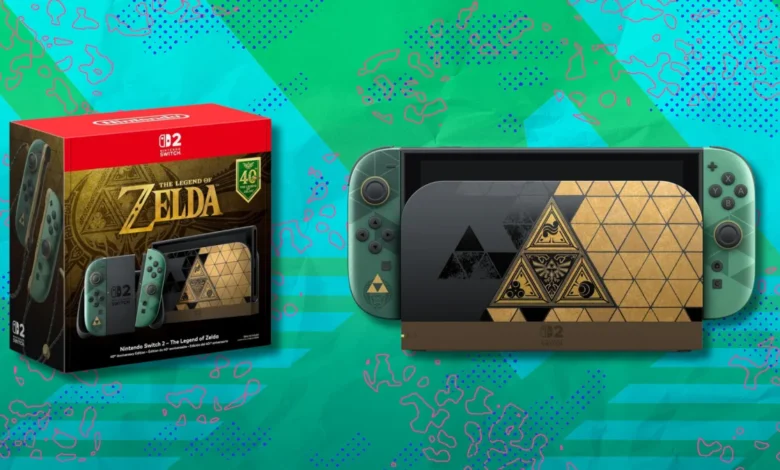
The initial wave of pre-orders for Nintendo’s landmark hardware and software offerings celebrating four decades of the Zelda franchise vanished from digital and physical storefronts within minutes last week, leaving millions of devoted fans empty-handed and searching for alternative purchasing avenues. The unprecedented demand was sparked by a major Nintendo Direct broadcast that provided the public with its first comprehensive look at the long-rumored The Legend of Zelda: Ocarina of Time complete remake tailored specifically for the forthcoming Nintendo Switch 2 hardware architecture. Alongside the software showcase, the Japanese gaming giant revealed a striking, limited-edition Nintendo Switch 2 console featuring intricate gold decorative decals commemorating the 40th anniversary of franchise creator Shigeru Miyamoto’s legendary fantasy universe.
Initial allocations across major global retailers were exhausted faster than industry analysts could project, echoing historical supply chain bottlenecks seen during past generational hardware transitions. However, official communications and regional store page updates have provided a glimmer of hope for prospective buyers who missed the initial purchasing window. Nintendo has quietly confirmed that subsequent inventory allocations are currently in development and will be deployed to the market in the near future, ensuring that the collector community has at least one more opportunity to secure the sought-after hardware package ahead of its official commercial rollout.
Regional Restock Strategies And Notification Mechanisms
Discerning shoppers navigating the official Nintendo digital storefronts across different global territories will encounter distinct instructions regarding how future inventory will be managed and distributed. In the United Kingdom, the corporate storefront has implemented a structured notification protocol for the hardware bundle. Prospective buyers visiting the UK portal are greeted with a formal advisory notice explicitly stating that upcoming restock windows and inventory drops will be announced exclusively through the dedicated Nintendo Store app, which is readily available for download across iOS and Android operating systems. This application-based notification method is designed to mitigate automated scalping operations and provide genuine consumers with a fair, equal opportunity to complete transactions during high-traffic inventory releases.
Meanwhile, the deployment strategy for the United States market maintains a slightly less rigid advisory framework, directing prospective purchasers simply to monitor the official listings and check back frequently for real-time inventory updates. Beyond official corporate channels, seasoned consumer technology collectors and retail analysts have pointed toward specialized crowdsourced stock-tracking networks and social media alert accounts—most notably consumer tracking outlets like Wario64 on the X platform—as reliable secondary mechanisms for tracking minute-by-minute inventory fluctuations and sudden retail restocks across third-party storefronts such as Amazon, Best Buy, Walmart, and Target.
Hardware Specifications And Pricing Controversy
At the center of the consumer frenzy is the specialized Zelda 40th Anniversary Nintendo Switch 2 console, which carries a manufacturer’s suggested retail price of $519.99. The hardware package distinguishes itself through a premium aesthetic design, incorporating sophisticated gold-plated iconography, Hylian crest engravings, and bespoke Joy-Con controllers adorned with color palettes and motifs directly inspired by the classic iconography of the franchise. Despite the premium pricing tier and the collector-focused nature of the hardware release, industry observers and consumer advocates have raised eyebrows over a notable omission within the bundle: the console does not include a physical or digital copy of the newly announced The Legend of Zelda: Ocarina of Time remake.
Consumers who purchase the $519.99 commemorative hardware will find themselves required to purchase the flagship software title separately, adding an additional financial burden to an already significant investment. While this unbundled hardware strategy aligns with historical precedent for certain limited-edition console variants produced by Nintendo and competing hardware manufacturers, the decision has drawn mixed reactions from the consumer base. Longtime supporters have expressed frustration regarding the added cost, pointing out that historical milestone bundles frequently integrated the flagship software title to justify the elevated hardware expenditures. Conversely, financial analysts note that separating the hardware and software allows Nintendo to maximize unit profitability on a complex, next-generation manufacturing run while accommodating consumers who may prefer digital versus physical software formats.
Contextualizing The Zelda Franchise Milestones
To fully understand the monumental market response to the Ocarina of Time remake and the 40th-anniversary hardware collection, one must examine the profound historical and cultural footprint of The Legend of Zelda series within the interactive entertainment landscape. Introduced to the global market in February 1986 on the Famicom Disk System in Japan and subsequently on the Nintendo Entertainment System in North America, the franchise fundamentally shaped the action-adventure genre, establishing narrative and exploratory conventions that continue to influence game developers decades later.
The centerpiece of the current software announcement, The Legend of Zelda: Ocarina of Time, originally launched in 1998 for the Nintendo 64. Widely regarded by critics and industry historians as one of the greatest and most influential video games ever created, Ocarina of Time revolutionized three-dimensional game design through the implementation of the "Z-targeting" camera system, dynamic environmental puzzles, and a sweeping musical score that became integral to gameplay mechanics. The decision by Nintendo to rebuild the 1998 classic from the ground up for the advanced capabilities of the Nintendo Switch 2 represents a significant milestone in software preservation and modernization, bridging the gap between foundational gaming history and modern high-definition rendering techniques.
Chronology Of The Nintendo Switch 2 Transition
The announcement of the Ocarina of Time remake and the accompanying anniversary console arrives at a critical juncture in Nintendo’s corporate timeline as the company manages the generational transition from the immensely successful original Nintendo Switch to its successor hardware, the Nintendo Switch 2. The original Nintendo Switch, launched in March 2017, maintained a remarkable commercial lifespan exceeding eight years, accumulating a massive global install base that placed immense pressure on Nintendo’s engineering and marketing divisions to deliver a successor capable of meeting elevated consumer and developer expectations.
Initial hardware reveals for the Nintendo Switch 2 occurred earlier in the fiscal year, detailing advanced processing architecture, enhanced graphical fidelity, and backward compatibility features designed to ease the migration of existing software libraries. The subsequent inclusion of a high-profile, first-party legacy remake alongside the early hardware lifecycle indicates a strategic shift toward leveraging foundational intellectual property to drive early adoption rates for the new platform. By pairing cutting-edge hardware innovations with deeply nostalgic, universally beloved software experiences, Nintendo has successfully galvanized both long-term enthusiasts and newer demographics of gamers who entered the ecosystem during the original Switch era.
Market Implications And Limited Availability Realities
As retail partners prepare for subsequent waves of inventory replenishment, economic analysts have evaluated the broader implications of Nintendo’s constrained manufacturing strategy for limited-edition hardware. Historically, commemorative or anniversary-themed hardware runs produced by Nintendo—such as the 35th-anniversary Super Mario Game & Watch or various limited hardware iterations of the 3DS and original Switch—are produced in strictly finite quantities. Corporate leadership typically utilizes scarcity models to heighten brand prestige and drive immediate, unhesitating consumer engagement, avoiding the long-term warehousing and depreciation costs associated with permanent product lines.
Consequently, industry insiders strongly caution that consumers should not anticipate an indefinite supply stream or multiple extended waves of restocks once the initial anniversary allocations are fully exhausted. The upcoming inventory drops are widely expected to represent the final opportunity for retail-priced acquisition of the collectible hardware bundle before secondary market resellers dominate pricing structures. Prospective buyers are advised to utilize the aforementioned notification tools, maintain updated payment information across designated digital storefronts, and act with urgency when official restock confirmations are formally deployed by regional retail networks.
Related posts: