Large language models (LLMs) are fundamentally designed to predict the most probable subsequent token in a sequence. While this architecture powers their impressive fluency, it creates a structural weakness: a propensity to prioritize immediate, surface-level responses over deep, deliberate reasoning. In environments where precision and multi-step logic are required—such as autonomous AI agent systems—this "leap-to-conclusion" behavior often leads to logical errors that appear deceptively coherent. To mitigate these risks, developers have increasingly turned to advanced prompting frameworks: Chain of Thought (CoT) and Tree of Thoughts (ToT). Understanding the divergence between these two methodologies is essential for engineering reliable AI systems capable of navigating complex, high-stakes environments.
The Evolution of Reasoning Frameworks
The necessity for these frameworks arose from the inherent limitations of standard LLM prompting. Early research, such as the seminal 2022 paper Chain-of-Thought Prompting Elicits Reasoning in Large Language Models by Wei et al., demonstrated that models struggle with multi-hop reasoning because they lack a "scratchpad" to process intermediate steps. Without explicit instruction to reason, a model typically attempts to generate a final answer immediately. If the prompt requires solving a complex math problem or a logical puzzle, the model’s probability-driven output is prone to compounding errors.
Chronologically, the industry moved from basic, zero-shot prompting to Chain of Thought in early 2022. By mid-2023, as the limitations of linear reasoning became apparent in complex software engineering and strategic planning tasks, researchers at Princeton and Google DeepMind introduced the Tree of Thoughts framework. This progression reflects the industry’s shift from optimizing for speed to optimizing for architectural robustness in autonomous agents.
Chain of Thought: The Linear Paradigm
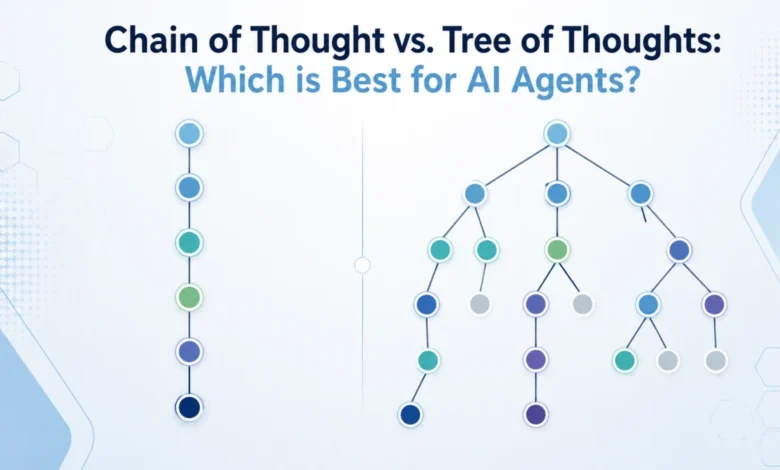
Chain of Thought functions as a structured "show your work" approach. By prompting a model with phrases like "Let’s think step by step," the developer forces the model to decompose a query into a linear sequence of logical propositions.
- Mechanism: The model produces an ordered chain of intermediate states. Each step is conditioned on the output of the preceding one.
- Strengths: It is highly efficient, requiring minimal computational overhead and latency. It provides a readable, auditable trail that allows developers to debug where a logic flow might have broken down.
- Limitations: Its primary failure mode is "cascading error." Because the model cannot evaluate or pivot from its own previous output, a single miscalculation in step two will inevitably invalidate steps three through ten. It is a rigid, one-way street of logic that lacks self-correction.
Tree of Thoughts: The Branching Strategy
Tree of Thoughts (ToT) was developed to solve the "blind alley" problem inherent in linear chains. Inspired by classical search algorithms—such as A* or Breadth-First Search (BFS)—ToT treats reasoning as a search process through a problem space.
- Mechanism: At each juncture, the model generates multiple potential "thought" candidates. A secondary evaluator (often the same model or a specialized critic function) scores these candidates based on their probability of leading to a successful resolution. Only the most promising paths are pursued. If a path reaches a dead end, the agent backtracks to a previous, more viable branch.
- Comparison to Chess: Just as a Grandmaster evaluates multiple variations before committing to a move, ToT allows an AI to simulate various outcomes. This significantly increases the probability of solving tasks involving creative writing, strategic planning, or complex coding problems where the "right" answer is not immediately obvious.
Comparative Data and Computational Costs
The trade-off between these two methods is quantifiable in terms of latency, token consumption, and success rates. Recent benchmarks on the "Game of 24" (a mathematical task) indicate that while standard LLMs fail to solve the problem roughly 95% of the time, CoT improves success rates to approximately 74%. However, when using the ToT framework, success rates have been documented to climb above 90%.
The cost of this accuracy is significant. Implementing ToT involves multiple model calls for a single user query. If a complex agentic task requires an average of 10 steps to complete, and each step evaluates three branches, the token consumption can be 30 to 50 times higher than a single CoT execution. For enterprises deploying these models at scale, this necessitates a rigorous cost-benefit analysis.
Implications for AI Agent Architecture
In modern agentic systems, reasoning frameworks are not applied uniformly. Instead, architects are adopting a "layered" approach to decision-making.
- Routine Execution (CoT): For tasks involving simple information retrieval, summarizing documents, or basic API calls, agents utilize Chain of Thought. The low latency is preferable, and the complexity of the task does not warrant the overhead of a search tree.
- Strategic Planning (ToT): When an agent is tasked with a goal that requires long-term planning—such as managing a complex supply chain or writing a modular software library—it switches to a ToT framework. In these scenarios, the cost of an error is high, and the "self-correction" provided by backtracking is a critical insurance policy.
Industry leaders, including engineers at major model providers, emphasize that the selection of the framework is now a core component of "System Prompting." An agent that blindly applies ToT to every query will be prohibitively expensive and sluggish, while an agent that uses CoT for everything will fail frequently on high-ambiguity tasks.
Future Perspectives
The field is currently moving toward "dynamic reasoning," where the agent itself decides which framework to use based on the complexity of the input. We are seeing the rise of "Self-Correction" agents, which use a version of ToT to critique their own output and refine it before final delivery.
Furthermore, the integration of "Reflexion"—a technique where agents learn from past failures by storing them in a memory buffer—is beginning to bridge the gap between simple linear reasoning and complex tree-based search. As compute costs decrease and inference optimization improves, the distinction between these methods will likely blur, moving toward a hybrid model where agents perform massive internal searches in milliseconds.
Summary of Strategic Considerations
For organizations implementing these systems, the choice between Chain of Thought and Tree of Thoughts is a management decision as much as a technical one.
- Chain of Thought is the standard for high-throughput, low-latency requirements. It is the backbone of efficient, reliable, and cost-effective automation.
- Tree of Thoughts represents the frontier of "reasoning" AI. It is the necessary investment for domains where the problem space is non-linear, the stakes of failure are high, and the objective requires multi-step synthesis.
As AI agents continue to migrate from simple chatbots to autonomous systems capable of executing complex workflows, the mastery of these reasoning frameworks will be the primary factor in determining which systems provide actual value and which remain stuck in the "fluent but wrong" trap of early-generation LLMs. By aligning the reasoning strategy with the specific needs of the task, developers can build agents that not only provide answers but provide solutions that are both accurate and defensible.