BricksFly Launches Comprehensive Toolkit for Bricks Builder with Limited Lifetime Licensing Opportunity

The ecosystem surrounding the Bricks website builder, a popular choice for WordPress developers seeking performance and design flexibility, has seen a significant shift today with the launch of BricksFly. This new all-in-one toolkit aims to reduce the "plugin bloat" often associated with professional WordPress development. By consolidating features that typically require multiple disparate add-ons—such as animation engines, template libraries, and utility elements—into a single, unified environment, BricksFly positions itself as a streamlined alternative for agencies and independent web designers. To mark its market entry, the company has initiated a highly constrained 72-hour lifetime licensing campaign, limiting total availability to 200 units.
Market Context and the Problem of Plugin Bloat
In the contemporary WordPress landscape, developers frequently rely on a stack of third-party plugins to extend the core functionality of builders like Bricks. A typical professional project might require one plugin for advanced element packs, another for GSAP-based animations, a third for a remote template library, and a collection of "utility" plugins to patch minor functional gaps. This architectural approach, while effective, introduces technical debt. Each additional plugin increases the surface area for security vulnerabilities, adds HTTP requests that can degrade Core Web Vitals, and creates potential conflicts during software updates.
Industry data suggests that site performance is increasingly tied to the number of active plugins. According to recent benchmarks from performance-focused testing platforms, reducing active plugin count by consolidating functionality can improve Time to Interactive (TTI) and First Contentful Paint (FCP) metrics, provided the replacement toolkit is optimized for performance. BricksFly enters the market with a direct value proposition: replacing four or more separate plugins with one, thereby reducing the overhead of maintaining multiple licenses and managing disparate codebases.
Chronology of the Launch and Licensing Strategy
The rollout of BricksFly follows a strategic, high-pressure release schedule designed to generate immediate market penetration.

- Pre-Launch Phase: The development team, leveraging their background in the "Animation Addons" plugin space, completed a multi-month beta testing phase focused on ensuring compatibility with the latest versions of Bricks Builder.
- Launch Day (July 28): BricksFly officially transitioned from a private beta to a public release. The launch was accompanied by the immediate activation of a 72-hour promotional window.
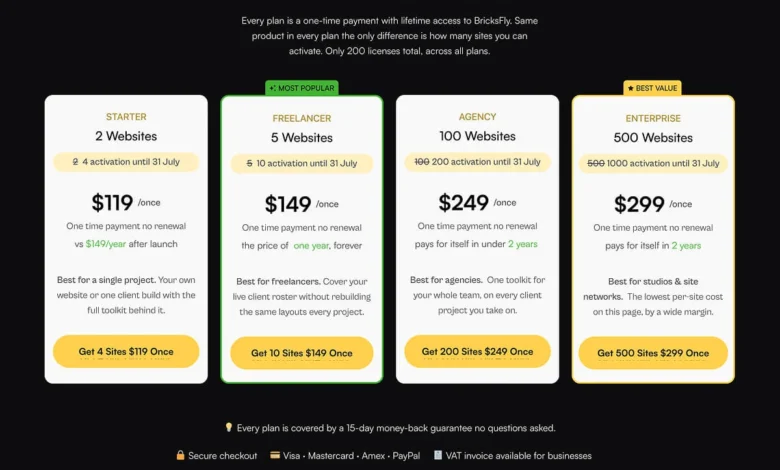
- The Lifetime Offer: The current promotional event is defined by two specific constraints: a time limit expiring on July 31st and a hard cap of 200 total licenses.
- Post-Promotion Transition: Upon the conclusion of the 72-hour window, the company will shift to a standard annual subscription model, with base plans starting at $39 per year.
The decision to offer a limited lifetime deal is a common, though calculated, strategy in the WordPress plugin ecosystem. It serves to bootstrap the user base, gather early feedback, and establish a community of "power users" who provide social proof for future sales.
Technical Implementation: GSAP Integration and Performance
One of the primary concerns for developers integrating new toolkits into high-traffic websites is the potential for performance degradation. GSAP (GreenSock Animation Platform) is an industry-standard library for web animation, but it is resource-intensive if implemented incorrectly.
BricksFly addresses this through conditional asset loading. Unlike legacy plugins that inject their full script library into the header of every page—regardless of whether animations are utilized—BricksFly employs a modular approach. The system only enqueues the necessary scripts on pages where animations are explicitly triggered. Furthermore, the toolkit is built upon the native Bricks structure, avoiding the common mistake of wrapping elements in proprietary containers that add unnecessary DOM bloat.
This technical decision is critical for professional developers. By ensuring that the toolkit does not force a performance tax on non-animated pages, BricksFly attempts to resolve the friction between visual design and technical optimization. The inclusion of features like ScrollTrigger, SplitText, and parallax effects within a visual interface—rather than through custom JavaScript injection—allows designers to implement high-end motion design without requiring extensive backend programming knowledge.
Leadership and Developer Provenance
The team behind BricksFly is not entering the market as novices. The core developers are the same individuals responsible for "Animation Addons," a widely utilized WordPress plugin with over 20,000 active installations and a sustained 4.7-star rating.

In the software-as-a-service (SaaS) and plugin development sectors, the "founder risk"—the danger that a company will cease operations or abandon a product—is a significant consideration for customers purchasing lifetime deals. The established reputation of the development team serves as a proxy for long-term viability. By having successfully maintained and updated a product with a large user base for several years, the team provides a degree of institutional credibility that is often missing from new plugin launches.
Comparative Analysis: Implications for Agencies
For web agencies managing multiple client sites, the implications of this release are twofold: cost-efficiency and workflow standardization.
- Workflow Standardization: The ability to move elements, styles, and entire sections across different domains via a "live copy-paste" feature is a significant productivity multiplier. For agencies, the ability to build a bespoke section once and replicate it across multiple client projects while retaining animation settings reduces development time by an estimated 15% to 20% per project.
- Economic Consolidation: Given that standard annual licensing for individual animation, template, and utility plugins can aggregate to over $150 per year, the lifetime offer—which allows for multiple site activations—presents a clear return on investment. The break-even point for the lifetime license is generally reached within the first 12 months of use, assuming current annual subscription pricing.
Broader Market Impact
The introduction of BricksFly is emblematic of a broader trend within the WordPress community: the consolidation of "power-user" tools. As WordPress site builders like Bricks, Oxygen, and Breakdance continue to mature, the demand for specialized, lightweight, and high-performance extensions is rising.
While the 200-license limit creates a sense of scarcity, the underlying product strategy suggests a long-term goal of becoming a "must-have" foundation for the Bricks community. If the product maintains its commitment to performance-first development, it may force competitors to re-evaluate their own licensing models and technical architecture.
However, users must remain cautious. While the 15-day refund window offers a safety net for developers testing the toolkit’s compatibility with their existing plugin stacks, the decision to invest in a lifetime license should be weighed against the specific technical requirements of an agency’s portfolio. Developers who rely on heavy custom coding or specific, niche animation frameworks may find that a generalized toolkit, however robust, cannot fully replace custom-tailored solutions.

Conclusion and Future Outlook
As the July 31st deadline approaches, the WordPress development community is watching to see how quickly the limited allocation of licenses is exhausted. For the end-user, the choice is between the security of a recurring, supported subscription model and the immediate capital expenditure of a lifetime deal.
Regardless of the outcome of this launch, BricksFly has effectively highlighted the growing necessity for better-integrated tools within the Bricks Builder ecosystem. By shifting the focus from "more plugins" to "more capable toolkits," the company is responding to a clear demand from professional developers who are tired of managing complex, fragmented plugin stacks. The success of this launch will likely be determined not just by the features themselves, but by the team’s ability to maintain the balance between high-end animation capabilities and the lean performance standards that the Bricks community demands.
Related posts: